


Eid al-Fitr: A festival of unity and thanksgiving

Heraa Hashmi
June 25, 2017

Today as the first rays of sunlight appeared, Muslims in many countries wake for Eid al-Fitr, the festival of the breaking of the fast. It marks the end of Ramadan, a month in which every Muslim (who is able to) fasts from food and water from dawn to dusk. The Qur’an, Islam’s holy book, was believed to have been revealed during this month.
eidulfitr

Eid al-Fitr is one of two annual festivals in Islam, different from Eid al-Adha, oft used interchangeably due to the similar names. This Eid, Eid al-Fitr, celebrates the completion of Ramadan, while Eid al-Adha, the feast of sacrifice, marks the end of Hajj, the annual pilgrimage to Makkah.

The exact date of Eid al-Fitr is difficult to predict as it’s dependent on the Islamic lunar-based calendar. The dates are decided according to the phases of the moon so it moves 10 to 11 days back each year in respect to the solar-based Gregorian calendar. Eid al-Fitr is observed when the new moon is sighted in the region, signifying the end of the 9th month of the Islamic calendar, Ramadan, and the start of the 10th month, Shawwal. This year it is on the 25th of June, but many countries around the world will be celebrating it on the 26th or 27th.

The significance of Eid al-Fitr is primarily spiritual. The month of Ramadan is seen as the holiest month of the year, culminating in Eid. The Prophet Muhammad (peace be upon him) said, “Whoever spends the nights of Ramadaan in prayer out of faith and in the hope of reward, his previous sins will be forgiven” (Sahih Muslim and Bukhari).

Muslims thank Allah for enabling them the health and capacity to fast and worship throughout the month. It is not a celebration of the end of Ramadan, but rather of the happiness of remaining steadfast through a blessed time. In fact, the day of Eid al-Fitr is one of the only days of the year on which fasting is prohibited, as the day is reserved for celebration. Many Muslims feel sorrow at the passing of Ramadan, counting the days until the next year arrives.

Eid al-Fitr is observed a public holiday in many Muslim countries, with school and work taking vacation days. In non-Muslim majority countries, this is not the case, but many employers and schools will make allowances for Muslims to take time off for their celebration.

Muslims celebrate Eid al-Fitr by spending time with loved ones and contributing to the community. It is obligatory upon Muslims, provided they are financially stable, to begin the day by paying Zakat al-Fitr (a special alms given at the end of Ramadan) to the poor and needy so they may have the means to celebrate the day along with others. Zakat al-Fitr is a special form of charity, given in addition to the annual zakat of 2.5% of one’s economic surplus. Charity is a vital aspect of Islam as one of its pillars. If one is not financially able to give zakat, they are eligible as a recipient instead.

Once the religious duty is fulfilled, Muslims gather to offer Eid Prayer, a special prayer only done twice a year. The prayer is usually offered early in the morning. Muslims greet each other by saying “Eid Mubarak, translated as “have a blessed Eid”.

The prayer is followed by a short sermon to remind people of the blessings of God, to reflect on the holy month that’s been completed. While the entire month was a time of spirituality and developing good habits, the day of Eid marks the beginning of a goal to maintain those habits throughout the year.

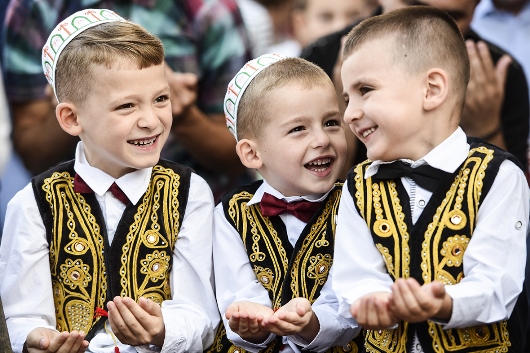
After the prayer, there are other traditions of Eid, such as wearing one’s best clothes and visiting family and friends. Sweets are exchanged, women and children adorn their hands with mehendi, and luncheons and dinners are often held with a spread of a variety of food. Kids are given Eidi, gifts of money, from the elders in the community. In Ramadan, one of the recommended ways to break fast is with the community, and this carries into the Eid celebrations. Muslims are encouraged to share meals with their neighbors, coworkers, and classmates.

Celebrations last long into the night and even throughout the week. It’s seen as a time of unity and giving thanks to Allah (God) for enabling them to complete the month of spiritual cleansing, forgiveness, and compassion.

Heraa Hashmi

The author, Heraa Hashmi, is a 19 year old University student at Boulder, Colorado. She’s studying Molecular Biology and is the president of Muslim Student Association. Recently she founded Muslims Condemn, a spreadsheet with over 5000 instances of Muslims condemning terrorism and is a part of the Bridge Initiative at Georgetown University, an initiative dedicated to tackling Islamophobia through education. This is her first article for coastaldigest.com

Comments

Add new comment

  • Coastaldigest.com reserves the right to delete or block any comments.
  • Coastaldigset.com is not responsible for its readers’ comments.
  • Comments that are abusive, incendiary or irrelevant are strictly prohibited.
  • Please use a genuine email ID and provide your name to avoid reject.
Wafa Sultana
April 4,2020

Over the last couple of days when the world was occupied with unifying efforts to fight the deadly Covid19 pandemic, sections of Indian media provided viewers a familiar scapegoat – the Indian Muslims – who are often stereotyped as a community being constantly at loggerheads with the citizenry and the State. Biased media channels were quick to resort to blaming the entire Muslim community for the spread of the disease in the country, thanks to an ill-timed Tablighi Jamaat gathering at its international headquarters in Delhi’s Nizamuddin. Unsurprisingly, the opprobrium was also marked by a sudden spike in WhatsApp forwards of videos with people wearing skullcaps licking spoons and performing Sufi breathing rituals, suggesting some sort of wild conspiracy on the part of the community to spread the virus.  Some media channels were quick to formulate, hypothesize and provide loose definitions of a newly discovered form of Jihad i.e. ‘Corona Jihad ’ thereby vilifying the Islamic faith and its followers.

While the investigation on the culpability of the organizers of the Nizamuddin event is still ongoing, there is enough information to suggest that the meeting was held before any lockdown was in force, and the problem began when there was no way of getting people out once the curfew was announced. Be that as it may, there is little doubt that organizing a meet of such a scale when there is a global pandemic smacks of gross misjudgment, and definitely the organizers should be held accountable if laws or public orders were defied. Attendees who attempt to defy quarantine measures must be dealt with strictly. However, what is alarming is that the focus and narrative have now shifted from the unfortunate event at Nizamuddin to the Tablighi Jamaat itself.

For those not familiar with the Tablighi Jamaat, the organization was founded in 1926 in Mewat by scholar Maulana Mohammad Ilyas. The Jamaat’s main objective was to get Muslim youth to learn and practice pristine Islam shorn of external influences. This is achieved through individuals dedicating time for moral and spiritual upliftment secluded from the rest of the world for a brief period of time. There is no formal membership process. More senior and experienced participants typically travel from one mosque to other delivering talks on religious topics, inviting local youth to attend and then volunteer for a spiritual retreat for a fixed number of days to a mosque in a nearby town or village to present the message to their co-religionists. Contrary to ongoing Islamophobic rhetoric, the movement does not actively proselytize. The focus is rather on getting Muslims to learn the teachings and practices of Islam.  This grassroots India-based movement has now grown to almost all countries with substantial Muslim populations. Its annual meets, or ‘ijtemas’ are among the largest Islamic congregations in the world after the annual Haj. One of the reasons for its popularity and wide network in the subcontinent and wordwide is the fact that it has eschewed the need for scholarly intervention, focusing on peer learning of fundamental beliefs and practice rather than high-falutin ideological debates. The Tablighi Jamaat also distinguishes itself from other Islamic movements through its strictly apolitical nature, with a focus on individual self-improvement rather than political mobilization. Hardships and difficulty in the world are expected to be face through ‘sabr’ (patience) and ‘dua’ (supplication),  than through quest for political power or influence. In terms of ideology, it is very much based on mainstream Sunni Islamic principles derived from the Deobandi school.

So, why is all this background important in the current context? While biased media entities have expectedly brought out their Islamophobic paraphernalia out for full display, more neutral commentators have tried to paint the Tablighi Jamaat as a fringe group and have tried to distance it from 'mainstream Muslims'. While the intent is no doubt innocent, this is a trap we must not fall into. This narrative, unfortunately, is also gaining ground due to apathy some Muslims have for the group, accusing it of being “disconnected from the realities of the world”. Unlike other Muslim organizations and movements, the Tablighi Jamat, by virtue of its political indifference, does not boast of high-profile advocates and savvy spokespersons who can defend it in mainstream or social media.  The use of adjectives such as 'outdated' and 'orthodox' by liberal columnists to describe the Jamaat feeds into the malignant attempt to change the narrative from the control of the spread of the pandemic due to the Nizamuddin gathering to 'raison d'etre' of the organization itself.

A large mainstream religious group like the Tablighi Jamaat with nearly a hundred-year history, normally considered to be peaceful, apolitical and minding its own business is now suddenly being villainized owing to unfortunate circumstances. Biased media reactions filled with disgust and hate seem to feed the Indian public conscience with a danngerous misconception - to be a nominal Muslim is okay but being a practicing one is not.  For those committed to the truth and fighting the spread of Islamophobia, the temptation to throw the entire Tablighi Jamaat under the bus must be resisted.

The writer is a lawyer and research scholar at Qatar University. Her research interests include Islamic law and politics.

Comments

zahoorahmed
 - 
Saturday, 4 Apr 2020

great article! provides a great perspective on tableeg jamat

Add new comment

  • Coastaldigest.com reserves the right to delete or block any comments.
  • Coastaldigset.com is not responsible for its readers’ comments.
  • Comments that are abusive, incendiary or irrelevant are strictly prohibited.
  • Please use a genuine email ID and provide your name to avoid reject.
coastaldigest.com news network
July 7,2020

Udupi, Jul 7: A hotelier committed suicide by jumping into a well at Hiriadka in Udupi district last evening. 

The deceased is Raghavendra Bhat (48), a resident of Kadiyali and owner of Hotel Shivasagar in Kadiyali.

He had been to his brother's house in Hiriyadka where he resorted to the extreme step. 

He was known for organising tiger dance competitions during Sri Krishnashtami every year.

He had contested the Udupi CMC election from Congress party, but had lost by a few votes. Later he had joined the BJP.

A case has been registered ar Hiriadka police station and investigations are on.

Comments

Add new comment

  • Coastaldigest.com reserves the right to delete or block any comments.
  • Coastaldigset.com is not responsible for its readers’ comments.
  • Comments that are abusive, incendiary or irrelevant are strictly prohibited.
  • Please use a genuine email ID and provide your name to avoid reject.
News Network
April 6,2020

Mangaluru, Apr 6: Three more COVID-19 positive cases in the Dakshina Kannada district have been recovered and discharged on Monday.

All three are Kasargod residents and were being treated in the city’s Wenlock hospital.

A 22-year-old man Bhatkal was discharged on Monday after recovering fully from the infection.

A total of 12 cases have been found COVID-19 positive in Mangaluru till now, said B Rupesh, Deputy Commissioner and District Magistrate's Office, Dakshina Kannada, on Monday.

"So far, 4 positive cases have recovered in Mangaluru, of which 3 COVID-19 positive patients have recovered and have been discharged today," said Rupesh.

He further said, "A total of 12 positive cases have been reported in the city till now."

As per the latest update by the Ministry of Health and Family Welfare, the total number of confirmed cases in the country is 4281. 151 cases are from Karnataka.

Comments

Add new comment

  • Coastaldigest.com reserves the right to delete or block any comments.
  • Coastaldigset.com is not responsible for its readers’ comments.
  • Comments that are abusive, incendiary or irrelevant are strictly prohibited.
  • Please use a genuine email ID and provide your name to avoid reject.