



Eid al-Fitr: A festival of unity and thanksgiving

Heraa Hashmi
June 25, 2017

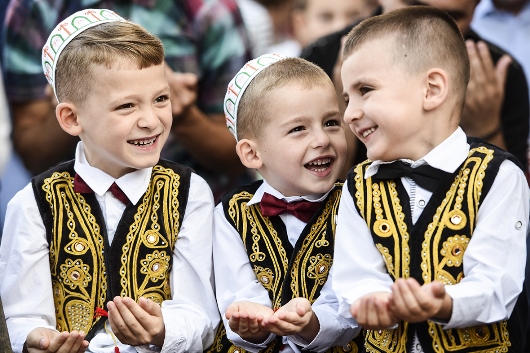
Today as the first rays of sunlight appeared, Muslims in many countries wake for Eid al-Fitr, the festival of the breaking of the fast. It marks the end of Ramadan, a month in which every Muslim (who is able to) fasts from food and water from dawn to dusk. The Qur’an, Islam’s holy book, was believed to have been revealed during this month.
eidulfitr

Eid al-Fitr is one of two annual festivals in Islam, different from Eid al-Adha, oft used interchangeably due to the similar names. This Eid, Eid al-Fitr, celebrates the completion of Ramadan, while Eid al-Adha, the feast of sacrifice, marks the end of Hajj, the annual pilgrimage to Makkah.

The exact date of Eid al-Fitr is difficult to predict as it’s dependent on the Islamic lunar-based calendar. The dates are decided according to the phases of the moon so it moves 10 to 11 days back each year in respect to the solar-based Gregorian calendar. Eid al-Fitr is observed when the new moon is sighted in the region, signifying the end of the 9th month of the Islamic calendar, Ramadan, and the start of the 10th month, Shawwal. This year it is on the 25th of June, but many countries around the world will be celebrating it on the 26th or 27th.

The significance of Eid al-Fitr is primarily spiritual. The month of Ramadan is seen as the holiest month of the year, culminating in Eid. The Prophet Muhammad (peace be upon him) said, “Whoever spends the nights of Ramadaan in prayer out of faith and in the hope of reward, his previous sins will be forgiven” (Sahih Muslim and Bukhari).

Muslims thank Allah for enabling them the health and capacity to fast and worship throughout the month. It is not a celebration of the end of Ramadan, but rather of the happiness of remaining steadfast through a blessed time. In fact, the day of Eid al-Fitr is one of the only days of the year on which fasting is prohibited, as the day is reserved for celebration. Many Muslims feel sorrow at the passing of Ramadan, counting the days until the next year arrives.

Eid al-Fitr is observed a public holiday in many Muslim countries, with school and work taking vacation days. In non-Muslim majority countries, this is not the case, but many employers and schools will make allowances for Muslims to take time off for their celebration.

Muslims celebrate Eid al-Fitr by spending time with loved ones and contributing to the community. It is obligatory upon Muslims, provided they are financially stable, to begin the day by paying Zakat al-Fitr (a special alms given at the end of Ramadan) to the poor and needy so they may have the means to celebrate the day along with others. Zakat al-Fitr is a special form of charity, given in addition to the annual zakat of 2.5% of one’s economic surplus. Charity is a vital aspect of Islam as one of its pillars. If one is not financially able to give zakat, they are eligible as a recipient instead.

Once the religious duty is fulfilled, Muslims gather to offer Eid Prayer, a special prayer only done twice a year. The prayer is usually offered early in the morning. Muslims greet each other by saying “Eid Mubarak, translated as “have a blessed Eid”.

The prayer is followed by a short sermon to remind people of the blessings of God, to reflect on the holy month that’s been completed. While the entire month was a time of spirituality and developing good habits, the day of Eid marks the beginning of a goal to maintain those habits throughout the year.

After the prayer, there are other traditions of Eid, such as wearing one’s best clothes and visiting family and friends. Sweets are exchanged, women and children adorn their hands with mehendi, and luncheons and dinners are often held with a spread of a variety of food. Kids are given Eidi, gifts of money, from the elders in the community. In Ramadan, one of the recommended ways to break fast is with the community, and this carries into the Eid celebrations. Muslims are encouraged to share meals with their neighbors, coworkers, and classmates.

Celebrations last long into the night and even throughout the week. It’s seen as a time of unity and giving thanks to Allah (God) for enabling them to complete the month of spiritual cleansing, forgiveness, and compassion.

Heraa Hashmi

The author, Heraa Hashmi, is a 19 year old University student at Boulder, Colorado. She’s studying Molecular Biology and is the president of Muslim Student Association. Recently she founded Muslims Condemn, a spreadsheet with over 5000 instances of Muslims condemning terrorism and is a part of the Bridge Initiative at Georgetown University, an initiative dedicated to tackling Islamophobia through education. This is her first article for coastaldigest.com

Comments

Add new comment

  • Coastaldigest.com reserves the right to delete or block any comments.
  • Coastaldigset.com is not responsible for its readers’ comments.
  • Comments that are abusive, incendiary or irrelevant are strictly prohibited.
  • Please use a genuine email ID and provide your name to avoid reject.
News Network
April 3,2020

Bengaluru, April 3: Messages have been displayed outside mosques in Shivajinagar requesting people to offer Friday prayers at home during the lockdown imposed in the wake of the COVID-19 threat.

In light of the coronavirus outbreak, several Muslim organisations and mosques across various states have temporarily halted the congregational prayers.

The usually bustling Jama Masjid area, today, wore a deserted look.

One new positive case of COVID-19 was reported in Karnataka on Friday.

The patient is a 75-year-old man from Bagalkot and has been isolated at a designated hospital in Bagalkot, the state government said.

"Till date, 125 COVID-19 cases have been confirmed in the state, this includes three deaths and 11 discharges," it added.

The total number of coronavirus positive cases rose to 2301 in India on Friday, including 156 cured/discharged, 56 deaths and 1 migrated, as per the data provided by the Ministry of Health and Family Welfare.

Comments

Add new comment

  • Coastaldigest.com reserves the right to delete or block any comments.
  • Coastaldigset.com is not responsible for its readers’ comments.
  • Comments that are abusive, incendiary or irrelevant are strictly prohibited.
  • Please use a genuine email ID and provide your name to avoid reject.
coastaldigest.com news network
June 14,2020

Newsroom, June 14: Bollywood star Sushant Singh Rajput, who was found dead in his house in Mumbai’s Bandra today, was heartbroken after the death of his former manager Disha Salian.

34-year-old actor had posted a heartfelt note after her death: “It’s such devastating news. My deepest condolences to Disha’s family and friends. May your soul rest in peace.” 

The police are considering 28-year-old Disha’s death as an accidental one and the investigation is on to find if it was a suicide. She died after falling off the 14th floor of a building in Malad, Mumbai on June 8.

It is not yet known if there is any connection between the two deaths. Sushant’s house help reportedly found him hanging inside his room on Sunday and cops are investigating the case. He was recently seen in Nitesh Tiwari’s Chhichhore and more recently on Netflix opposite Jacqueline Fernandez in Drive.

Who is Disha Salian?

Disha Salian hails from Karnataka’s coastal district of Udupi. She was born in 1992 into a business family background. She reportedly migrated to Mumbai with her family at an early age. 

After completing her education, she worked in the Times of India Group for more than three years. The she went on the become the celebrity manager at Media Vantage.

Apart from Sushant, she had great links with many popular celebrities like Bharti Singh, Alisha Panwar, and others.

Comments

Add new comment

  • Coastaldigest.com reserves the right to delete or block any comments.
  • Coastaldigset.com is not responsible for its readers’ comments.
  • Comments that are abusive, incendiary or irrelevant are strictly prohibited.
  • Please use a genuine email ID and provide your name to avoid reject.
News Network
April 20,2020

Thiruvananthapuram, Apr 20: The Kerala government announced the relaxation of COVID-19 lockdown restrictions in two zones, allowing among other private vehicles movement in an odd-even basis and dine-in services at hotels from Monday.

State police chief Loknath Behera said the relaxations of restrictions imposed would come into effect in the Green and Orange-B zones in the state from Monday,an official release said.

Earlier, the Left government had colour-coded 14 districts of the state into four zones-- Red, Green, Orange-A and Orange-B, for containing the Covid-19 pandemic. Red zone comprises Kasaragod, Kannur, Kozhikode and Malappuram districts. In this zone, a complete lockdown will be in place until May 3 while two entry and exit points are allowed for carrying essential commodities to coronavirus hotspots. Orange-A zone comprises Pathanamthitta, Ernakulam and Kollam while orange-B zone comprises Alappuzha, Thiruvananthapuram, Palakkad, Thrissur and Wayanad.

The lockdown will be in effect until April 24 in this zone and then partial relaxation will be allowed. Kottayam and Idukki come under the Green zone, in which lockdown will be in effect until April 20 and then regulations will be eased. However, large gatherings, the functioning of educational institutions, religious functions, celebrations and travel outside the district will not be allowed in this zone.

Not more than 20 people are allowed to take part in weddings and funerals, according to government instructions. On the functioning of courts, the release said, "Courts in the Green and Orange-B zones will re-open on April 21 while that in Orange-A zone will start functioning from April 25. The courts will function with 33 per cent of staff. The cases will be heard via video conferencing."

Meanwhile, the Bankers' Council has announced that banks will function as per the usual timings from Monday in the state except four districts falling under the Red zone. The Transport Ministry has clarifiedthat public transport won't be allowed to ply in the state during the lockdown period. "Inter-district travel will not be allowed despite relaxations in the state, but essential services such as medical services, food supplies will not be stopped. However, in case of emergency, inter-district travel will be allowed with an affidavit prepared by the traveller," Behra said in a release.

On the implementation of the odd-even scheme for private vehicles, the police said, "Vehicles with odd numbers will be permitted on Mondays, Wednesdays and Fridays. Those with even numbers will be allowed on Tuesdays, Thursdays and Saturdays." Woman drivers travelling solo or with dependants are also exempted from it, police said. On Sundays, only those working for essential services are allowed to use their vehicles.

All education institutions, cinema halls, shopping malls, public parks, bars, places of worship will remain closed in all zones of the state. The health department and local administration, which carry out sanitation work before the monsoon, are allowed to operate. Four-wheelers are permitted to carry two passengers besides the driver and in case of a two-wheeler, only the driver will be allowed while the pillion rider is allowed in case the person is a family member.

On Dine-in services, a government order said it is allowed at hotels and restaurants until 7 PM in Green and Orange-B zone from Monday and in Orange-A zone from April 24. However, take-away counters can function until 8 PM, it said. Kerala on Sunday reported two positive cases of Covid-19 in the state taking the total number of affected to 401 while the health department announced that 13 people were cured.

Comments

Add new comment

  • Coastaldigest.com reserves the right to delete or block any comments.
  • Coastaldigset.com is not responsible for its readers’ comments.
  • Comments that are abusive, incendiary or irrelevant are strictly prohibited.
  • Please use a genuine email ID and provide your name to avoid reject.