Eid-Round 2: Koorath followers offer prayers amidst clashes in Ullal dargah mosque

CD Network
June 26, 2017

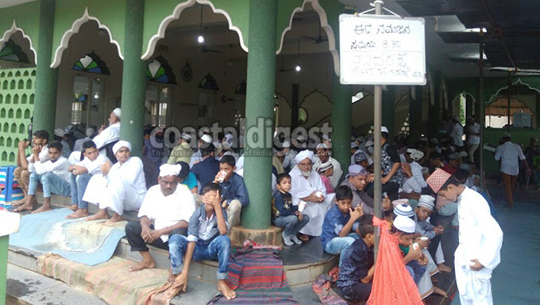
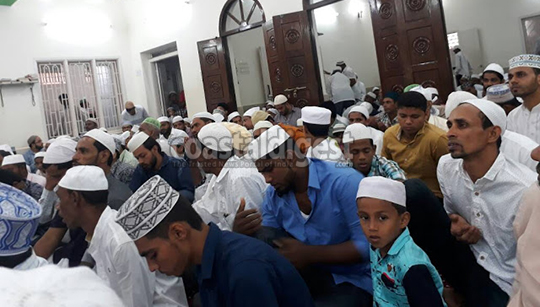
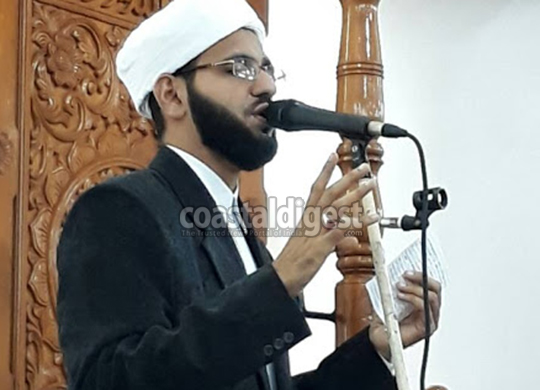
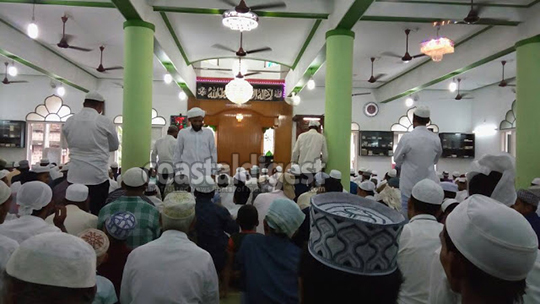
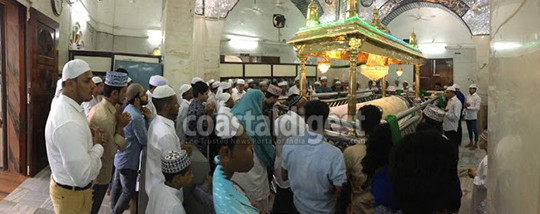
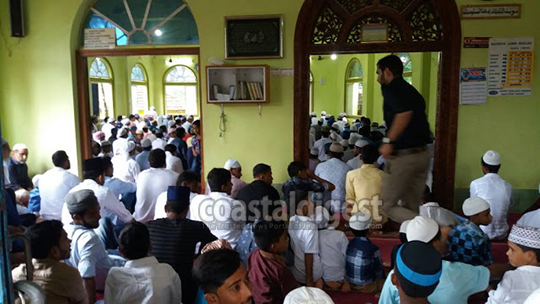
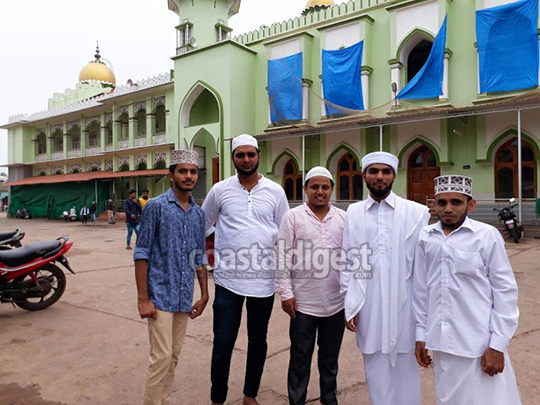
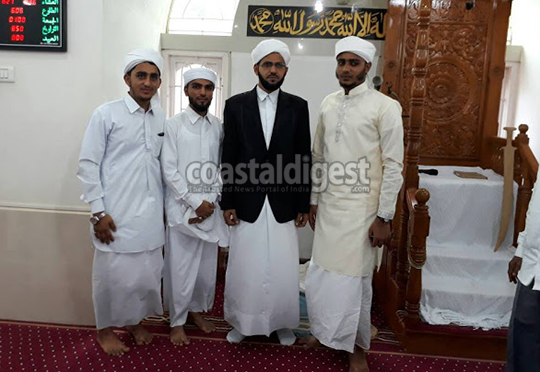
Mangaluru, Jun 26: For the first time in the history of Ullal, Muslims offered Eid al-Fitr namaz for two consecutive days in the same mosque, a development observed by Islamic scholars  as “most unfortunate and un-Islamic.”

ullals 1

With this the internal clash between two factions of Sayyid Shareeful Madani Dargah and central Juma Masjid has entered a new phase.

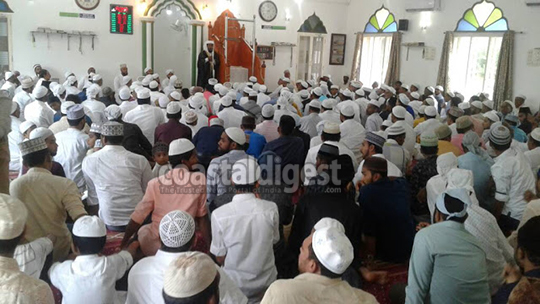
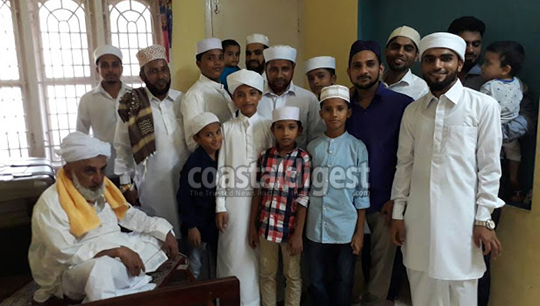
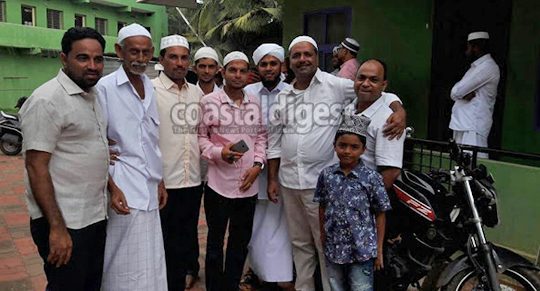
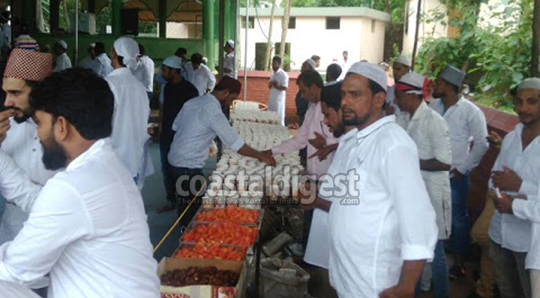
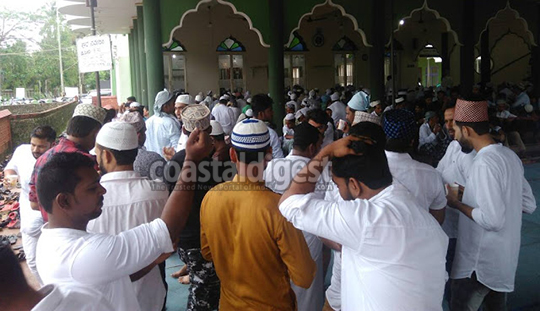
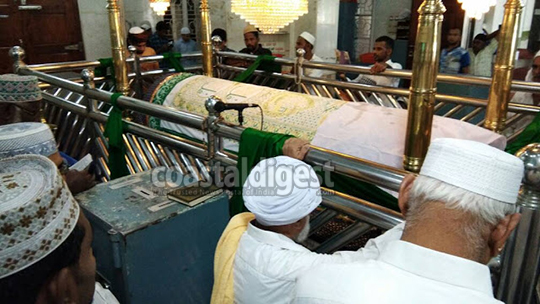
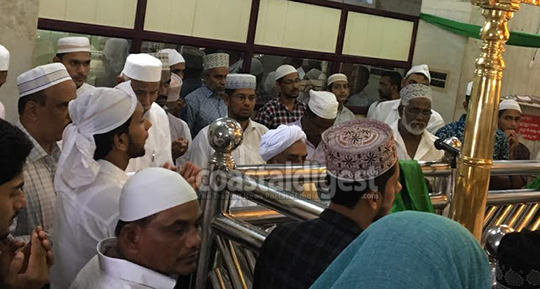
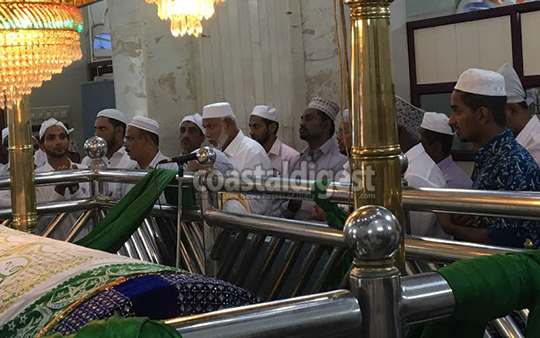
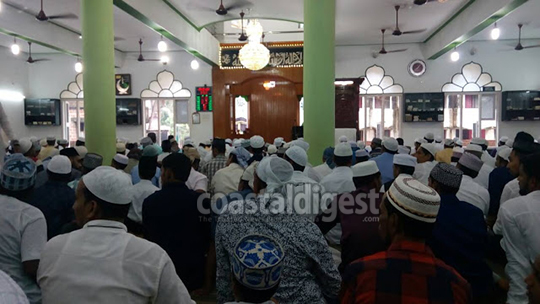
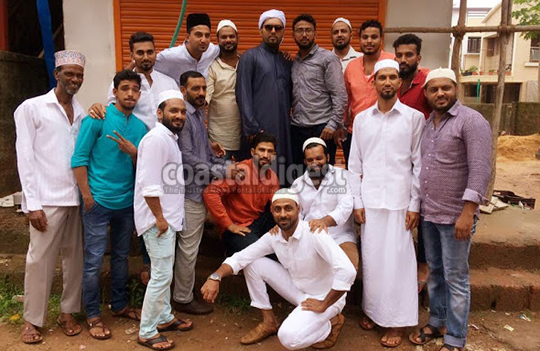
High drama prevailed, when a group of followers of beleaguered Ullal Khazi Fazal Koyamma Thangal aka Koorath Thangal, entered the premises of the mosque located adjacent to the dargah chanting takbir as part of Eid celebration on Monday noon.

Those who were inside the mosque, locked the doors from inside in an attempt to prevent the followers of Koorth Thangal from offering Eid namaz for the second day. Police had to intervene to bring the situation under control when the verbal altercation between two group led to a physical clash.

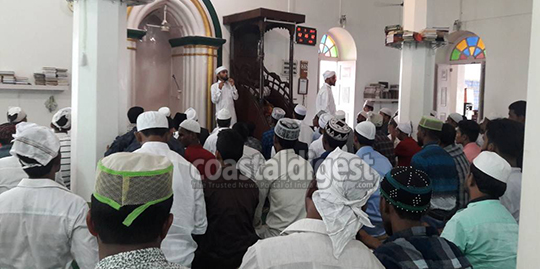
After a prolonged argument, the followers of Koorath Thangal were allowed to offer Eid namaz in congregation in the same mosque. Police had provided tight security for the namaz.

A majority of Muslims in Ullal had offered Eid namaz in juma mosque (dargah mosque) and other mosques on Sunday. However, followers of Koortha Thangal had observed fast on Sunday and postponed Eid to Monday.

Abdul Rasheed Haji, the president of the management committee of the Juma mosque and dargah had yesterday justified the decision of celebrating Eid al-Fitr on Sunday in spite of the sudden opposition by Koorath Thangal, who is not in touch with the committee for past one year.

“Dakshina Kannada Khazi Thwaka Ahmed Musliyar and Udupi Khazi Ibrahim Musliyar Bekal had already announced Eid after verifying moon-sighting reports from Bhatkal on Saturday night. Hence, in Ullal, assistant Khazi announced the Eid in the absence of Koorath Thangal,” he clarified.
Why two days?

Koorath Thangal was appointed as the Khazi of Ullal in March 2014 following the demise of his father Thajul Ulama Assayyid Abdurrahman Al-Bukhari, who was the Khazi of Ullal for several decades. Koorath Thangal’s several moves had triggered controversy in last couple of years.

According to sources, the reason for fresh controversy is that management committee of the mosque did not inform Koorath Thangal before announcing the end of the Ramadan Saturday night as he was not in touch with the committee.

As soon as Koorath Thangal realized that announcement of Eid was made without his permission, he sent a voice message on social media stating that Sunday will be the 30th day of Ramadan. A few clerics reportedly tried to convince Koorath Thangal to change his decision but in vain.

ullals 2

ullals 3

ullals 4

ullals 5

ullals 6

ullals 7

ullals 8

ullals 9

ullals 10

ullals 11

ullals 12

ullals 13

ullals 14

ullals 15

ullals 16

ullals 17

ullals 18

ullals 19

Comments

MILAN
 - 
Monday, 26 Jun 2017

this is nothing but ego from koora thangal.

in middle east, if one observe moon in saudi, all gcc countries follow saudi.

sam
 - 
Monday, 26 Jun 2017

Shame on you people... ullal people are scapegoat for two kerala thangals EGO CLASH. I dont know when you people unite in the name of Allah and Rasool than these dargas and thangals.

Alam
 - 
Tuesday, 27 Jun 2017

@Milan,
I would respectfully disagree, if thats the case then all of India should celebrate Eid on one day right?
If you check moonsighting.com, you will see different methods used by different countries to declare eid. One of the method is foll

Mohammed
 - 
Tuesday, 27 Jun 2017

None of the thangal or Mullah are scared of ALLAH, all they are doing this for their own benefit. lets avoid this thangal and mullahs in this cases to be united.

koora thangal announced 30th day of ramadan Just because the committee didn't inform him about the decision, WAW endu thanga bava if this is not called EGO then what? and those who still support him should be labeled as BHAKTS.

Mohammed
 - 
Wednesday, 28 Jun 2017

Eid Clashes are only because of EGO. There are two groups EK & AP who are taking people for ride. People with no knowledge of Islam go behind these fools. Y do we need any Thangal or Mullah to follow Islam? There is Quraan & haddeeth, that is more than enough. people who are half-learned scholars are creating this rift between muslim community. Educated people will never do this. May ALLAH give Hidaya to these fools running behind MULLAH & Thangal.

Add new comment

  • Coastaldigest.com reserves the right to delete or block any comments.
  • Coastaldigset.com is not responsible for its readers’ comments.
  • Comments that are abusive, incendiary or irrelevant are strictly prohibited.
  • Please use a genuine email ID and provide your name to avoid reject.
Ram Puniyani
February 10,2020

Noam Chomsky is one of the leading peace workers in the world. In the wake of America’s attack on Vietnam, he brought out his classic formulation, ‘manufacturing consent’. The phrase explains the state manipulating public opinion to have the public approve of it policies—in this case, the attack of the American state on Vietnam, which was then struggling to free itself from French colonial rule.

In India, we are witness to manufactured hate against religious minorities. This hatred serves to enhance polarisation in society, which undermines India’s democracy and Constitution and promotes support for a Hindu nation. Hate is being manufactured through multiple mechanisms. For example, it manifests in violence against religious minorities. Some recent ghastly expressions of this manufactured hate was the massive communal violence witnessed in Mumbai (1992-93), Gujarat (2002), Kandhamal (2008) and Muzaffarnagar (2013). Its other manifestation was in the form of lynching of those accused of having killed a cow or consumed beef. A parallel phenomenon is the brutal flogging, often to death, of Dalits who deal with animal carcasses or leather.

Yet another form of this was seen when Shambhulal Regar, indoctrinated by the propaganda of Hindu nationalists, burned alive Afrazul Khan and shot the video of the heinous act. For his brutality, he was praised by many. Regar was incited into the act by the propaganda around love jihad. Lately, we have the same phenomenon of manufactured hate taking on even more dastardly proportions as youth related to Hindu nationalist organisations have been caught using pistols, while police authorities look on.

Anurag Thakur, a BJP minster in the central government recently incited a crowd in Delhi to complete his chant of what should happen to ‘traitors of the country...” with a “they should be shot”. Just two days later, a youth brought a pistol to the site of a protest at Jamia Millia Islamia university and shouted “take Azaadi!” and fired it. One bullet hit a student of Jamia. This happened on 30 January, the day Nathuram Godse had shot Mahatma Gandhi in 1948. A few days later, another youth fired near the site of protests against the CAA and NRC at Shaheen Bagh. Soon after, he said that in India, “only Hindus will rule”.

What is very obvious is that the shootings by those associated with Hindu nationalist organisations are the culmination of a long campaign of spreading hate against religious minorities in India in general and against Muslims in particular. The present phase is the outcome of a long and sustained hate campaign, the beginning of which lies in nationalism in the name of religion; Muslim nationalism and Hindu nationalism. This sectarian nationalism picked up the communal view of history and the communal historiography which the British introduced in order to pursue their ‘divide and rule’ policy.

In India what became part of “social common sense” was that Muslim kings had destroyed Hindu temples, that Islam was spread by force, and that it is a foreign religion, and so on. Campaigns, such as the one for a temple dedicated to the Hindu god Rama to be built at the site where the Babri masjid once stood, further deepened the idea of a Muslim as a “temple-destroyer”. Aurangzeb, Tipu Sultan and other Muslim kings were tarnished as the ones who spread Islam by force in the subcontinent. The tragic Partition, which was primarily due to British policies, and was well-supported by communal streams also, was entirely attributed to Muslims. The Kashmir conflict, which is the outcome of regional, ethnic and other historical issues, coupled with the American policy of supporting Pakistan’s ambitions of regional hegemony, (which also fostered the birth of Al-Qaeda), was also attributed to the Muslims.

With recurring incidents of communal violence, these falsehoods went on going deeper into the social thinking. Violence itself led to ghettoisation of Muslims and further broke inter-community social bonds. On the one hand, a ghettoised community is cut off from others and on the other hand the victims come to be presented as culprits. The percolation of this hate through word-of-mouth propaganda, media and re-writing of school curricula, had a strong impact on social attitudes towards the minorities.

In the last couple of decades, the process of manufacturing hate has been intensified by the social media platforms which are being cleverly used by the communal forces. Swati Chaturvedi’s book, I Am a Troll: Inside the Secret World of the BJP’s Digital Army, tells us how the BJP used social media to spread hate. Whatapp University became the source of understanding for large sections of society and hate for the ‘Other’, went up by leaps and bounds. To add on to this process, the phenomenon of fake news was shrewdly deployed to intensify divisiveness.

Currently, the Shaheen Bagh movement is a big uniting force for the country; but it is being demonised as a gathering of ‘anti-nationals’. Another BJP leader has said that these protesters will indulge in crimes like rape. This has intensified the prevalent hate.

While there is a general dominance of hate, the likes of Shambhulal Regar and the Jamia shooter do get taken in by the incitement and act out the violence that is constantly hinted at. The deeper issue involved is the prevalence of hate, misconceptions and biases, which have become the part of social thinking.

These misconceptions are undoing the amity between different religious communities which was built during the freedom movement. They are undoing the fraternity which emerged with the process of India as a nation in the making. The processes which brought these communities together broadly drew from Gandhi, Bhagat Singh and Ambedkar. It is these values which need to be rooted again in the society. The communal forces have resorted to false propaganda against the minorities, and that needs to be undone with sincerity.

Combating those foundational misconceptions which create hatred is a massive task which needs to be taken up by the social organisations and political parties which have faith in the Indian Constitution and values of freedom movement. It needs to be done right away as a priority issue in with a focus on cultivating Indian fraternity yet again.


Comments

Add new comment

  • Coastaldigest.com reserves the right to delete or block any comments.
  • Coastaldigset.com is not responsible for its readers’ comments.
  • Comments that are abusive, incendiary or irrelevant are strictly prohibited.
  • Please use a genuine email ID and provide your name to avoid reject.
Media Release
February 14,2020

Veteran journalist P. Sainath has said that the nation is in a crisis. And this crisis is not limited to just the rural area. It has become a national crisis at various areas such as agriculture, education, economy, job creation etc.

He was delivering the endowment lecture on the topic ‘Indian democracy at the post-liberalization and post-truth era’ at Media Manthan 2020 organized by the PG department of journalism and mass communication at St Aloysius College (Autonomous). 

Mr Sainath said that the many policies adopted in the 90s led to India becoming unusually unequal. Referring to the speech Ambedkar had made at the Constituent Assembly while handing over the draft of the Constitution, Mr Sainath said, “Ambedkar had warned about the weakness of Indian democracy that liberty without equality allows the supremacy of a few over the multitude. Liberty, equality and fraternity must be kept together as we cannot have one without the other.” 

Mr Sainath stated that the agrarian crisis was no longer about the loss of productivity, employment or about farmer suicide; it was a societal, civilizational crisis. Commenting on the lopsided policies such as cow-slaughter ban, he explained how cow slaughter ban had adversely affected many industries due to their interdependency. While Muslims who slaughtered cows were rendered helpless, the cattle traders who were mostly OBCs lost their earnings as the cattle prices crashed. An important industry like Kolhapur sandals industry in Maharashtra went bankrupt as a result of the cow slaughter ban in Maharashtra. He said the policymakers had no idea how the rural industries were interconnected. Demonetisation too devastated the rural economy as 98 percent of rural transactions happen through cash. 

Mr Sainath also spoke about the crisis of inequality which affects the Dalits and the Adivasis far more than anyone else as 90 percent of the rural households take home less than Rs 10,000/- per month. “Women are yet another group whose labour is never counted in the gross domestic product. Women and girls globally do unpaid work which amounts to about 12.5 billion working hours per year. Monetarily speaking, this is worth 10.8 trillion dollars,” Mr Sainath added. 

Speaking about the crisis of jobs Mr Sainath said that major companies were laying off employees just to create more profits for the investors and the adoption of artificial intelligence in the industry would further destroy millions of jobs.

Rector of St Aloysius College Institutions Fr Dionysius Vaz SJ, Principal Dr (Fr) Praveen Martis SJ, HOD of Journalism and Mass Communication department Dr (Fr) Melwyn Pinto SJ were present.

‘Veerappan and Vijay Mallya’s business models are interesting!’

Addressing the gathering during his endowment lecture on Friday, Mr Sainath made an interesting comment on the so called ‘revenue model’. “Whenever I visit IIMs and IITs for lectures on my PARI project, the students there ask me what my revenue model for my project is. I tell them that I do not have a revenue model. In fact, journalism does not begin with a revenue model. Gandhiji, Ambedkar, Bhagat Singh were all great journalists. But they did not have a revenue model,” Mr Sainath said.

On a lighter note, he said that the best revenue model that he liked was that of forest brigand Veerappan and liquor baron Vijay Mallya. “Veerappan ruled the forest for forty years and from the top ministers to the villagers he could dictate terms and liver royally. Similarly, Mallya’s revenue model was to steal the banks and run away abroad and live like a king,” Mr Sainath added.

Journalism is not and can never be a business. It is a calling, he opined. While newspaper can be a business, television can be a business, journalism per se cannot be reduced to a business. “Unfortunately today, journalists are recruited on a contract basis and they have no bargaining power; and there are no unions to fight for their cause. Hence, they are at the mercy of the corporate media houses for their survival and are made to write stories that cannot be called journalism,” Mr Sainath said.

Answering a question as to the pressures he faced as a journalist, he said that external pressures from the government or others could be very well handled. It is the internal pressures from once own media house that journalists find it difficult to manage.


Comments

Add new comment

  • Coastaldigest.com reserves the right to delete or block any comments.
  • Coastaldigset.com is not responsible for its readers’ comments.
  • Comments that are abusive, incendiary or irrelevant are strictly prohibited.
  • Please use a genuine email ID and provide your name to avoid reject.
News Network
January 10,2020

Mangaluru, Jan 10: Two members of a notorious honey-trap gang that used to lure rich men using women and then extort money from them by staging fake police raid have been arrested by the Dakshina Kannada district police.

Lohith, a resident of Kushalnagara, and Sharif from Vittal, were arrested in connection with a honey-trap case registered in Uppinangady police station. Jamal, Jeevan and Naushad, who were also involved in the case, are absconding.

Police said they received information that a few people under the guise of being Kerala police, were planning to raid a resort near Uppinangady where two couples were staying.

They were informed that they would threaten and try to extort money from them. The police were tipped off about the same by their counterparts in Kerala.

Police said the accused are experts in setting honeytraps, and were involved in similar crimes since a long time. Their modus operandi was to use two women from Mangaluru to lure their intended targets.

Once they trap their target, the woman and victim are sent to resorts. They then raid the resort posing as police officials, and click pictures in compromising positions of the victim with the woman.

They threaten to release the pictures on social media or TV channels, if they fail to pay up.

Police said the accused demanded Rs 10 lakh from each victim, but they denied to pay up. Irked by this, the accused took away the victims’ belongings such as phone, money and car.

The victims who believed that the accused were police personnel, asked them to take them to the police station. Instead of taking them to the police, the accused took them to a secluded place, where they claimed that they were putting the victims under house arrest. Police have seized an SUV from the accused.

Comments

Add new comment

  • Coastaldigest.com reserves the right to delete or block any comments.
  • Coastaldigset.com is not responsible for its readers’ comments.
  • Comments that are abusive, incendiary or irrelevant are strictly prohibited.
  • Please use a genuine email ID and provide your name to avoid reject.