


Elderly woman mauled to death by stray dogs; another injured

August 20, 2016

Thiruvananthapuram, Aug 20: The stray dog menace in Kerala continues unabated with a 65-year-old woman being mauled to death by a large pack on a suburban beach at nearby Kanjiramkulam in the state capital.
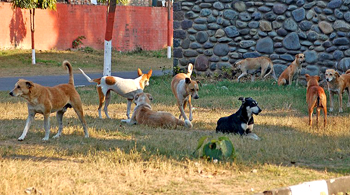
straydogs

The hapless woman, Siluvamma, a resident of the coastal belt, was attacked by a large number of stray dogs at Pulluvila beach, according to her family.

She suffered dog bites all over her body and succumbed to injuries while on her way to hospital.

The dogs also attacked the local people who tried to rescue the woman by chasing them away.

Siluvamma's son Selvan, who was also attacked by the dogs while trying to rescue his mother, escaped by jumping into the sea.

"My mother went to the beach in the night. As she did not return, I went out searching for her. What I saw was shocking. She was being attacked by over 100 stray dogs.She was bleeding all over the body," Selvan told reporters later.

Meanwhile, in a separate incident, another native of Pulluvila, Daisy, was also attacked and severely injured by stray dogs last night.

The 52-year-old woman said she was attacked by a pack of dogs when she went out of the house at around 11.30 PM.

She was rushed to the government medical college here and given a shot of anti-rabies vaccination

Medical college hospital sources said though she had injuries on her hands and legs, her condition was stable.She was shifted to Pulluvila primary healthcare centre for further treatment in the morning, they added.

Stray dogs have been posing a great threat to people, especially women, children and the elderly in coastal stretches in Kerala, including Pulluvila, for some time.

The issue has been a point of debate in Kerala for the last few years after increase in incidents of stray dog attacks and was also raised in the Assembly earlier this year.

According to a report submitted in the Supreme Court recently in a connected case, more than one lakh people in Kerala have been bitten by dogs in 2015-16.

The report was submitted by a committee appointed by the apex court to look into the aspect of treatment of people bitten by stray dogs and claims of compensation in the state.

The report also said Kerala is estimated to have stray dog population of 2.5 lakh, which feed lavishly on the waste and garbage dumps across cities and towns.

According to the panel, the maximum reported cases of dog bites were from Thiruvananthapuram- 5948, Palakkad-4916, Kollam-3670, Pathanamthitta-2892, Alappuzha-2967, Ernakulam - 2050, Thrissur-2044 cases and Koattayam-1614.

Comments

Muzzamil
 - 
Saturday, 20 Aug 2016

Santhosh first u start to eat dogs, then dog rakshak will come.

SANTHOSH
 - 
Saturday, 20 Aug 2016

Where is \DOG RAKSHAK\""

Add new comment

  • Coastaldigest.com reserves the right to delete or block any comments.
  • Coastaldigset.com is not responsible for its readers’ comments.
  • Comments that are abusive, incendiary or irrelevant are strictly prohibited.
  • Please use a genuine email ID and provide your name to avoid reject.
Agencies
May 8,2020

Washington D.C., May 8: The prime time for brain development in a child's life is the first year, where the infant spends most of the time asleep. It is the time when neural connections form and sensory memories are encoded.

However, when sleep is disrupted, as occurs more often among children with autism, brain development may be affected, too.

New research led by the University of Washington finds that sleep problems in a baby's first 12 months may not only precede an autism diagnosis but also may be associated with altered growth trajectory in a key part of the brain, the hippocampus.

The study, which was published in the American Journal of Psychiatry, researchers report that in a sample of more than 400 taken of 6- to 12-month-old infants, those who were later diagnosed with autism were more likely to have had difficulty falling asleep.

It also states that this sleep difficulty was associated with altered growth trajectories in the hippocampus.

"The hippocampus is critical for learning and memory, and changes in the size of the hippocampus have been associated with poor sleep in adults and older children.

As many as 80 per cent of the children with autism spectrum disorder have sleep problems," said Annette Estes, director of the UW Autism Center and senior author of the study.

"In our clinical experience, parents have a lot of concerns about their children's sleep, and in our work on early autism intervention, we observed that sleep problems were holding children and families back," added Estes, who is also a UW professor of speech and hearing sciences.

"It could be that altered sleep is part-and-parcel of autism for some children. One clue is that behavioural interventions to improve sleep don't work for all children with autism, even when their parents are doing everything just right. This suggests that there may be a biological component to sleep problems for some children with autism," said Estes.

To consider links among sleep, brain development, and autism, researchers at the IBIS Network looked at MRI scans of 432 infants, surveyed parents about sleep patterns, and measured cognitive functioning using a standardized assessment.

At the outset of the study, infants were classified according to their risk for developing autism: Those who were at higher risk of developing autism -- about two-thirds of the study sample -- had an older sibling who had already been diagnosed.

Infant siblings of children with autism have a 20 per cent chance of developing autism spectrum disorder -- a much higher risk than children in the general population.

In the current study, 127 of the 432 infants were identified as "low risk" at the time the MRI scans were taken because they had no family history of autism.

They later evaluated all the participants at 24 months of age to determine whether they had developed autism. Of the roughly 300 children originally considered "high familial risk," 71 were diagnosed with autism spectrum disorder at that age.

Problems with sleep were more common among the infants later diagnosed with an autism spectrum disorder, as were larger hippocampi. No other subcortical brain structures were affected, including the amygdala, which is responsible for certain emotions and aspects of memory, or the thalamus, a signal transmitter from the spinal cord to the cerebral cortex.

The authors note that while parents reported more sleep difficulties among infants who developed autism compared to those who did not, the differences were very subtle and only observed when looking at group averages across hundreds of infants.

Sleep patterns in the first years of life change rapidly as infants transition from sleeping around the clock to a more adult-like sleep/wake cycle. Until further research is completed, Estes said, it is not possible to interpret challenges with sleep as an early sign of increased risk for autism.

Comments

Add new comment

  • Coastaldigest.com reserves the right to delete or block any comments.
  • Coastaldigset.com is not responsible for its readers’ comments.
  • Comments that are abusive, incendiary or irrelevant are strictly prohibited.
  • Please use a genuine email ID and provide your name to avoid reject.
News Network
January 8,2020

Bengaluru, Jan 8: The Karnataka high court on Tuesday directed the government to submit steps taken in respect of the order of Lokyukta in relation to the Kethaganahalli landgrab case involving former chief minister HD Kumaraswamy, his relatives and former minister DC Thammanna.

A division bench headed by Chief Justice Abhay Shreeniwas Oka gave the direction on a PIL filed by Samaj Parivartan Samudaya (SPS), an NGO. The petitioner said despite an order from the Lokayukta on August 5, 2014, to take action within 15 days, no action has been initiated till date in respect of encroachment of a huge tract of land in Kethaganahalli along Bengaluru-Mysuru highway.

SPS says the land was purchased in 1979 contrary to norms of Karnataka Land Revenue Act. It claims Kumaraswamy and others paid only Rs 5,000 per acre, although the prevailing market rate was Rs 25,000 to Rs 30,000 per acre.

Comments

Add new comment

  • Coastaldigest.com reserves the right to delete or block any comments.
  • Coastaldigset.com is not responsible for its readers’ comments.
  • Comments that are abusive, incendiary or irrelevant are strictly prohibited.
  • Please use a genuine email ID and provide your name to avoid reject.
News Network
May 9,2020

Bengaluru, May 9: The bar owners in Karnataka, while welcoming the state government's decision to allow takeaway sales of liquor, said that the move is not going to benefit them much.

Venkatesh Babu, a Bengaluru-based bar owner said, "We welcome this move, our bar was closed for two months due to coronavirus crisis. We have been facing losses since then."

"The state government has told us to sell our stocks at maximum retail price (MRP). It is difficult for us to manage as the rent is high and we also have to pay salaries," he added.

The owner of Pingara Bar and Restaurant, Shivamogga said, "The government has said that is for parcel only and that too at MRP. There is no benefit to our business. We are only clearing the existing stock. They have given us time till May 17 and are not even giving us fresh stock. We are only allowed to sell what we have already."

Karnataka government in its Friday order allowed restaurants, pubs and bars to sell liquor at retail prices from May 9 till May 17, the day the third phase of lockdown is slated to end.

Earlier, the government had allowed the opening of liquor shops in order to mobilise revenue.

However, bars, pubs, restaurants were ordered to remain closed amid the COVID-19 lockdown.

Comments

Add new comment

  • Coastaldigest.com reserves the right to delete or block any comments.
  • Coastaldigset.com is not responsible for its readers’ comments.
  • Comments that are abusive, incendiary or irrelevant are strictly prohibited.
  • Please use a genuine email ID and provide your name to avoid reject.