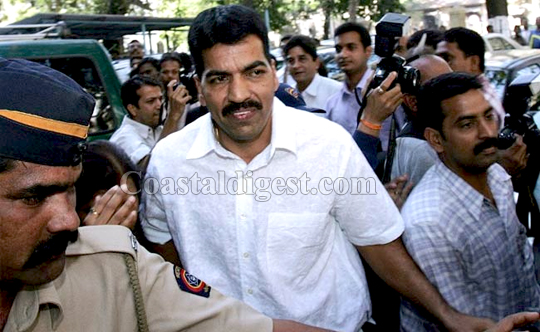
'Encounter specialist' Daya Nayak reinstated in police force

January 12, 2016

Mumbai, Jan 12: The famed 'encounter specialist' police officer Daya Nayak had been reinstated in the state police department, a source said on Monday.

DAYA

Sub-inspector Nayak's suspension had been cancelled, a senior police officer on Monday said on condition of anonymity.

Mr Nayak was suspended in June last year for not joining duty and being on sick leave for a very long time. At that time his posting was in Nagpur area.

Before that, after being under suspension for around six years, Mr Nayak was reinstated in June 2012.

A 1995-batch police officer, he was suspended in 2006 after the Maharashtra Anti-Corruption Bureau arrested him on the charge of possessing assets disproportionate to his known sources of income.

In 2010, the Supreme Court quashed the charges against him. He was reinstated in 2012 and posted in Local Arms wing of the department.

After a brief stint there, he was transferred to the west region (Bandra to Andheri) of the city which is considered as a 'high-profile' zone in the police department.

Comments

RAVINDRA
 - 
Wednesday, 13 Jan 2016

Wishing you all the best.

Add new comment

  • Coastaldigest.com reserves the right to delete or block any comments.
  • Coastaldigset.com is not responsible for its readers’ comments.
  • Comments that are abusive, incendiary or irrelevant are strictly prohibited.
  • Please use a genuine email ID and provide your name to avoid reject.
News Network
March 15,2020

Bengaluru, Mar 15: The Karnataka government has intensified screening all international passengers at airports by classifying them into three risk categories.

Passengers, who are symptomatic on arrival fall under risk category 1, those aged above 60 and have Symptoms fall under category 2. Those who fall in both these categories are being quarantined at designated facilities for 14 days from arrival.

Asymptomatic passengers arriving from any of the COVID-19 affected countries will fall under category 3 and will be advised to be under strict home quarantine for 14 days, Medical Education Minister Dr K Sudhakar said here on Sunday.

Comments

Add new comment

  • Coastaldigest.com reserves the right to delete or block any comments.
  • Coastaldigset.com is not responsible for its readers’ comments.
  • Comments that are abusive, incendiary or irrelevant are strictly prohibited.
  • Please use a genuine email ID and provide your name to avoid reject.
Media Release
February 14,2020

Veteran journalist P. Sainath has said that the nation is in a crisis. And this crisis is not limited to just the rural area. It has become a national crisis at various areas such as agriculture, education, economy, job creation etc.

He was delivering the endowment lecture on the topic ‘Indian democracy at the post-liberalization and post-truth era’ at Media Manthan 2020 organized by the PG department of journalism and mass communication at St Aloysius College (Autonomous). 

Mr Sainath said that the many policies adopted in the 90s led to India becoming unusually unequal. Referring to the speech Ambedkar had made at the Constituent Assembly while handing over the draft of the Constitution, Mr Sainath said, “Ambedkar had warned about the weakness of Indian democracy that liberty without equality allows the supremacy of a few over the multitude. Liberty, equality and fraternity must be kept together as we cannot have one without the other.” 

Mr Sainath stated that the agrarian crisis was no longer about the loss of productivity, employment or about farmer suicide; it was a societal, civilizational crisis. Commenting on the lopsided policies such as cow-slaughter ban, he explained how cow slaughter ban had adversely affected many industries due to their interdependency. While Muslims who slaughtered cows were rendered helpless, the cattle traders who were mostly OBCs lost their earnings as the cattle prices crashed. An important industry like Kolhapur sandals industry in Maharashtra went bankrupt as a result of the cow slaughter ban in Maharashtra. He said the policymakers had no idea how the rural industries were interconnected. Demonetisation too devastated the rural economy as 98 percent of rural transactions happen through cash. 

Mr Sainath also spoke about the crisis of inequality which affects the Dalits and the Adivasis far more than anyone else as 90 percent of the rural households take home less than Rs 10,000/- per month. “Women are yet another group whose labour is never counted in the gross domestic product. Women and girls globally do unpaid work which amounts to about 12.5 billion working hours per year. Monetarily speaking, this is worth 10.8 trillion dollars,” Mr Sainath added. 

Speaking about the crisis of jobs Mr Sainath said that major companies were laying off employees just to create more profits for the investors and the adoption of artificial intelligence in the industry would further destroy millions of jobs.

Rector of St Aloysius College Institutions Fr Dionysius Vaz SJ, Principal Dr (Fr) Praveen Martis SJ, HOD of Journalism and Mass Communication department Dr (Fr) Melwyn Pinto SJ were present.

‘Veerappan and Vijay Mallya’s business models are interesting!’

Addressing the gathering during his endowment lecture on Friday, Mr Sainath made an interesting comment on the so called ‘revenue model’. “Whenever I visit IIMs and IITs for lectures on my PARI project, the students there ask me what my revenue model for my project is. I tell them that I do not have a revenue model. In fact, journalism does not begin with a revenue model. Gandhiji, Ambedkar, Bhagat Singh were all great journalists. But they did not have a revenue model,” Mr Sainath said.

On a lighter note, he said that the best revenue model that he liked was that of forest brigand Veerappan and liquor baron Vijay Mallya. “Veerappan ruled the forest for forty years and from the top ministers to the villagers he could dictate terms and liver royally. Similarly, Mallya’s revenue model was to steal the banks and run away abroad and live like a king,” Mr Sainath added.

Journalism is not and can never be a business. It is a calling, he opined. While newspaper can be a business, television can be a business, journalism per se cannot be reduced to a business. “Unfortunately today, journalists are recruited on a contract basis and they have no bargaining power; and there are no unions to fight for their cause. Hence, they are at the mercy of the corporate media houses for their survival and are made to write stories that cannot be called journalism,” Mr Sainath said.

Answering a question as to the pressures he faced as a journalist, he said that external pressures from the government or others could be very well handled. It is the internal pressures from once own media house that journalists find it difficult to manage.


 

Comments

Add new comment

  • Coastaldigest.com reserves the right to delete or block any comments.
  • Coastaldigset.com is not responsible for its readers’ comments.
  • Comments that are abusive, incendiary or irrelevant are strictly prohibited.
  • Please use a genuine email ID and provide your name to avoid reject.
News Network
June 4,2020

Bengaluru, Jun 4: All shops, offices, malls, commercial establishments and others in Karnataka must not allow Covid-stamped people to enter their premises before the completion of the prescribed quarantine time, said a top official on Wednesday.

"They should not allow those with quarantine stamp to enter before the end of their quarantine period or till they get current Covid negative test report," ordered Chief Secretary T.M. Vijay Bhaskar.

Bhaskar has also issued the order to all religious places, hotels and others to first check for quarantine stamp on all their customers or visitors before they enter the premises.

"All shops, commercial establishments, offices, factories, malls, religious places, hotels and etc.. are required to check for quarantine stamp on all their customers or visitors before they enter the premises," he said.

In the event of a violation, Bhaskar said the police should be informed at 100.

He issued the same order to the general public and resident welfare associations asking them to be vigilant.

"General public and resident welfare associations are advised to report any violation of the quarantine in their neighbourhood to the police at telephone number 100," said the chief secretary.

The orders came under the head aRole of general public, resident welfare associations and commercial establishments''.

General public, commercial establishments and resident welfare associations have been empowered to report quarantine violations at a time when many activities are set to reopen from June 8 as part of Unlock - 1, after more than two months of lockdown.

Comments

Add new comment

  • Coastaldigest.com reserves the right to delete or block any comments.
  • Coastaldigset.com is not responsible for its readers’ comments.
  • Comments that are abusive, incendiary or irrelevant are strictly prohibited.
  • Please use a genuine email ID and provide your name to avoid reject.