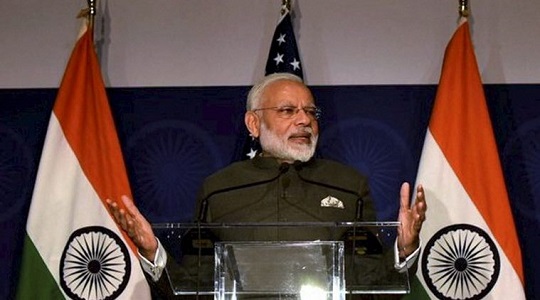
Even at 2 am, Swaraj helps Indians tweeting for help: Modi

Agencies
June 26, 2017

Washington, Jun 26: Prime Minister Narendra Modi today heaped praise on External Affairs Minister Sushma Swaraj, saying she and her ministry have set an example of effectively using social media to deliver good governance and help Indians in distress in any corner of the world.

modi

"Social media has become a very powerful. I am also connected with it. But the External Affairs Ministry and Sushma Swaraj have set the best example of how a department can be strengthened through its use," Modi said in his address to the Indian diaspora during a community event in Virginia.

Modi lauded Swaraj for giving a "human face" to diplomacy and effectively using of social media in delivering good governance. He said the External Affairs Ministry is now connected with the poorest of the poor in the country.

He also praised Swaraj's habit of promptly responding and acting on tweets by Indians in distress anywhere in the world.

"If any Indian in distress tweets from anywhere in the world to the External Affairs Ministry, even at two in the night, within 15 minutes Sushma Swaraj replies to it, the government takes prompt action and delivers results. This is good governance," Modi said.

He said in the last three years, India's External Affairs Ministry has achieved new heights in human diplomacy.

He said that over 80,000 Indians were facing some trouble or the other in different corners of the globe but the Indian government was able to bring them safely back home.

He referred to the incident of Uzma Ahmad, a young Indian woman who said she was forced to marry a Pakistani man at gun point.

"A daughter of India, who landed in distress in Pakistan, returned to India through efforts of Indian High Commission. Sushma Ji deserves credit for this," Modi said.

Comments

Add new comment

  • Coastaldigest.com reserves the right to delete or block any comments.
  • Coastaldigset.com is not responsible for its readers’ comments.
  • Comments that are abusive, incendiary or irrelevant are strictly prohibited.
  • Please use a genuine email ID and provide your name to avoid reject.
Agencies
March 22,2020

Mumbai, Mar 22: The total number of coronavirus positive patients in Maharashtra has risen to 74 with 10 more positive cases reported in the last 24 hours, officials said.

Of the 10 new cases, 6 are in Mumbai and 4 in Pune, they said on Sunday.

Earlier this week, a Covid-19 patient died in Mumbai.

Comments

Add new comment

  • Coastaldigest.com reserves the right to delete or block any comments.
  • Coastaldigset.com is not responsible for its readers’ comments.
  • Comments that are abusive, incendiary or irrelevant are strictly prohibited.
  • Please use a genuine email ID and provide your name to avoid reject.
News Network
April 27,2020

New Delhi, Apr 27: The number of COVID-19 cases climbed to 28,380 and the death toll due to it rose to 886 in the country on Monday, registering a record increase of 60 deaths in 24 hours, according to the Union Health Ministry.

There has been a spike of 1,463 cases since Sunday evening.

The number of active COVID-19 cases stood at 21,132, while 6,361 people have recovered, and one patient has migrated, the ministry said.

Thus, around 22.41 per cent of patients have recovered in the country so far.

The total number of cases includes 111 foreign nationals.

A total of 60 deaths were reported since Sunday evening, of which 19 fatalities were reported from Maharashtra, 18 from Gujarat, eight from Rajasthan, seven from Madhya Pradesh, two each from Karnataka, West Bengal and Uttar Pradesh, and one each from Punjab and Tamil Nadu.

Of the 886 deaths, Maharashtra tops the tally with 342 fatalities, followed by Gujarat at 151, Madhya Pradesh at 106, Delhi at 54, Rajasthan at 41, and Andhra Pradesh and Uttar Pradesh at 31 each.

The death toll reached 26 in Telangana, 24 in Tamil Nadu while West Bengal and Karnataka have reported 20 deaths each.

Punjab has registered 18 fatalities so far. The disease has claimed six lives in Jammu and Kashmir, four in Kerala while Jharkhand and Haryana have recorded three COVID-19 deaths each.

Bihar has reported two deaths, while Meghalaya, Himachal Pradesh, Odisha and Assam have reported one fatality each, according to the ministry data.

According to the Health Ministry data updated in the evening, the highest number of confirmed cases in the country are from Maharashtra at 8,068, followed by Gujarat at 3,301, Delhi at 2,918, Rajasthan at 2,185, Madhya Pradesh at 2,168, Uttar Pradesh at 1,955 and Tamil Nadu at 1,885.

The number of COVID-19 cases has gone up to 1,177 in Andhra Pradesh and 1,002 in Telangana.

The number of cases has risen to 649 in West Bengal, 523 in Jammu and Kashmir, 511 in Karnataka, 469 in Kerala, 313 in Punjab and 289 in Haryana.

Bihar has reported 277 novel coronavirus cases, while Odisha has 108 cases. Eighty-two people have been infected with the virus in Jharkhand and 51 in Uttarakhand.

Himachal Pradesh has 40 cases, Chhattisgarh has 37 and Assam has registered 36 infections each so far.

Andaman and Nicobar Islands has 33 COVID-19 cases while Chandigarh has 30 cases and Ladakh has reported 20 infections so far.

Meghalaya has reported 12 cases, Puducherry has eight cases while Goa has seven COVID-19 cases.

Manipur and Tripura have two cases each, while Mizoram and Arunachal Pradesh have reported a case each.

Comments

Add new comment

  • Coastaldigest.com reserves the right to delete or block any comments.
  • Coastaldigset.com is not responsible for its readers’ comments.
  • Comments that are abusive, incendiary or irrelevant are strictly prohibited.
  • Please use a genuine email ID and provide your name to avoid reject.
Agencies
June 30,2020

United Nations, Jun 30: India accounts for 45.8 million of the world's 142.6 million "missing females" over the past 50 years, a report by the United Nations said on Tuesday, noting that the country along with China form the majority of such women globally.

The State of World Population 2020 report released on Tuesday by the United Nations Population Fund (UNFPA), the world organisation's sexual and reproductive health agency, said that the number of missing women has more than doubled over the past 50 years - from 61 million in 1970 to a cumulative 142.6 million in 2020.

Of this global figure, India accounted for 45.8 million missing females as of 2020 and China accounted for 72.3 million.

Missing females are women missing from the population at given dates due to the cumulative effect of postnatal and prenatal sex selection in the past, the agency said.

Between 2013 and 2017, about 460,000 girls in India were missing' at birth each year. According to one analysis, gender-biased sex selection accounts for about two-thirds of the total missing girls, and post-birth female mortality accounts for about one-third, the report said.

Citing data by experts, it said that China and India together account for about 90-95 per cent of the estimated 1.2 million to 1.5 million missing female births annually worldwide due to gender-biased (prenatal) sex selection.

The two countries also account for the largest number of births each year, it said.

The report cites data by Alkema, Leontine and others, 2014 National, Regional, and Global Sex Ratios of Infant, Child, and under-5 Mortality and Identification of Countries with Outlying Ratios: A Systematic Assessment' from The Lancet Global Health.

According to their analysis, India has the highest rate of excess female deaths, 13.5 per 1,000 female births, which suggests that an estimated one in nine deaths of females below the age of 5 may be attributed to postnatal sex selection.

The report notes that governments have also taken action to address the root causes of sex selection. India and Vietnam have included campaigns that target gender stereotypes to change attitudes and open the door to new norms and behaviours.

They spotlight the importance of daughters and highlight how girls and women have changed society for the better. Campaigns that celebrate women's progress and achievements may resonate more where daughter-only families can be shown to be prospering, it said.

The report said that successful education-related interventions include the provision of cash transfers conditional on school attendance; or support to cover the costs of school fees, books, uniforms and supplies, taking note of successful cash-transfer initiatives such as Apni Beti Apna Dhan' in India.

It said that preference for a male child manifested in sex selection has led to dramatic, long-term shifts in the proportions of women and men in the populations of some countries.

This demographic imbalance will have an inevitable impact on marriage systems. In countries where marriage is nearly universal, many men may need to delay or forego marriage because they will be unable to find a spouse, the report said.

This so-called "marriage squeeze", where prospective grooms outnumber prospective brides, has already been observed in some countries and affects mostly young men from lower economic strata.

"At the same time, the marriage squeeze could result in more child marriages, the report said citing experts.

Some studies suggest that the marriage squeeze will peak in India in 2055. The proportion of men who are still single at the age of 50 is forecast to rise after 2050 in India to 10 per cent, it said.

The UN report said that every year, millions of girls globally are subjected to practices that harm them physically and emotionally, with the full knowledge and consent of their families, friends and communities.

At least 19 harmful practices, ranging from breast ironing to virginity testing, are considered human rights violations, according to the UNFPA report, which focuses on the three most prevalent ones: female genital mutilation, child marriage, and extreme bias against daughters in favour of sons.

Harmful practices against girls cause profound and lasting trauma, robbing them of their right to reach their full potential, says UNFPA Executive Director Dr. Natalia Kanem.

This year, an estimated 4.1 million girls will be subjected to female genital mutilation. Today, 33,000 girls under age 18 will be forced into marriages, usually to much older men and an extreme preference for sons over daughters in some countries has fuelled gender-biased sex selection or extreme neglect that leads to their death as children, resulting in the 140 million missing females.

The report said that ending child marriage and female genital mutilation worldwide is possible within 10 years by scaling up efforts to keep girls in school longer and teach them life skills and to engage men and boys in social change.

Investments totalling USD 3.4 billion a year through 2030 would end these two harmful practices and end the suffering of an estimated 84 million girls, it said.

A recent analysis revealed that if services and programmes remain shuttered for six months due to the COVID-19 pandemic, an additional 13 million girls may be forced into marriage and 2 million more girls may be subjected to female genital mutilation between now and 2030.

The pandemic both makes our job harder and more urgent as so many more girls are now at risk, Kanem said.


Comments

Add new comment

  • Coastaldigest.com reserves the right to delete or block any comments.
  • Coastaldigset.com is not responsible for its readers’ comments.
  • Comments that are abusive, incendiary or irrelevant are strictly prohibited.
  • Please use a genuine email ID and provide your name to avoid reject.