


EVMs to have candidates' photos

DHNS
January 23, 2018

Bengaluru, Jan 23: In a move that could go a long way in preventing bogus candidates from playing mischief, the Election Commission of India (ECI) will use photographs of candidates on the electronic voting machines (EVM) during the upcoming Assembly elections.

It will be the first Legislative Assembly polls in Karnataka where this will be implemented.

Besides helping voters recognise their candidate from among those with similar names, the move will also help raise voter confidence amid concerns aired by the ruling Congress that the EVMs are prone to tampering.

Each EVM will have the names of candidates, their black-and-white photographs and the symbol of the party they represent. Each photograph will be 2.5 cm in size.

"Photographs of candidates were used on the EVMs in the recent Gujarat and Himachal Pradesh polls. Photographs will be used in the upcoming bypolls in Rajasthan. In fact, we had candidates' photographs for the Nanjangud and Gundlupet bypolls last year," Chief Electoral Officer Sanjiv Kumar said.

Candidates' names will be classified under three categories. "Names will be listed alphabetically starting with those from national parties, followed by those from regional parties and then the independents or other parties," he said.

Use of photographs coupled with alphabetical listing of candidate names will further negate claims that EVMs can be tampered with. "For an EVM to be rigged so as to favour a particular candidate, how will anyone know whose name is listed where?" Kumar asked.

The 2018 Assembly election will see the introduction of voter verifiable paper audit trail (VVPAT) machines, which will allow voters to verify the votes they have cast. The Election Commission will also tally votes cast on the EVM with the VVPAT printouts in one polling booth selected randomly under each Assembly constituency.

Comments

wellwisher
 - 
Tuesday, 23 Jan 2018

EVM will only beenifit  for counting and earliest results. It will not stop manipulating and illigal set for any particular groups.  Providing candidates photo in EVM system is type of bluff and to divert mind.

To avoid corrupt and criminal politiciance benifit  - Ballot is the perfect BULLET.

For our nations benifit INDIA badly require Ballot polling system for ever.


Jai Hind !


Add new comment

  • Coastaldigest.com reserves the right to delete or block any comments.
  • Coastaldigset.com is not responsible for its readers’ comments.
  • Comments that are abusive, incendiary or irrelevant are strictly prohibited.
  • Please use a genuine email ID and provide your name to avoid reject.
News Network
August 2,2020

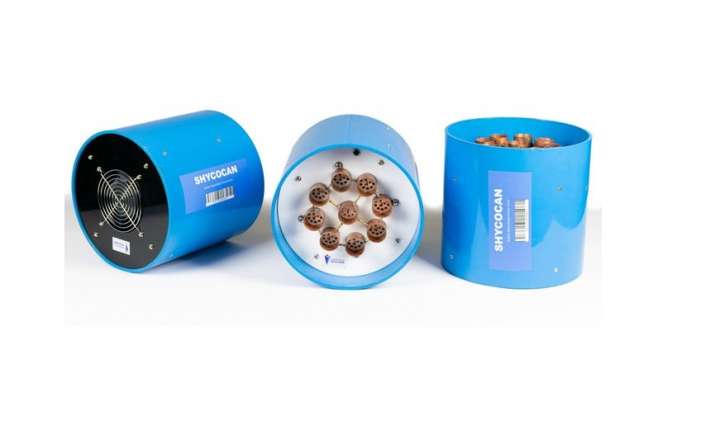
Bengaluru, Aug 2: Bengaluru based Centre for Advanced Research and Development (CARD), the research wing of organisation De scalene has come up with a device called "SHYCOCAN" (Scalene Hypercharge Corona Canon) which neutralizes the coronavirus.

Speaking to news agency Dr Rajah Vijay Kumar, Chairman, Organisation De Scalene said that the device will not kill any bacteria or fungus, however, neutralizes the coronavirus particles.

"The device was tested for its safety and efficacy and is soon going to be manufactured and marketed in the US under the Enforcement Discretion policy of USFDA and in Europe as the device is CE compliant and is CE marked," said Kumar.

He also added the device will cover a volume of 10,000 cubic feet.

The device Scalene Hypercharge Corona Canon (SHYCOCAN) is intended to be used in the residential, industrial and commercial environment and is designed for active containment by attenuation of Corona family of viruses. (Laboratories de Especialidades Immunological S.A. de C.V, Virucidal Activity concludes 99.9 per cent virus elimination), Kumar asserted.

"SHYCOCAN operates on regular 110/240V - 50/60 Hz wall socket and is a plug and play device, that delivers the necessary signals to a photon mediated electrons emitters (PMEE), that produces hypercharge high-velocity electrons by photon mediation that interacts with the negative seeking S-protein of Corona family of viruses thus reducing infectivity and prevent air and surface borne transmission of corona family of viruses," said Kumar.

The device does not use any chemicals, or any other consumables and does not produce harmful ozone gas or any other substances and is completely safe for use in any environment, he added.

"The attack mechanism of the Virus starts with the initial attachment of the virion to the host cell, it is initiated by interactions between the S-protein and its receptor on the "negative" cell membrane. The sites of receptor binding domains (RBD) within the S1 region of a coronavirus S-protein vary depending on the virus. 

The S-protein/receptor interaction is the primary determinant for a coronavirus to infect a host species and governs the tissue tropism of the virus. However, the end result is the fusion and release of the viral genome into the cytoplasm," said Kumar.

He continued saying that the counter mechanism by the device SHYCOCAN is that if negative seeking is the guidance mechanism of the S- Protein, attracted by the transmembrane potential of the host cells, then breaking this mechanism would block the Coronavirus infectivity and spread.

"The device has been in use for more than a year at the S-CARD campus, the headquarters of Scalene," said Kumar.

Comments

Add new comment

  • Coastaldigest.com reserves the right to delete or block any comments.
  • Coastaldigset.com is not responsible for its readers’ comments.
  • Comments that are abusive, incendiary or irrelevant are strictly prohibited.
  • Please use a genuine email ID and provide your name to avoid reject.
News Network
January 6,2020

Hubballi, Jan 6: Elected representatives of the BJP, Congress and JD(S) on Sunday decided to sink their differences and fight unitedly for Karnataka’s rightful share in the Mahadayi and Kalasa-Banduri water dispute with Goa.

The meeting convened by JD(S) MLC Basavaraj Horatti here saw participation of BJP ministers Prahlad Joshi and Jagadish Shettar, Congress and JD(S) lawmakers, among others.

After a 70-minute closed door meeting, MLC Horatti told reporters that they discussed the water dispute in detail and decided to take steps based on inputs from legal and technical experts on the rightful apportioning of water. “Today, we took the first big step towards the overall development of the region, unencumbered by political divisions,” he said.

Though the air was filled with a sense of jubilation as the issue had united seemingly hostile political parties on one side, a few activists expressed disappointment that the meeting failed to set a timeline to resolve the dispute.

Comments

Add new comment

  • Coastaldigest.com reserves the right to delete or block any comments.
  • Coastaldigset.com is not responsible for its readers’ comments.
  • Comments that are abusive, incendiary or irrelevant are strictly prohibited.
  • Please use a genuine email ID and provide your name to avoid reject.
News Network
March 31,2020

Mangaluru, Mar 31: With the Dakshina Kannada district administration relaxing the lockdown from 6 am to 3 pm to purchase essential commodities, panic-stricken citizens rushed to the shops early in the morning itself.

The citizens had formed a serpentine line in front of shops and supermarkets in different parts of Mangaluru and on the outskirts of the city to purchase their requirements.

As a precautionary measure, many were seen wearing masks.

“In spite of waiting in a long queue to purchase, we are not able to get the required essential commodities. Why can’t the district administration ensure enough stock of commodities in the shops and supermarkets,’’ asked a customer who had stood in a queue outside a supermarket at Chilimbi.
People were seen crowding outside markets at Kankanady, Mallikatte, Urwa and Central Market, violating the purpose of social distancing.

Consequently, vegetable prices have increased in the markets and shops. This is despite abundant stocks being available in these markets.

Trucks had unloaded the vegetables at Central Market on Sunday, according to sources. The prices of onions are skyrocketing yet again and is sold from Rs 50 to Rs 55 while a kg of carrot costs Rs 100.

"Why can’t the authorities check the rise in the price of vegetables and ensure that the poor are not inconvenienced," asks Lakshmi, a housewife.

Comments

Add new comment

  • Coastaldigest.com reserves the right to delete or block any comments.
  • Coastaldigset.com is not responsible for its readers’ comments.
  • Comments that are abusive, incendiary or irrelevant are strictly prohibited.
  • Please use a genuine email ID and provide your name to avoid reject.