


Expected? Key documents in Malegaon blasts case missing from NIA court!

April 7, 2016

Mumbai, Apr 7: All the statements were given in front of a magistrate and hence admissible as evidence to nail the alleged culprits that include a 'sadhvi' and a serving Indian Army officer.
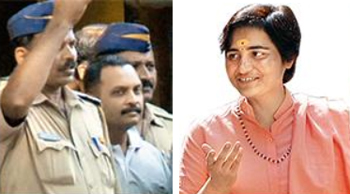
blastIn a major setback to the 2008 Malegaon blasts case, seven statements of witnesses - all recorded in the presence of a magistrate and admissible as evidence - have gone missing from the Special NIA Court.

Coming in the wake of Special Public Prosecutor Rohini Salian's statement in June last year that National Investigation Agency (NIA) officers were putting pressure on her to go soft in the case, the disappearance of the crucial court documents will again call into question the prosecution's intent and ability to take the case, in which members of an alleged Hindu radical group stand accused, to its logical conclusion.

Two low-intensity explosions in Malegaon's Bhikku Chowk on September 29, 2008, had left seven people dead and left over 80 injured. The Maharashtra police's Anti Terrorist Squad, which investigated the case before it was handed over to NIA in 2011, arrested a dozen-odd accused, including self-styled Sadhvi Pragya Singh Thakur and serving Indian Army officer Lt Col Srikant Purohit. Both worked for Hindu radical group Abhinav Bharat.

An embarrassed NIA has formed three teams to look for the missing statements, while the court officials have also joined in the search. Salian, who quit the case last year over, what she called, NIA's pressure to not push too hard, on Wednesday told media that an official from the Special NIA Court came to her looking for the documents. "One of the staff from the special court enquired with me if I am in the possession of the key documents, including several witness statements recorded under section 164 of the Criminal Procedure Code, which, he said, were not traceable in the court," she said.

Salian said she had handed over all documents to the designated special prosecutor Avinash Rasal in the presence of NIA officials. "I have not kept a single document related to the case with me," she said.

Rasal, on his part, said he had no knowledge of any witness statements having gone missing, but said that it is possible that some documents may have been misplaced. "The documents have been moved frequently from one court to the other. If the documents are not in the Special NIA Court, then they are probably some place else and the court officials should be able to locate them," he said.

Top NIA officials, including DIG Abhin Modak, all through Wednesday did not respond to calls and text messages and an agency spokesman said he had no comment to offer on the matter.

Among the witness statements gone missing is that of Dharmendra Bairagi, a close aid of Ramji Kalsangra, a key accused in the case who is absconding. Bairagi, in his statement recorded before a magistrate, had said that he was witness to a meeting between Kalsangra and Pragya Thakur in Ujjain just months before the 2008 blasts. He had also said he had heard the two discussing a plan to engineer blasts.

Another key statement that is missing is that of the founder of Abhinav Bharat Hemani Savarkar. Savarkar's statement details a meeting between Lt Col Purohit and Pragya Thakur in Nashik in 2007. It also accuses Lt Col Purohit of misusing Abhinav Bharat's name to raise funds.

Top criminal lawyer Majid Memon called the disappearance of the documents shocking. "In a case relating to terror, which is considered a serious offence, if lethargy, negligence or deliberate removal of important documents surfaces, it is an extremely serious matter. The court should not tolerate such lapses."

He added that this appears as a deliberate attempt at weakening the case and helping the accused. "On the face of it, this cannot be accidental or a case of omission."

While copies of the missing statements are available with the accused, these, in the absence of the originals, become secondary evidence. Statements recorded in the presence of a magistrate have evidentiary value before the trial court. Though a witness can still be called for deposition before the trial court so that he can be cross-examined, if the witness deviates from the statement given before the magistrate, the trial court can still rely on the statement.

Advocate Shirikant Bhat said that while statements can be reconstructed from a copy of the same available either with the prosecution or the defence, it all depends on how reliable or authentic this document being relied upon is. "And whether or not that document should be relied upon for reconstruction is for the court to decide," he said.

Advocate Shrikant Shivade, who is appearing for Col. Purohit in the case, said reconstruction based on the copies available either with the prosecution or the defense will be possible only if the process of filing the documents on record has been followed. "We will have to check if the statements were ever on record in this case," he said.

Comments

PONDER & Use UR
 - 
Saturday, 9 Apr 2016

Naren, Bopanna..
I dont think U guys have read QURAN...
I feel U just quoted the same thing which the devils agent salman rusdie... explained in his book...
If U read QURAN with its content ... U will understand the TRUTH. Sometimes try to read by yourself and dont be like animals, whatever is fed, U accept it.
Also If we quote from the Hindu scriptures... We can find many such wars & violence done ... But we use our intellectual which ALLAH and Prophet Muhammad pbuh taught us... not to insult other religion.
Please quote from hindu scriptures also, there are plenty of verse of Violence.... and some verses, I feel disgusting to read ... which u people say its from god... But its NOT and which was added by some shaukuni along with the word of God.....to FOOL U and those who blindly follow without using the intellect that God has given us.

Please read with open mind and Stop following blindly..

Curious
 - 
Friday, 8 Apr 2016

NIA looks like a RSS wing works pro for some community and anti for other communities.

Naren kotian
 - 
Thursday, 7 Apr 2016

Jai Sri ram ...god knew that nationalist Indians will never commit henious crimes like one particular community... So documents disappeared...welcome nationalist Indians ..soon we will make sure all sangh parivar guys are out from jail .hara hara modi ..death to jihad ...we must create terror in the hearts of terrorist community ..its the mossad policy ...jai ho Israel jai ho Indo Israel relationshi ...sangh parivar must double up nexus with Israel in all fields covertly and overtly ...hahaha jihadi galige menasina kaayi itta haage madlikke ishtu saaku ...ummah muah chummah ..

Bopanna
 - 
Thursday, 7 Apr 2016

Koran instruct in violence, 4:89; 5:33. 9,5,111,123. 47;4. but still further the Koran also teaches that the Jewish people are descendants of swine and apes.2:65.; 7:166; 5:60. T

PONDER & Dont
 - 
Thursday, 7 Apr 2016

When Tiger bit human --- There is no law to punish the Tiger
When leopard bit human --- There is no law to punish the leopard
When snake bit human --- There is no law to punish the snake
When Dog bites the human --- There is no law to punish the Dog

Dear HUMAN, when human makes trouble to other human, there is LAW to protect the innocent... (cos humans are intelligent creature, Created by God)
Some people in the authorities are joining the ANIMALs category and they are proving it by their EVIL plans & DECEPTION.

HONeST
 - 
Thursday, 7 Apr 2016

Our system in the hands of DECIEVERS and LIARS... An OPEN LIE to protect the KILLERS

ummar
 - 
Thursday, 7 Apr 2016

AAB KI BAAAR MODHI SARKAAR ,,'

EFFECT OF FEKUUMODHII

Rikaz
 - 
Thursday, 7 Apr 2016

That means no justice for those who killed due to their heinous crime. They should have put to gallows.

Add new comment

  • Coastaldigest.com reserves the right to delete or block any comments.
  • Coastaldigset.com is not responsible for its readers’ comments.
  • Comments that are abusive, incendiary or irrelevant are strictly prohibited.
  • Please use a genuine email ID and provide your name to avoid reject.
News Network
May 29,2020

Bengaluru, May 29: Seven out of ten (72 per cent) workers in Karnataka reported having lost their employment during the COVID-19-induced lockdown, according to findings of a survey by Azim Premji University, in collaboration with ten civil society organisations.

The university said in a statement it conducted "a detailed" phone survey of 5,000 workers across 12 states in the country, to gauge the impact of the COVID-19 lockdown on employment, livelihoods, and access to government relief schemes.

The survey covered self-employed, casual, and regular wage and salaried workers and it released the findings for Karnataka on Thursday.

Seventy-six per cent of urban workers and 66 per cent of rural workers lost their employment, the survey findings said.

For non-agricultural self-employed workers and wage workers, who were still employed, average weekly earnings fell by two-third.

More than four in ten salaried workers (44 per cent) saw either a reduction in their salary or received no salary during the lockdown.

Six out of ten households reported that they did not have enough money to buy even a weeks worth of essential items, according to the survey.

Eight out ten households reported a reduction in food intake, while less than three in ten vulnerable households (27 per cent) in urban Karnataka received any form of cash transfer from the government, it said.

In summary, the disruption in the Karnatakas economy and labour markets is enormous. Livelihoods have been devastated at unprecedented levels during the lockdown.

The recovery from this could be slow and very painful, the statement said.

As a response to the findings of this survey, the team which has conducted the survey suggested a universalisation of the PDS to expand its reach and implementation of expanded rations for at least the next six months.

It suggested cash transfers equal to at least Rs.7000 per month for two months, and proactive steps like expansion of MGNREGA, introduction of urban employment guarantee, and investment in universal basic services, among others.

Comments

Add new comment

  • Coastaldigest.com reserves the right to delete or block any comments.
  • Coastaldigset.com is not responsible for its readers’ comments.
  • Comments that are abusive, incendiary or irrelevant are strictly prohibited.
  • Please use a genuine email ID and provide your name to avoid reject.
News Network
June 18,2020

Bengaluru, Jun 18: The Karnataka police has arrested a German national wanted for kidnapping and causing bodily harm to a person in his home country, an official said on Wednesday. The person was also found to be overstaying on an expired visa, which police said that it appeared that the visa had been tampered with to look more current.

"On receipt of credible information by the CID Interpol Division officers, the Red Corner Notice subject, the German national Alexander Bruno Wehnelt, was traced at Hulimangala village," a police official told media persons.

Hulimangala is on the outskirts of Bengaluru city.

Alexander, 55, escaped from Germany and took shelter in Bengaluru.

The Interpol Division of CBI NCB (Central Bureau of Intelligence, Narcotics Control Bureau) in New Delhi had communicated to the Interpol liaison officer in Karnataka's Criminal Investigation Department (CID) about Alexander, directing extensive search measures to trace the criminal at large.

The Narcotics Control Bureau of Wiesbaden in Germany was on the hunt for Wehnelt for the crimes he committed in 2015, and have finally found him five years later.

"A special team of officers was constituted by the CID - Interpol division under the supervision of ADGP (Additional Director General of Police) B. Dayananda and the Interpol liaison officer and efforts were made to trace the subject," said the official.

On Monday, the police received credible information leading to his arrest.

"It was learnt that his visa had expired in 2016 and he tried to show a visa which was issued in December 2019 which had expired on Saturday, June 13," said the official.

Prima facie, it appeared that Alexander had tampered with his visa and the police are probing on that front as well.

He was handed over to Hebbagodi Police Station in Bengaluru Urban, for his overstay and a criminal case has been registered against him, under the Foreigners Act.

Comments

Add new comment

  • Coastaldigest.com reserves the right to delete or block any comments.
  • Coastaldigset.com is not responsible for its readers’ comments.
  • Comments that are abusive, incendiary or irrelevant are strictly prohibited.
  • Please use a genuine email ID and provide your name to avoid reject.
News Network
April 2,2020

The current physical distancing guidelines provided by the World Health Organisation (WHO) and by the US Centers for Disease Control and Prevention (CDC) may not be adequate to curb the coronavirus spread, according to a research which says the gas cloud from a cough or sneeze may help virus particles travel up to 8 metres. The research, published in the Journal of the American Medical Association, noted that the the current guidelines issued by the WHO and CDC are based on outdated models from the 1930s of how gas clouds from a cough, sneeze, or exhalation spread.

Study author, MIT associate professor Lydia Bourouiba, warned that droplets of all sizes can travel 23 to 27 feet, or 7-8 metres, carrying the pathogen.

According to Bourouiba, the current guidelines are based on "arbitrary" assumptions of droplet size, "overly simplified", and "may limit the effectiveness of the proposed interventions" against the deadly pandemic.

 She explained that the old guidelines assume droplets to be one of two categories, small or large, taking short-range semi-ballistic trajectories when a person exhales, coughs, or sneezes.

However based on more recent discoveries, the MIT scientist said, sneezes and coughs are made of a puff cloud that carries ambient air, transporting within it clusters of droplets of a wide range of sizes.

Bourouiba warned that this puff cloud, with ambient air entrapped in it, can offer the droplets moisture and warmth that can prevent it from evaporation in the outer environment.

"The locally moist and warm atmosphere within the turbulent gas cloud allows the contained droplets to evade evaporation for much longer than occurs with isolated droplets," she said.

"Under these conditions, the lifetime of a droplet could be considerably extended by a factor of up to 1000, from a fraction of a second to minutes," the researcher explained in the study.

The MIT scientist, who has researched the dynamics of coughs and sneezes for years, added that these droplets settle along the trajectory of a cough or sneeze contaminating surfaces, with their residues staying suspended in the air for hours.

"Even when maximum containment policies were enforced, the rapid international spread of COVID-19 suggests that using arbitrary droplet size cutoffs may not accurately reflect what actually occurs with respiratory emissions, possibly contributing to the ineffectiveness of some procedures used to limit the spread of respiratory disease," Bourouiba wrote in the study

Comments

Add new comment

  • Coastaldigest.com reserves the right to delete or block any comments.
  • Coastaldigset.com is not responsible for its readers’ comments.
  • Comments that are abusive, incendiary or irrelevant are strictly prohibited.
  • Please use a genuine email ID and provide your name to avoid reject.