


Expected? Key documents in Malegaon blasts case missing from NIA court!

April 7, 2016

Mumbai, Apr 7: All the statements were given in front of a magistrate and hence admissible as evidence to nail the alleged culprits that include a 'sadhvi' and a serving Indian Army officer.
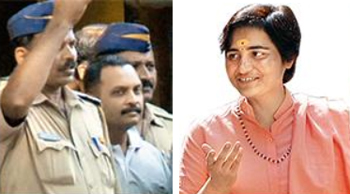
blastIn a major setback to the 2008 Malegaon blasts case, seven statements of witnesses - all recorded in the presence of a magistrate and admissible as evidence - have gone missing from the Special NIA Court.

Coming in the wake of Special Public Prosecutor Rohini Salian's statement in June last year that National Investigation Agency (NIA) officers were putting pressure on her to go soft in the case, the disappearance of the crucial court documents will again call into question the prosecution's intent and ability to take the case, in which members of an alleged Hindu radical group stand accused, to its logical conclusion.

Two low-intensity explosions in Malegaon's Bhikku Chowk on September 29, 2008, had left seven people dead and left over 80 injured. The Maharashtra police's Anti Terrorist Squad, which investigated the case before it was handed over to NIA in 2011, arrested a dozen-odd accused, including self-styled Sadhvi Pragya Singh Thakur and serving Indian Army officer Lt Col Srikant Purohit. Both worked for Hindu radical group Abhinav Bharat.

An embarrassed NIA has formed three teams to look for the missing statements, while the court officials have also joined in the search. Salian, who quit the case last year over, what she called, NIA's pressure to not push too hard, on Wednesday told media that an official from the Special NIA Court came to her looking for the documents. "One of the staff from the special court enquired with me if I am in the possession of the key documents, including several witness statements recorded under section 164 of the Criminal Procedure Code, which, he said, were not traceable in the court," she said.

Salian said she had handed over all documents to the designated special prosecutor Avinash Rasal in the presence of NIA officials. "I have not kept a single document related to the case with me," she said.

Rasal, on his part, said he had no knowledge of any witness statements having gone missing, but said that it is possible that some documents may have been misplaced. "The documents have been moved frequently from one court to the other. If the documents are not in the Special NIA Court, then they are probably some place else and the court officials should be able to locate them," he said.

Top NIA officials, including DIG Abhin Modak, all through Wednesday did not respond to calls and text messages and an agency spokesman said he had no comment to offer on the matter.

Among the witness statements gone missing is that of Dharmendra Bairagi, a close aid of Ramji Kalsangra, a key accused in the case who is absconding. Bairagi, in his statement recorded before a magistrate, had said that he was witness to a meeting between Kalsangra and Pragya Thakur in Ujjain just months before the 2008 blasts. He had also said he had heard the two discussing a plan to engineer blasts.

Another key statement that is missing is that of the founder of Abhinav Bharat Hemani Savarkar. Savarkar's statement details a meeting between Lt Col Purohit and Pragya Thakur in Nashik in 2007. It also accuses Lt Col Purohit of misusing Abhinav Bharat's name to raise funds.

Top criminal lawyer Majid Memon called the disappearance of the documents shocking. "In a case relating to terror, which is considered a serious offence, if lethargy, negligence or deliberate removal of important documents surfaces, it is an extremely serious matter. The court should not tolerate such lapses."

He added that this appears as a deliberate attempt at weakening the case and helping the accused. "On the face of it, this cannot be accidental or a case of omission."

While copies of the missing statements are available with the accused, these, in the absence of the originals, become secondary evidence. Statements recorded in the presence of a magistrate have evidentiary value before the trial court. Though a witness can still be called for deposition before the trial court so that he can be cross-examined, if the witness deviates from the statement given before the magistrate, the trial court can still rely on the statement.

Advocate Shirikant Bhat said that while statements can be reconstructed from a copy of the same available either with the prosecution or the defence, it all depends on how reliable or authentic this document being relied upon is. "And whether or not that document should be relied upon for reconstruction is for the court to decide," he said.

Advocate Shrikant Shivade, who is appearing for Col. Purohit in the case, said reconstruction based on the copies available either with the prosecution or the defense will be possible only if the process of filing the documents on record has been followed. "We will have to check if the statements were ever on record in this case," he said.

Comments

PONDER & Use UR
 - 
Saturday, 9 Apr 2016

Naren, Bopanna..
I dont think U guys have read QURAN...
I feel U just quoted the same thing which the devils agent salman rusdie... explained in his book...
If U read QURAN with its content ... U will understand the TRUTH. Sometimes try to read by yourself and dont be like animals, whatever is fed, U accept it.
Also If we quote from the Hindu scriptures... We can find many such wars & violence done ... But we use our intellectual which ALLAH and Prophet Muhammad pbuh taught us... not to insult other religion.
Please quote from hindu scriptures also, there are plenty of verse of Violence.... and some verses, I feel disgusting to read ... which u people say its from god... But its NOT and which was added by some shaukuni along with the word of God.....to FOOL U and those who blindly follow without using the intellect that God has given us.

Please read with open mind and Stop following blindly..

Curious
 - 
Friday, 8 Apr 2016

NIA looks like a RSS wing works pro for some community and anti for other communities.

Naren kotian
 - 
Thursday, 7 Apr 2016

Jai Sri ram ...god knew that nationalist Indians will never commit henious crimes like one particular community... So documents disappeared...welcome nationalist Indians ..soon we will make sure all sangh parivar guys are out from jail .hara hara modi ..death to jihad ...we must create terror in the hearts of terrorist community ..its the mossad policy ...jai ho Israel jai ho Indo Israel relationshi ...sangh parivar must double up nexus with Israel in all fields covertly and overtly ...hahaha jihadi galige menasina kaayi itta haage madlikke ishtu saaku ...ummah muah chummah ..

Bopanna
 - 
Thursday, 7 Apr 2016

Koran instruct in violence, 4:89; 5:33. 9,5,111,123. 47;4. but still further the Koran also teaches that the Jewish people are descendants of swine and apes.2:65.; 7:166; 5:60. T

PONDER & Dont
 - 
Thursday, 7 Apr 2016

When Tiger bit human --- There is no law to punish the Tiger
When leopard bit human --- There is no law to punish the leopard
When snake bit human --- There is no law to punish the snake
When Dog bites the human --- There is no law to punish the Dog

Dear HUMAN, when human makes trouble to other human, there is LAW to protect the innocent... (cos humans are intelligent creature, Created by God)
Some people in the authorities are joining the ANIMALs category and they are proving it by their EVIL plans & DECEPTION.

HONeST
 - 
Thursday, 7 Apr 2016

Our system in the hands of DECIEVERS and LIARS... An OPEN LIE to protect the KILLERS

ummar
 - 
Thursday, 7 Apr 2016

AAB KI BAAAR MODHI SARKAAR ,,'

EFFECT OF FEKUUMODHII

Rikaz
 - 
Thursday, 7 Apr 2016

That means no justice for those who killed due to their heinous crime. They should have put to gallows.

Add new comment

  • Coastaldigest.com reserves the right to delete or block any comments.
  • Coastaldigset.com is not responsible for its readers’ comments.
  • Comments that are abusive, incendiary or irrelevant are strictly prohibited.
  • Please use a genuine email ID and provide your name to avoid reject.
News Network
March 15,2020

While it makes perfect sense for IT employees to work from remote locations via video conferencing and collaboration tools seamlessly - especially in the case of tech giants like Google or Microsoft -- workers from the non-IT companies and small and medium enterprises (SMBs) are the worst-hit in India as most of them have little or no clue about how these messaging and collaboration tools work amid the coronavirus pandemic.

Small companies -- from corporate to education verticals -- are scrambling to get their act together as new coronavirus threat has reached their premises, prompting them to send employees home who have age-old laptops, poor network and connectivity with no UPS backups and little knowledge about how to handle group chat and collaboration software like Zoom, Google Hangouts Meet, Microsoft Teams and Flock etc.

Instead of halting operations, however, businesses can choose to shift towards remote working methods with teaching non-IT staff on how to use the latest digital software to connect and work, say industry experts.

The training will take some time and may hamper productivity in the short run but is a win-win situation for the non-tech companies in the long run, in case any such global emergency arises in the future.

According to a latest report by Gartner, 54 per cent of HR leaders have cited that poor technology and/or infrastructure for remote working is the biggest barrier to effective remote working.

Sandy Shen, Senior Director Analyst, Gartner, says that with COVID-19 disrupting the business landscape, CIOs should relook at the digital fulfillment of market demand.

"The value of digital channels, products and operations is immediately obvious to companies everywhere right now. This is a wake-up call for organisations that have placed too much focus on daily operational needs at the expense of investing in digital business and long-term resilience," warned Shen.

Businesses that can shift technology capacity and investments to digital platforms will mitigate the impact of the outbreak and keep their companies running smoothly now, and over the long term.

"Videoconferencing, messaging, collaboration tools and document sharing are just a few examples of technologies that facilitate remote work. Additional bandwidth and network capacity may also be needed, given the increasing number of users and volume of communications," informed Shen.

The IT industry's apex body Nasscom has asked the government to relax norms for a month to allow work-from-home for technology and back-office employees as a measure to deal with the spread of Covid-19 in India.

Networking giant Cisco said that it has seen "significant growth" in the usage of its web conferencing and video-conferencing service Webex in India.

According to Muneer Ahmad, Business Head, ViewSonic India, due to COVID-19 pandemic, the corporate and educational sector is severely getting affected in the country.

"ViewSonic IFP has a cloud-based software which help teachers and corporates to connect through video conferencing to multiple people at the same time and can split the screen into six screens. It can also connect with various tools like Skype, Cisco WebEx, Zoom, Google Hangouts and GoToMeeting," Ahmad told IANS.

Co-working sector has also taken a hit and the industry is looking at several measures to tackle it -- from ensuring supply of juices rich in Vitamin C to supply of disinfectants and giving work from home facilities.

"The scheduled visits of the clients at our co-working offices have been postponed. Few of our clients have cancelled their outstation meetings and have now started audio/video conferencing for virtual meetings," said Nakul Mathur, MD, Avanta India.

According to reports, India has approximately 1,000 co-working locations (as of September 2019) and is the second-largest market for the co-working industry after China.

As India's first licensed B2B Virtual Network Operator, CloudConnect Communications offers a collaborative platform that allows companies to overcome the COVID-19 threat while maintaining seamless business continuity and optimum employee productivity.

"We offer a secure, robust, reliable, scalable and trackable mobile-first unified communication infrastructure that aids remote teleworking so that businesses can continue operating even under any unforeseen circumstances," said Gokul Tandon, Executive Chairman, CloudConnect Communications.

Comments

Add new comment

  • Coastaldigest.com reserves the right to delete or block any comments.
  • Coastaldigset.com is not responsible for its readers’ comments.
  • Comments that are abusive, incendiary or irrelevant are strictly prohibited.
  • Please use a genuine email ID and provide your name to avoid reject.
News Network
January 27,2020

New Delhi, Jan 27: Non-Muslim refugees from Pakistan, Bangladesh and Afghanistan will have to provide proofs of their religious beliefs while applying for Indian citizenship under the controversial Citizenship Amendment Bill (CAA), officials said on Monday.

The applicants belonging to Hindu, Sikh, Christian, Buddhist, Jain or Parsi faiths will also have to furnish documents to prove that they entered India on or before December 31, 2014.

Those who will seek Indian citizenship under the CAA will have to provide proofs of their religious beliefs and this will be mentioned in the rules to be issued under the CAA, a government official said.

According to the CAA, members of Hindu, Sikh, Buddhist, Jain, Parsi and Christian communities who have come from Pakistan, Bangladesh and Afghanistan till December 31, 2014, due to religious persecution there will not be treated as illegal immigrants and will be given Indian citizenship.

The central government is also likely to give a relatively smaller window of just three months to those who want to apply for Indian citizenship in Assam under the CAA, another official said.

Some Assam-specific provisions are expected to be incorporated in the rules to be issued for the implementation of the CAA.

Assam chief minister Sarbananda Sonowal and his finance minister Himanta Biswa Sarma had made a request about a fortnight ago to keep a limited period window for applying under the CAA and also incorporate some other Assam-specific provisions in the CAA rules.

The move comes in view of continuing protests against the CAA in Assam that have been going on since the legislation was passed by Parliament in December last year.

There has been a growing feeling among the indigenous people of Assam that the newly enacted legislation will hurt their interests politically, culturally as well as socially.

The Assam Accord provides for detection and deportation of all illegal immigrants who have entered the country after 1971 and are living in the state, irrespective of their religion.

The protesters in Assam say that the CAA violates the provisions of the Assam Accord.

Comments

Add new comment

  • Coastaldigest.com reserves the right to delete or block any comments.
  • Coastaldigset.com is not responsible for its readers’ comments.
  • Comments that are abusive, incendiary or irrelevant are strictly prohibited.
  • Please use a genuine email ID and provide your name to avoid reject.
coastaldigest.com web desk
July 24,2020

Indore, Jul 24: A woman who sells fruits on a cart and who lashed out at municipal officials here has done PhD in Materials Science. Her siblings too are well educated and sell fruits as they did not find jobs.

Dr Raisa Ansari, who lives at Bakery Street in Pardeshipura with her family said she wanted to be a scientist but did not get a job anywhere.

Speaking to media persons, Raisa said, "I have done PhD in Materials Science and wanted to be a scientist but did not get job anywhere. I sell fruit here but the municipal officials are bothering us. We are being forced to move from here to there like cattle. Our religion may be the reason why we are not getting jobs but we are proud to be Indian. I am still looking for a job."

Dr Raisa's mother Ayesha Ansari said she herself is not educated, but has four children of whom three girls and one boy studied a lot but no one got job.

Speaking to media persons Ayesha said, "I have four children and they are well educated. I have not studied but all my children are educated but did not get job so all of them sell fruits."

"When the matter came to marriage, one of the daughters got married. Raisa and Shahjahan Bi wanted an educated boy, but they were not able to find a suitable match because of their complexion and sometimes they rejected the proposal because of dowry, so both are single. Two of my grandchildren are studying biology. They will become doctors," said Ayesha.

Meanwhile, people in the neighbourhood lauded the family's abilities. They said theirs was an educated family had to sell fruits as they did not get jobs.

Comments

Add new comment

  • Coastaldigest.com reserves the right to delete or block any comments.
  • Coastaldigset.com is not responsible for its readers’ comments.
  • Comments that are abusive, incendiary or irrelevant are strictly prohibited.
  • Please use a genuine email ID and provide your name to avoid reject.