



Explosion rocks Brussels train station, cops kill suspected bomber

Agencies
June 21, 2017

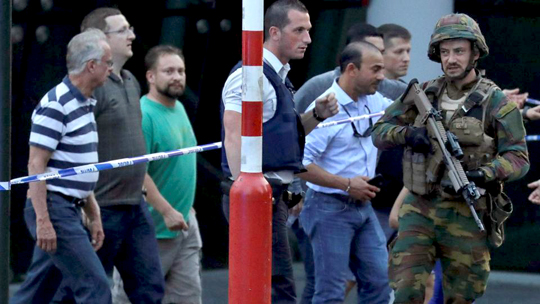
Brussels, Jun 21: Belgian soldiers shot and killed a suspected “terrorist” bomber after an explosion rocked a central Brussels train station Tuesday in the latest attack to hit Europe.
Brussels

Witnesses said the suspect shouted “Allahu Akbar” (God is Greatest) before setting off the blast, which triggered a small but intense ball of flames in the station hall.

There were no other casualties apart from the suspect, who was confirmed dead by prosecutors hours after the attack.

Crying rail passengers fled the station after the explosion, with memories still fresh of last year’s metro and airport suicide attacks in the city that hosts the EU’s headquarters.

“This is considered as a terrorist attack,” federal prosecutor’s office spokesman Eric Van Der Sypt told a news conference outside the station.

The blast in Belgium came a day after a man mowed down Muslims near a mosque in London, and a suspected Islamist on a terror watchlist rammed a car laden with weapons into a police vehicle in Paris.

Brussels has been on high alert since suicide bombers struck the Zavantem Airport and Maalbeek metro station near the EU headquarters in March 2016, killing 32 people and injuring hundreds more.

The Islamic State group claimed the attacks, which were carried out by the same Brussels-based cell behind the November 2015 Paris attacks that killed 130 people.

Initial reports said the blast at Central Station could have come from an explosive belt, but subsequent accounts pointed to the blast coming from a suitcase.

Van Der Sypt said that at about 1830 GMT there was a “small explosion at Central Station here in Brussels.” “The suspect has been neutralised by the military that were present at the scene immediately after the explosion,” he said.

The incident happened well after rush hour, but hundreds of passengers were still evacuated from one of Belgium’s busiest stations. The nearby Grand Place, a major tourist destination, was also cleared.

“There were people crying, there were people shouting,” said Elisa Roux, a spokeswoman for the Belgian rail company SNCB. “There was a movement of panic.”

Hours after the incident the suspect’s body remained at the scene of confrontation as bomb squads searched the area. An AFP journalist reported that a controlled explosion was heard several hours after the attack.

Ball of fire

Social media images showed an intense yet contained ball of fire in a nearly empty underground arrival hall.

“I went down to the mezzanine level, someone was shouting. Then he yelled ‘Allahu Akbar’, and he blew up a wheeled suitcase,” Nicolas Van Herringer, a railway sorting agent, told reporters. “I was behind a wall when it exploded. I went down and alerted my colleagues to evacuate everyone. He (the suspect) was still around but after that we didn’t see him.”

Van Herrewegen added: “It wasn’t exactly a big explosion but the impact was pretty big. People were running away.”

He described the suspect as well-built and tanned with short hair, wearing a white shirt and jeans. “I saw that he had something on him because I could see wires emerging, so it may have been a suicide vest,” Van Herrewegen said.

Prosecutors told Libre Belgique that the individual was carrying a backpack and an explosive belt, before being shot down.

‘Under control’

About an hour after the events, the situation was “under control”, the federal crisis centre said in a tweet. It said it was keeping the country’s terror alert at level 3, the second highest.

“The centre of Brussels is calm,” mayor Philippe Close said in a tweet.

Belgian Prime Minister Charles Michel hailed the “courage” of security forces and said he would chair a security council meeting on Wednesday morning.

Gare Centrale is largely underground, located in the heart of Brussels, a few blocks from the Grand Place and the Manneken Pis statue.

It appeared that the suspect was shot by soldiers deployed at railway stations and landmark buildings since the aftermath of the Paris terror attacks, when a link to Brussels was first established.

Belgium suffered another shock last August when a machete-wielding man shouting “Allahu akbar” attacked two policewomen in the industrial town of Charleroi, before being shot dead.

The country’s law enforcement agencies and intelligence services came under intense scrutiny for apparently missing a series of leads after the Paris attacks that could have led to the Brussels bombers.

Comments

Add new comment

  • Coastaldigest.com reserves the right to delete or block any comments.
  • Coastaldigset.com is not responsible for its readers’ comments.
  • Comments that are abusive, incendiary or irrelevant are strictly prohibited.
  • Please use a genuine email ID and provide your name to avoid reject.
News Network
February 27,2020

Washington, Feb 27: President Donald Trump has said that the US' relationship with India is "extraordinary" right now and a lot of progress was made in bilateral ties during his maiden official visit to the country where America will be doing a lot of business.

Talking to reporters, after his return from India on Wednesday, Trump said, "He (Prime Minister Narendra Modi) is a great gentleman, a great leader. It's an incredible country."

President Trump visited India from February 24 to 25. He was accompanied by first lady Melania Trump, daughter Ivanka Trump, son-in-law Jared Kushner and the top brass of his administration, including national security advisor Robert O'Brien.

They visited Ahmedabad, Agra and New Delhi before leaving for Washington on Tuesday.

During his stay, he addressed a massive rally in Ahmedabad, visited Agra and held official meetings in New Delhi.

The US President was feted at the world's largest cricket stadium in the "Namaste Trump" event in Ahmedabad and was cheered by tens of thousands of people.

"We were treated very, very well and we really enjoyed it. A lot of tremendous progress was made in terms of relationship - our relationship with India is extraordinary right now," he said.

"We are going to be doing a lot of business with India, they are sending billions and billions of dollars now to the United States," Trump said in response to a question.

In a tweet, his daughter Ivanka said that, Trump announced that US international development finance corporation "will establish a permanent presence in India to strengthen our economic ties, improve development plus further women's economic empowerment through WGDP (Women's Global Development and Prosperity Initiative)!"

On her arrival from India, she thanked PM Modi for "your warm hospitality as we visited your beautiful country and celebrated the strength, spirit and unity of the US and India!"

"Throughout our visit we saw monumental achievements of human creativity and proof of the infinite capacity of the human heart!" she said.

The first lady tweeted two pictures of her with Trump facing the Taj Mahal in Agra.

"One of the Seven Wonders of the World, the breathtaking Taj Mahal!" she said.

President Trump "reaffirmed the strong strategic partnership, vibrant economic ties and expanding security relationship between our two countries. Wonderful trip, but glad to be home! Thank you India!" said White House press secretary Stephanie Grisham.

During the visit, India and the US on Tuesday finalised defence deals worth $3 billion under which 30 military helicopters will be procured from two American defence majors for Indian armed forces.

The deals will include procurement of 24 MH-60 Romeo helicopters by India from the US at a cost of $2.6 billion. Another contract to acquire six AH-64E Apache helicopters for $800 million from the US is also on the table.

Comments

Add new comment

  • Coastaldigest.com reserves the right to delete or block any comments.
  • Coastaldigset.com is not responsible for its readers’ comments.
  • Comments that are abusive, incendiary or irrelevant are strictly prohibited.
  • Please use a genuine email ID and provide your name to avoid reject.
News Network
June 30,2020

Washington, Jun 30: Indian-American Medha Raj has been named by Democratic presidential candidate Joe Biden as his digital chief of staff, a key role in his election campaigns which are entirely going virtual due to the Covid-19 pandemic in the US.

In this capacity, Raj will work across all facets of the digital department to streamline and coordinate how to maximise the impact of its digital outputs, the Biden campaign said.

“Excited to share that I've joined Joe Biden's campaign as the Digital Chief of Staff. 130 days to the election and we're not going to waste a minute!” she said on LinkedIn.

Raj comes from Pete Buttigieg's campaign, who has now endorsed Biden.

The news was first reported by CNN, which the news channel said is part of the efforts of the Biden campaign to adapt to an almost entirely virtual campaign trail brought on by the coronavirus pandemic.

The US is the hardest-hit country by the coronavirus pandemic, with more than 2.64 million official cases and over 128,000 deaths.

According to CNN, Clarke Humphrey, who previously worked on Hillary Clinton's 2016 campaign, will act as the Biden campaign's new deputy digital director for the grassroots fundraising.

Jose Nunez is the campaign's new digital organising director.

He is from the Kamala Harris' campaign. Christian Tom is the new director of digital partnerships. Over the past few months, Biden has been relying more and more on digital campaigning and raising funds virtually.

A graduate in international politics from Georgetown University, Raj has earned her MBA from Stanford University.

Biden, 77, is challenging the 74-year-old Republican incumbent President Donald Trump in the November 3 presidential elections.

Former US vice president Biden would formally accept his Democratic presidential nomination at the party’s scaled back convention in Wisconsin’s Milwaukee city on August 20.

In view of the coronavirus pandemic, the Democratic National Convention Committee (DNCC) on Wednesday announced its convention plan to broadcast from Milwaukee and across the nation to reach out to all Americans.

According to some of the latest opinion polls, Biden is leading by more than eight percentage points over Trump.

Comments

Add new comment

  • Coastaldigest.com reserves the right to delete or block any comments.
  • Coastaldigset.com is not responsible for its readers’ comments.
  • Comments that are abusive, incendiary or irrelevant are strictly prohibited.
  • Please use a genuine email ID and provide your name to avoid reject.
News Network
June 4,2020

Jun 4: A malaria drug President Donald Trump took to try to prevent COVID-19 proved ineffective for that in the first large, high-quality study to test it in people in close contact with someone with the disease.

Results published Wednesday by the New England Journal of Medicine show that hydroxychloroquine was no better than placebo pills at preventing illness from the coronavirus.

The drug did not seem to cause serious harm, though -- about 40% on it had side effects, mostly mild stomach problems.

 “We were disappointed. We would have liked for this to work,” said the study leader, Dr. David Boulware, an infectious disease specialist at the University of Minnesota.

“But our objective was to answer the question and to conduct a high-quality study,” because the evidence on the drug so far has been inconclusive, he said.

Hydroxychloroquine and a similar drug, chloroquine, have been the subject of much debate since Trump started promoting them in March.

Hydroxychloroquine has long been used for malaria, lupus, and rheumatoid arthritis, but no large studies have shown it or chloroquine to be safe or effective for much sicker patients with coronavirus, and some studies have suggested the drugs may do harm.

Trump took a two-week course of hydroxychloroquine, along with zinc and Vitamin D, after two staffers tested positive for COVID-19, and had no ill effects, according to results of his latest physical released by his doctor Wednesday.

Federal regulators have warned against hydroxychloroquine's use except in hospitals and formal studies because of the risk of side effects, especially heart rhythm problems.

Boulware's study involved 821 people in the United States and Canada living with someone diagnosed with COVID-19 or at high risk of getting it because of their job -- doctors, nurses, ambulance workers who had significant exposure to a sick patient while not wearing full protective gear.

They were randomly assigned to get either the nutrient folate as a placebo or hydroxychloroquine for five days, starting within four days of their exposure. Neither they nor others involved in the research knew who was getting which pills.

After 14 days in the study, 12 per cent on the drug developed COVID-19 symptoms versus 14 per cent in the placebo group, but the difference is so small it could have occurred by chance, Boulware said.

“There's basically no effect. It does not prevent infection,” he said of the drug. Even if it were to give some slim advantage, “we'd want a much larger effect” to justify its use and risk of side effects for preventing illness, he said.

Results were no different among a subgroup of participants who were taking zinc or vitamin C, which some people believe might help make hydroxychloroquine more effective or fight the coronavirus.

There are some big caveats: The study enrolled people through the Internet and social media, relying on them to report their own symptoms rather than having them tracked in a formal way by doctors.

Participants were not all tested for the coronavirus but were diagnosed as COVID-19 cases based on symptoms in many cases. And not all took their medicines as directed.

The results “are more provocative than definitive,” and the drug may yet have prevention benefits if tried sooner or in a different way, Dr. Myron Cohen of the University of North Carolina at Chapel Hill wrote in a commentary in the journal.

Others were glad to see a study that had a comparison group and good scientific methods after so many weaker reports on hydroxychloroquine.

“This fits with everything else we've seen so far which suggests that it's not beneficial," said Dr. Peter Bach, director of a health policy center at Memorial Sloan Kettering Cancer Center in New York.

This study was in younger relatively healthy people, but the results “would make me very discouraged about trying to use this in older people” who are most vulnerable to serious illness from the coronavirus, Bach said.

“If it does work, it doesn't work very well.” Dr. Dan Culver, a lung specialist at the Cleveland Clinic, said there's still a chance that giving the drug sooner than four days after someone's exposure to the virus may help prevent illness.

But the study “takes 'home run' off the table” as far as hopes for the drug, he said.

The study was mostly funded by David Baszucki, founder of Roblox, a California-based game software company, and other private donors and the Minnesota university.

Boulware also is leading a study testing hydroxychloroquine for treating COVID-19. The study is finished and results are being analyzed now.

On Tuesday, the journal Lancet posted an “expression of concern” about a study it published earlier this month of nearly 15,000 COVID-19 patients on the malaria drugs that tied their use to a higher risk of dying in the hospital or developing a heartbeat problem.

Scientists have raised serious questions about the database used for that study, and its authors have launched an independent audit.

That work had a big impact: the World Health Organization suspended use of hydroxychloroquine in a study it is leading, and French officials stopped the drug's use in hospitals. On Wednesday, the WHO said experts who reviewed safety information decided that its study could resume.

Comments

Add new comment

  • Coastaldigest.com reserves the right to delete or block any comments.
  • Coastaldigset.com is not responsible for its readers’ comments.
  • Comments that are abusive, incendiary or irrelevant are strictly prohibited.
  • Please use a genuine email ID and provide your name to avoid reject.