


With an eye on Venus and Mars, ISRO attempts mega world record

February 12, 2017

Bengaluru, Feb 12: India will boldly go to Venus for the first time and re-visit the Red Planet very soon. Buried and hidden in the hundreds of pages of the new format electronic budget documents, is the first formal acknowledgement by the government about these two new bold inter-planetary sojourns to Earth's immediate neighbours.
satellite

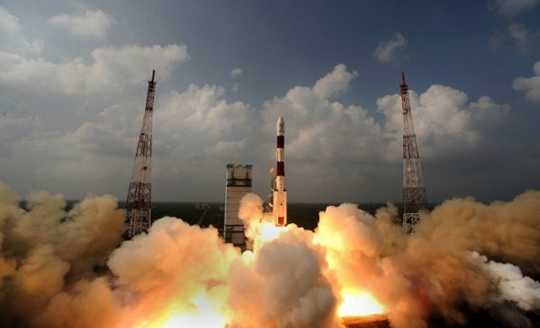
This uplifting news comes ahead of the Indian Space Research Organisation (ISRO) attempting to undertake its mega launch where it will drop off into space not one, two or three but a full load of 104 satellites in space in a single mission.

No other country has ever tried to hit a century in a single mission. The last world record is held by Russia which in 2014 rocketed 37 satellites in a single launch using a modified inter-continental ballistic missile.

If all goes according to plan, on the morning of February 15, ISRO will hurl into space using the Polar Satellite Launch Vehicle (PSLV) three Indian satellites and a 101 small foreign satellites.

India is hoping to better the previous world record by a whopping two-and-a-half times. ISRO, considered the new kid on the block in the multi-billion dollar world launcher market, hopes to set an enviable benchmark for the space fairing nations.

Prime Minister Narendra Modi's love affair with space is quite evident. The government, it seems, is rather pleased with the Indian space agency as Finance Minister Arun Jaitley gave the Department of Space a whopping 23 per cent increase in its budget. Under the space sciences section, the budget mentions provisions "for Mars Orbiter Mission II and Mission to Venus".

The second mission to Mars is tentatively slated for in 2021-2022 timeframe and as per existing plans it may well involve putting a robot on the surface of the Red Planet.

While India's first mission to Mars undertaken in 2013 was a purely Indian mission, the French space agency wants to collaborate in making the Mars rover.

In fact on a visit to India this month, Michael M Watkins, Director of the Jet Propulsion Laboratory of NASA, said they would be keen to at least put a telematics module so NASA's rovers and the Indian satellites are able to talk to each other.

The second Indian mission to Mars is likely to be all about doing good science since the first one had a nationalistic streak on it in trying to beat China to the orbit of Mars which the Mars Orbiter Mission (MOM) did magnificently.

India's maiden mission to Venus, the second planet of the Solar System named after the Roman goddess of love and beauty, is in all probability going to be a modest orbiter mission.

Watkins said a mission to Venus is very-very worthwhile as so little is understood about that planet and NASA would definitely be willing to partner in India's maiden voyage to Venus.

Towards that, NASA and ISRO have already initiated talks this month on trying to jointly undertake studies on using electrical propulsion for powering this mission.

India's original inter-planetary dreamer K Kasturirangan, former chairman of ISRO, says, "India should be part of this global adventure and exploring Venus and Mars is very worthwhile since humans definitely need another habitation beyond Earth."

Closer to home on its 39th launch India's workhorse rocket the PSLV will lift off carrying 1378 kg of robots to be deployed in space.

The first to be let off will be India's high resolution Cartosat-2 series satellite made especially to monitor activities of India's hostile neighbours at a resolution of less than a metre keeping a bird's eye view on both Pakistan and China.

This earth imaging capability is not unusual but the rest of the passengers are unique. There are two small Indian satellites each weighing less than 10 kg that are forerunners of a new class of satellites called ISRO Nano Satellites which the engineers seek to master.

What follows next is a trailblazing performance by the PSLV when at an altitude of over 500 km in space it will release from its womb, 101 co-passengers one each from Israel, Kazakhstan, The Netherlands, Switzerland, the UAE and a whopping 96 from the US. It is only recently American private companies have warmed up to ISRO as India offers cheap and reliable option.

Eighty-eight of the American satellites belong to a San Francisco based start-up company Planet Inc which is sending a swarm of small 4.7 kg each satellite it calls 'Doves'. This constellation will image earth like never before and with a high repeat rate providing satellite imagery at an affordable cost.

This suite of 101 small satellites all together weighing 664 kg will be released in space in a manner akin to a typical school bus which drops of its passengers namely children at their respective bus stops in a sequential manner, avoiding squabbling and elbowing in near zero gravity is not easy.

Ensuring that no collisions take place even is an art that ISRO has mastered from previous launches. In less than 600 seconds all 101 satellites will be released into space each travelling at whopping velocity of over 27,000 km per hour or at 40 times the speed of an average passenger airliner.

Some experts are suggesting that in a bid to earn some money ISRO is actually contributing significantly to the creation of space junk as these small satellites are really not very useful.

But Laura Grego, Senior Scientist, Global Security Program, Union of Concerned Scientists, Cambridge, USA says, "I think that these launches can be done responsibly and provide benefits to all people. Developing a culture of responsible space launch and operations is key as more and more countries become space-faring.

"While the number of countries that can launch satellites independently is still quite small, many dozens of countries own and operate satellites."

Kasturirangan says, "India has the capability putting several satellites in a single launch and demonstrating that capability is certainly not bad as it adds to India's credibility and then later if ISRO deploys this capability of formation flying in a constellation of its own satellites it would be a useful addition to its arsenal."

Comments

Naren kotian
 - 
Sunday, 12 Feb 2017

@9 hahaha ... pakistanis posing as indians commenting about toilets ... FYI ... first ask your community to pay tax ... kaka antha bitti sigo benefits ge baayi tegedu kondu nillodakke bidodakke heli , we can understand frustration boss , not even 0.01% ar

Add new comment

  • Coastaldigest.com reserves the right to delete or block any comments.
  • Coastaldigset.com is not responsible for its readers’ comments.
  • Comments that are abusive, incendiary or irrelevant are strictly prohibited.
  • Please use a genuine email ID and provide your name to avoid reject.
News Network
June 12,2020

Bengaluru, Jun 12: All the four candidates, including former prime minister H D Deve Gowda (JDS), and senior Congress leader Mallikarjna Kharge, on Friday were declared elected unopposed to the Rajya Sabha from Karnataka.

Karnataka Assembly Secretary sources here said that all the four candidates, who were in the fray for as many berths, were elected after the last date of withdrawal of candidature ended on Friday.

Comments

Add new comment

  • Coastaldigest.com reserves the right to delete or block any comments.
  • Coastaldigset.com is not responsible for its readers’ comments.
  • Comments that are abusive, incendiary or irrelevant are strictly prohibited.
  • Please use a genuine email ID and provide your name to avoid reject.
Ram Puniyani
March 14,2020

In the wake of Citizenship Amendment Act (CAA) UN High Commissioner, Michele Bachelet, has filed an intervention in the Supreme Court petition challenging the constitutionality of the Citizenship Amendment Act, as she is critical of CAA. Responding to her, India’s Foreign Minister S. Jai Shanker strongly rebutted her criticism, saying that the body (UNHCR) has been wrong and is blind to the problem of cross border terrorism. The issue on hand is the possibility of scores of people, mainly Muslims, being declared as stateless. The problem at hand is the massive exercise of going through the responses/documents from over 120 crore of Indian population and screening documents, which as seen in Assam, yield result which are far from truthful or necessary.

The issue of CAA has been extensively debated and despite heavy critique of the same by large number of groups and despite the biggest mass opposition ever to any move in Independent India, the Government is determined on going ahead with an exercise which is reminiscent of the dreaded regimes which are sectarian and heartless to its citizens, which have indulged in extinction of large mass of people on grounds of citizenship, race etc. The Foreign minister’s assertion is that it is a matter internal to India, where India’s sovereignty is all that matters! As far as sovereignty is concerned we should be clear that in current times any sovereign power has to consider the need to uphold the citizenship as per the principle of non-discrimination which is stipulated in Art.26 of the International Covenant on Civil and Political (ICCPR) rights.

Can such policies, which affect large number of people and are likely to affect their citizenship be purely regarded as ‘internal’? With the World turning into a global village, some global norms have been formulated during last few decades. The norms relate to Human rights and migrations have been codified. India is also signatory to many such covenants in including ICCPR, which deals with the norms for dealing with refugees from other countries. One is not talking of Chicago speech of Swami Vivekanand, which said that India’s greatness has been in giving shelter to people from different parts of the World; one is also not talking of the Tattariaya Upanishad’s ‘Atithi Devovhav’ or ‘Vasudhaiva Kutumbkam’ from Mahaupanishad today.

What are being talked about are the values and opinions of organizations which want to ensure to preserve of Human rights of all people Worldwide. In this matter India is calling United Nations body as ‘foreign party’; having no locus standi in the case as it pertains to India’s sovereignty. The truth is that since various countries are signatories to UN covenants, UN bodies have been monitoring the moves of different states and intervening at legal level as Amicus (Friend of the Court) to the courts in different countries and different global bodies. Just to mention some of these, UN and High Commissioner for Human Rights has often submitted amicus briefs in different judicial platforms. Some examples are their intervention in US Supreme Court, European Court of Human Rights, International Criminal Court, and the Inter-American Court of Human Rights. These are meant to help the Courts in areas where UN bodies have expertise.

 Expertise on this has been jointly formulated by various nations. These interventions also remind the nations as to what global norms have been evolved and what are the obligations of individual states to the values which have evolved over a period of time. Arvind Narrain draws our attention to the fact that, “commission has intervened in the European Court of Human Rights in cases involving Spain and Italy to underscore the principle of non-refoulement, which bars compulsory expulsion of illegal migrants… Similarly, the UN has intervened in the International Criminal Court in a case against the Central African Republic to explicate on the international jurisprudence on rape as a war crime.”

From time to time organizations like Amnesty International and Human Rights Watch have been monitoring the status of Human rights of different countries. This puts those countries in uncomfortable situation and is not welcome by those establishments. How should this contradiction between ‘internal matter’, ‘sovereignty’ and the norms for Human rights be resolved? This is a tough question at the time when the freedom indices and democratic ethos are sliding downwards all over the world. In India too has slid down on the scale of these norms.

In India we can look at the intervention of UN body from the angle of equality and non discrimination. Democratic spirit should encourage us to have a rethink on the matters which have been decided by the state. In the face of the greatest mass movement of Shaheen bagh, the state does need to look inwards and give a thought to international morality, the spirit of global family to state the least.

The popular perception is that when Christians were being persecuted in Kandhmal the global Christian community’s voice was not strong enough. Currently in the face of Delhi carnage many a Muslim majority countries have spoken. While Mr. Modi claims that his good relations with Muslim countries are a matter of heartburn to the parties like Congress, he needs to relook at his self gloating. Currently Iran, Malaysia, Indonesia and many Muslim majority countries have spoken against what Modi regime is unleashing in India. Bangladesh, our neighbor, has also seen various protests against the plight of Muslims in India. More than the ‘internal matter’ etc. what needs to be thought out is the moral aspect of the whole issue. We pride ourselves in treading the path of morality. What does that say in present context when while large section of local media is servile to the state, section of global media has strongly brought forward what is happening to minorities in India.   

The hope is that Indian Government wakes up to its International obligations, to the worsening of India’s image in the World due to CAA and the horrific violence witnessed in Delhi.

Comments

Add new comment

  • Coastaldigest.com reserves the right to delete or block any comments.
  • Coastaldigset.com is not responsible for its readers’ comments.
  • Comments that are abusive, incendiary or irrelevant are strictly prohibited.
  • Please use a genuine email ID and provide your name to avoid reject.
coastaldigest.com news network
May 30,2020

Bengaluru, May 31: The coronavirus related fatalities in Karnataka rose to 49 with the death of a 47-year-old woman while 141 new coronavirus cases were confirmed on Saturday taking the infection tally to 2,922, Karnataka minister S Suresh Kumar said.

Among the fresh cases, 90 are inter-state passengers, he told reporters.

The deceased woman from Bidar was admitted on May 24 and died on May 28 at a designated hospital in Bidar, Kumar, minister for primary and secondary education and spokesperson for Covid-19 in the state, said.

The woman was diagnosed with influenza like illness with a history of paralysis and was bed-ridden besides having hypertension and convulsions, Kumar said.

According to him, the total cases include 997 discharges, 1,874 active cases, 49 Covid-19 deaths and two non-Covid related deaths.

Of the total active cases, 15 are in the ICU, he added.

The new cases comprise 33 in Bengaluru, 18 in Yadagir, 14 in Dakshina Kannada, 13 each in Udupi and Hassan, 11 in Vijayapura, 10 in Bidar, six in Shivamogga, four each in Davangere and Haveri, three in Kolar, two each in Kalaburagi, Mysuru, Uttara Kannada, Dharwad, and one each in Belagavi, Chitradurga, Tumakuru and Bengaluru Rural, the health department said in its bulletin.

The minister said the government has issued an order regarding relaxation of curfew on Sundays.

According to the order issued by Chief Secretary T M Vijay Bhaskar, there will not be any curfew on Sundays throughout the day following requests from people.

As per the previous order, curfew was from 7 am to 7 pm on Sundays.

Comments

Add new comment

  • Coastaldigest.com reserves the right to delete or block any comments.
  • Coastaldigset.com is not responsible for its readers’ comments.
  • Comments that are abusive, incendiary or irrelevant are strictly prohibited.
  • Please use a genuine email ID and provide your name to avoid reject.