


With an eye on Venus and Mars, ISRO attempts mega world record

February 12, 2017

Bengaluru, Feb 12: India will boldly go to Venus for the first time and re-visit the Red Planet very soon. Buried and hidden in the hundreds of pages of the new format electronic budget documents, is the first formal acknowledgement by the government about these two new bold inter-planetary sojourns to Earth's immediate neighbours.
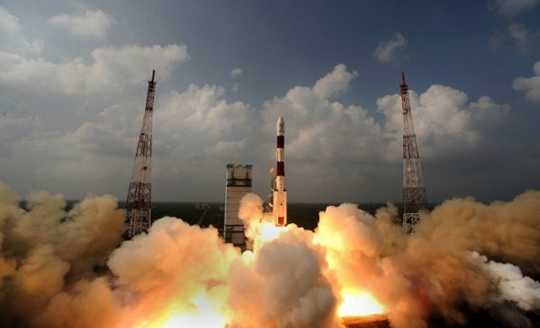
satellite

This uplifting news comes ahead of the Indian Space Research Organisation (ISRO) attempting to undertake its mega launch where it will drop off into space not one, two or three but a full load of 104 satellites in space in a single mission.

No other country has ever tried to hit a century in a single mission. The last world record is held by Russia which in 2014 rocketed 37 satellites in a single launch using a modified inter-continental ballistic missile.

If all goes according to plan, on the morning of February 15, ISRO will hurl into space using the Polar Satellite Launch Vehicle (PSLV) three Indian satellites and a 101 small foreign satellites.

India is hoping to better the previous world record by a whopping two-and-a-half times. ISRO, considered the new kid on the block in the multi-billion dollar world launcher market, hopes to set an enviable benchmark for the space fairing nations.

Prime Minister Narendra Modi's love affair with space is quite evident. The government, it seems, is rather pleased with the Indian space agency as Finance Minister Arun Jaitley gave the Department of Space a whopping 23 per cent increase in its budget. Under the space sciences section, the budget mentions provisions "for Mars Orbiter Mission II and Mission to Venus".

The second mission to Mars is tentatively slated for in 2021-2022 timeframe and as per existing plans it may well involve putting a robot on the surface of the Red Planet.

While India's first mission to Mars undertaken in 2013 was a purely Indian mission, the French space agency wants to collaborate in making the Mars rover.

In fact on a visit to India this month, Michael M Watkins, Director of the Jet Propulsion Laboratory of NASA, said they would be keen to at least put a telematics module so NASA's rovers and the Indian satellites are able to talk to each other.

The second Indian mission to Mars is likely to be all about doing good science since the first one had a nationalistic streak on it in trying to beat China to the orbit of Mars which the Mars Orbiter Mission (MOM) did magnificently.

India's maiden mission to Venus, the second planet of the Solar System named after the Roman goddess of love and beauty, is in all probability going to be a modest orbiter mission.

Watkins said a mission to Venus is very-very worthwhile as so little is understood about that planet and NASA would definitely be willing to partner in India's maiden voyage to Venus.

Towards that, NASA and ISRO have already initiated talks this month on trying to jointly undertake studies on using electrical propulsion for powering this mission.

India's original inter-planetary dreamer K Kasturirangan, former chairman of ISRO, says, "India should be part of this global adventure and exploring Venus and Mars is very worthwhile since humans definitely need another habitation beyond Earth."

Closer to home on its 39th launch India's workhorse rocket the PSLV will lift off carrying 1378 kg of robots to be deployed in space.

The first to be let off will be India's high resolution Cartosat-2 series satellite made especially to monitor activities of India's hostile neighbours at a resolution of less than a metre keeping a bird's eye view on both Pakistan and China.

This earth imaging capability is not unusual but the rest of the passengers are unique. There are two small Indian satellites each weighing less than 10 kg that are forerunners of a new class of satellites called ISRO Nano Satellites which the engineers seek to master.

What follows next is a trailblazing performance by the PSLV when at an altitude of over 500 km in space it will release from its womb, 101 co-passengers one each from Israel, Kazakhstan, The Netherlands, Switzerland, the UAE and a whopping 96 from the US. It is only recently American private companies have warmed up to ISRO as India offers cheap and reliable option.

Eighty-eight of the American satellites belong to a San Francisco based start-up company Planet Inc which is sending a swarm of small 4.7 kg each satellite it calls 'Doves'. This constellation will image earth like never before and with a high repeat rate providing satellite imagery at an affordable cost.

This suite of 101 small satellites all together weighing 664 kg will be released in space in a manner akin to a typical school bus which drops of its passengers namely children at their respective bus stops in a sequential manner, avoiding squabbling and elbowing in near zero gravity is not easy.

Ensuring that no collisions take place even is an art that ISRO has mastered from previous launches. In less than 600 seconds all 101 satellites will be released into space each travelling at whopping velocity of over 27,000 km per hour or at 40 times the speed of an average passenger airliner.

Some experts are suggesting that in a bid to earn some money ISRO is actually contributing significantly to the creation of space junk as these small satellites are really not very useful.

But Laura Grego, Senior Scientist, Global Security Program, Union of Concerned Scientists, Cambridge, USA says, "I think that these launches can be done responsibly and provide benefits to all people. Developing a culture of responsible space launch and operations is key as more and more countries become space-faring.

"While the number of countries that can launch satellites independently is still quite small, many dozens of countries own and operate satellites."

Kasturirangan says, "India has the capability putting several satellites in a single launch and demonstrating that capability is certainly not bad as it adds to India's credibility and then later if ISRO deploys this capability of formation flying in a constellation of its own satellites it would be a useful addition to its arsenal."

Comments

Naren kotian
 - 
Sunday, 12 Feb 2017

@9 hahaha ... pakistanis posing as indians commenting about toilets ... FYI ... first ask your community to pay tax ... kaka antha bitti sigo benefits ge baayi tegedu kondu nillodakke bidodakke heli , we can understand frustration boss , not even 0.01% ar

Add new comment

  • Coastaldigest.com reserves the right to delete or block any comments.
  • Coastaldigset.com is not responsible for its readers’ comments.
  • Comments that are abusive, incendiary or irrelevant are strictly prohibited.
  • Please use a genuine email ID and provide your name to avoid reject.
coastaldigest.com web desk
April 30,2020

In the wake of Saudi Arabia's assurance that Masjid al-Haram of Makkah and Masjid an-Nabawi of Madinah will be opened for believers after some days, a message has gone viral on social media claiming that both the holy mosques will open on Ramadan 8 (May 1).

The message which was widely circulated on Facebook and WhatsApp, also contained certain condition such as people should fetch their own prayer mats and that they should not use the washrooms in the mosques. 

Clarification

Meanwhile, the authorities of the two holy mosques, issued a clarification that the claims made in the viral post are false and baseless.

"The message being circulated about the opening date for Haramiain (two holy mosques) for public is completely baseless and false. The suspension of prayers for general public is still in effect," they said in a social media post.

Comments

Add new comment

  • Coastaldigest.com reserves the right to delete or block any comments.
  • Coastaldigset.com is not responsible for its readers’ comments.
  • Comments that are abusive, incendiary or irrelevant are strictly prohibited.
  • Please use a genuine email ID and provide your name to avoid reject.
Media Release
June 1,2020

As part of the Indian Overseas Congress Mera Bharat Mahaan NRI Series, a Facebook live Global Conference was facilitated by Dr Arathi Krishna, Dy. KPCC NRI Chairman and Mr. Mohammad Mansoor President IOC Bahrain on 30th May, 2020.

In the one and half hour live interaction, questions and answers were addressed by DK Shivakumar, President of PCC Karnataka and attended by hundreds of participants, accumulating an impressive 300K people viewing the live broadcast across the globe.

The event was inaugurated with a welcome address by the inspiring and innovative IOC chairman Sam Pitroda followed by the motivational speech of AICC Secretary Shri Himanshu Vyas, IOC US President Mr. Mohinder Singh Gilzian and former KPCC NRI Dy Chairman Dr. Arathi Krishna by whom Shivakumar was introduced.

The event was remarkably successful with maximum interaction of global congress family members and straight forward answers by Shivakumar. 

He emphasized on the present political issues in India and the Indian government's negligence in handling the crisis related to Covid-19 and the indefinite lockdown. He added at present, that the Congress is playing a frontline, constructive role by addressing and articulating the Covid-19 issues and offering critique-based solutions to the government as a responsible opposition party.

The insightful meeting covered the congress strategy and the rebuilding of the KPCC, as well as discussed counter corrupt and hatred politics of current regime along with the role of constructive opposition, etc.

IOC Bahrain President Mr. Mohammad Mansoor thanked IOC Chairman Sam Pitroda, AICC Secretary  Himanshu Vyas for their role in strengthening the party and motivating the team; former KPCC NRI Dy Chairman Dr. Arathi Krishna for introducing the guest; IOC global IT Cell Chairman Manoj Shinde, along with Dananjay and Vinay for professionally managing the event;  IOC US President Mohinder and  Karnataka Chapter President Gauri Shankar for emphasizing the guest of honour; Ms Sofiya Sharma and Ms Vijya Nadela for beautifully moderating the event and all the distinguished guests and Presidents of IOC and KPCC wing Leaders from Saudi Arabia, Bahrain, Kuwait, UAE, Germany and other countries who were present on the online meeting and especially  Mr. Althaf,  PA to DKS and Mr. A.N.Nataraj Gowda in charge of KPCC IT Cell for helping facilitatethe online meeting.

Comments

Add new comment

  • Coastaldigest.com reserves the right to delete or block any comments.
  • Coastaldigset.com is not responsible for its readers’ comments.
  • Comments that are abusive, incendiary or irrelevant are strictly prohibited.
  • Please use a genuine email ID and provide your name to avoid reject.
Agencies
June 26,2020

New Delhi, Jun 26: With looming uncertainty and no likelihood of an early economic recovery in sight, the bull run in gold prices is here to stay. Analysts expect domestic futures to touch ₹ 52,000 per 10 grams in the next few months, till Diwali.

Experts also predict that with the current trend, gold may reach historic levels around ₹ 65,000 per 10 grams in two years time.

Futures of the yellow metal have touched new highs in India off late. On Wednesday, the August contract of gold futures on the Multi-Commodity Exchange (MCX) touched an all-time high of Rs 48,589 per 10 grams.

It has, however corrected since and is currently trading at ₹ 48,057 on the MCX, higher by ₹ 116 or 0.24 per cent from its previous close.

Market experts are of the view that both domestic and international gold prices are yet not done breaching records and will touch new highs in days to come.

The resurgence in the number of new cases of coronavirus infection across the globe has added to the uncertainty and fears.

Speaking to media persons, Anuj Gupta, DVP for Commodities and Currencies Research at Angel Broking, noted: "In short term we are expecting it to reach ₹ 48,800-49,000 and for long term, we are expecting ₹ 51,000-Rs 52,000 till Diwali."

On the prices in the international market, he said that it may reach around $1,790 per ounce in the near term from the current levels of $1,762 and the long term, it is likely to be around $1,820-1,850 per ounce.

Gupta noted that with International Monetary Fund's (IMF) latest downward revision of economic outlook, both global and of India, and the rising number of cases and high demand by gold exchange traded funds (ETF) have led to this record breaking rise in gold prices.

Covid-19 battered India's economy is projected to contract by 4.5 per cent this fiscal, according to the IMF and the global output is projected to decline by 4.9 per cent in 2020, 1.9 percentage points below the IMF's April forecast.

Hareesh V, Head of Commodity Research at Geojit Financial Services, said that gold's safe haven appeal will remain on the higher side as there is little hope of a quick global economic recovery amid rising virus cases across the world.

"Increased geopolitical instability and an under-performing dollar also lift the metal's sentiments," he added.

According to Prathamesh Mallya, AVP Research, Non-Agro Commodities & Currencies at Angel Broking, said that with the global output to contract and the economies in a deeper recession than most anticipate, gold as an asset class is a safe bet for investors across the globe.

"Although, the physical demand has declined drastically due to the restrictions and lockdowns, the activity of global central banks and their net purchases of gold signal that uncertainty will continue for most of 2020," he said.

He was also of the view that in the international market price of the metal may move towards $1,850 per ounce and in the domestic market it is likely to move higher towards Rs 50,000 per 10 grams.

"The investment demand as seen in the net additions of ETF holdings also signals that gold will shine for a much longer time even if the pandemic is under control. Till then, keep buying gold, if not in physical form, but in digital form," Mallya added.

Industry insiders like Aditya Pethe, Director, WHP Jewellers said: "I basically feel that the current trend for the gold is bullish and for the coming next 2 years, it is likely to move upwards. No one can predict the exact price as currently the trend is on rise but it might change after 6 months. In general for the coming 6 months to one year, the gold prices are likely to cross $2,000 which comes to roughly Rs 55,000. For a temporary moment it may reduce, basically fluctuate as well but overall trend of gold is going to be bullish."

On his part, Ishu Datwani, Founder, Anmol Jewellers said: "Yes - it's very likely that the gold price could easily go up to Rs 60,000-Rs 65,000 in the next two years. There is also a possibility of it going up even more."

"A lot of banks have been buying gold and there is also a possibility that the Indian rupee will depreciate against the dollar. This and geopolitical reasons will cause bullishness in gold."

Comments

Add new comment

  • Coastaldigest.com reserves the right to delete or block any comments.
  • Coastaldigset.com is not responsible for its readers’ comments.
  • Comments that are abusive, incendiary or irrelevant are strictly prohibited.
  • Please use a genuine email ID and provide your name to avoid reject.