


With an eye on Venus and Mars, ISRO attempts mega world record

February 12, 2017

Bengaluru, Feb 12: India will boldly go to Venus for the first time and re-visit the Red Planet very soon. Buried and hidden in the hundreds of pages of the new format electronic budget documents, is the first formal acknowledgement by the government about these two new bold inter-planetary sojourns to Earth's immediate neighbours.
satellite

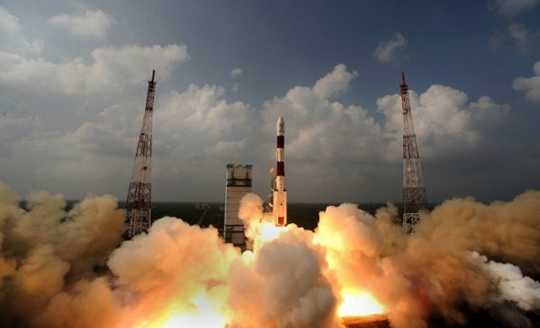
This uplifting news comes ahead of the Indian Space Research Organisation (ISRO) attempting to undertake its mega launch where it will drop off into space not one, two or three but a full load of 104 satellites in space in a single mission.

No other country has ever tried to hit a century in a single mission. The last world record is held by Russia which in 2014 rocketed 37 satellites in a single launch using a modified inter-continental ballistic missile.

If all goes according to plan, on the morning of February 15, ISRO will hurl into space using the Polar Satellite Launch Vehicle (PSLV) three Indian satellites and a 101 small foreign satellites.

India is hoping to better the previous world record by a whopping two-and-a-half times. ISRO, considered the new kid on the block in the multi-billion dollar world launcher market, hopes to set an enviable benchmark for the space fairing nations.

Prime Minister Narendra Modi's love affair with space is quite evident. The government, it seems, is rather pleased with the Indian space agency as Finance Minister Arun Jaitley gave the Department of Space a whopping 23 per cent increase in its budget. Under the space sciences section, the budget mentions provisions "for Mars Orbiter Mission II and Mission to Venus".

The second mission to Mars is tentatively slated for in 2021-2022 timeframe and as per existing plans it may well involve putting a robot on the surface of the Red Planet.

While India's first mission to Mars undertaken in 2013 was a purely Indian mission, the French space agency wants to collaborate in making the Mars rover.

In fact on a visit to India this month, Michael M Watkins, Director of the Jet Propulsion Laboratory of NASA, said they would be keen to at least put a telematics module so NASA's rovers and the Indian satellites are able to talk to each other.

The second Indian mission to Mars is likely to be all about doing good science since the first one had a nationalistic streak on it in trying to beat China to the orbit of Mars which the Mars Orbiter Mission (MOM) did magnificently.

India's maiden mission to Venus, the second planet of the Solar System named after the Roman goddess of love and beauty, is in all probability going to be a modest orbiter mission.

Watkins said a mission to Venus is very-very worthwhile as so little is understood about that planet and NASA would definitely be willing to partner in India's maiden voyage to Venus.

Towards that, NASA and ISRO have already initiated talks this month on trying to jointly undertake studies on using electrical propulsion for powering this mission.

India's original inter-planetary dreamer K Kasturirangan, former chairman of ISRO, says, "India should be part of this global adventure and exploring Venus and Mars is very worthwhile since humans definitely need another habitation beyond Earth."

Closer to home on its 39th launch India's workhorse rocket the PSLV will lift off carrying 1378 kg of robots to be deployed in space.

The first to be let off will be India's high resolution Cartosat-2 series satellite made especially to monitor activities of India's hostile neighbours at a resolution of less than a metre keeping a bird's eye view on both Pakistan and China.

This earth imaging capability is not unusual but the rest of the passengers are unique. There are two small Indian satellites each weighing less than 10 kg that are forerunners of a new class of satellites called ISRO Nano Satellites which the engineers seek to master.

What follows next is a trailblazing performance by the PSLV when at an altitude of over 500 km in space it will release from its womb, 101 co-passengers one each from Israel, Kazakhstan, The Netherlands, Switzerland, the UAE and a whopping 96 from the US. It is only recently American private companies have warmed up to ISRO as India offers cheap and reliable option.

Eighty-eight of the American satellites belong to a San Francisco based start-up company Planet Inc which is sending a swarm of small 4.7 kg each satellite it calls 'Doves'. This constellation will image earth like never before and with a high repeat rate providing satellite imagery at an affordable cost.

This suite of 101 small satellites all together weighing 664 kg will be released in space in a manner akin to a typical school bus which drops of its passengers namely children at their respective bus stops in a sequential manner, avoiding squabbling and elbowing in near zero gravity is not easy.

Ensuring that no collisions take place even is an art that ISRO has mastered from previous launches. In less than 600 seconds all 101 satellites will be released into space each travelling at whopping velocity of over 27,000 km per hour or at 40 times the speed of an average passenger airliner.

Some experts are suggesting that in a bid to earn some money ISRO is actually contributing significantly to the creation of space junk as these small satellites are really not very useful.

But Laura Grego, Senior Scientist, Global Security Program, Union of Concerned Scientists, Cambridge, USA says, "I think that these launches can be done responsibly and provide benefits to all people. Developing a culture of responsible space launch and operations is key as more and more countries become space-faring.

"While the number of countries that can launch satellites independently is still quite small, many dozens of countries own and operate satellites."

Kasturirangan says, "India has the capability putting several satellites in a single launch and demonstrating that capability is certainly not bad as it adds to India's credibility and then later if ISRO deploys this capability of formation flying in a constellation of its own satellites it would be a useful addition to its arsenal."

Comments

Naren kotian
 - 
Sunday, 12 Feb 2017

@9 hahaha ... pakistanis posing as indians commenting about toilets ... FYI ... first ask your community to pay tax ... kaka antha bitti sigo benefits ge baayi tegedu kondu nillodakke bidodakke heli , we can understand frustration boss , not even 0.01% ar

Add new comment

  • Coastaldigest.com reserves the right to delete or block any comments.
  • Coastaldigset.com is not responsible for its readers’ comments.
  • Comments that are abusive, incendiary or irrelevant are strictly prohibited.
  • Please use a genuine email ID and provide your name to avoid reject.
coastaldigest.com news network
May 13,2020

Mangaluru, May 13: Union Minister and former Karnataka chief minister D V Sadananda Gowda today assured that he will exert pressure on the authorities concerned to operate more repatriate flights to bring back Kannadigas from Saudi Arabia to Karnataka. 

Speaking in a video conference organised by coastaldigest.com with Kannadiga delegates in Saudi Arabia, Mr Gowda said: “Today itself I will contact the external affairs ministry and Director General of Civil Aviation (DGCA) to convince them the need to add operate flights to bring back stranded Kannaidgas from the Kingdom.

After paying heed to the advices, requests and concerns of Kannadiga delegates that participated in the video conference, Mr Gowda said: “Two things need to be done. First thing is number of flights from Saudi Arabia to Karnataka should be increased. Second thing is to ensure that most of these flights land in the Mangaluru Airport as most of the Kannadiga expats in Saudi Arabia are from the coastal region.

“There should be at least two to three flights from Saudi Arabia to Karnataka (Bengaluru Airport or Mangaluru Airport) every week. That is my intention,” he added.

Comments

Add new comment

  • Coastaldigest.com reserves the right to delete or block any comments.
  • Coastaldigset.com is not responsible for its readers’ comments.
  • Comments that are abusive, incendiary or irrelevant are strictly prohibited.
  • Please use a genuine email ID and provide your name to avoid reject.
News Network
July 25,2020

Bengaluru, Jul 25: The Karnataka government on Saturday announced a waiver of crematorium fees for those who succumb to the COVID-19 infection in Bengaluru and said the city civic body would bear the cost.

It said that from now on, families of the COVID deceased need not pay any fees fixed by the city civic body- Bruhat Bengaluru Mahanagara Palike (BBMP)- across 12 electric crematoriums in the city.

"There were reports in the media about difficulties faced in performing the last rites of those who died due to COVID-19 infections. Aimed at resolving those difficulties, certain decisions have been taken," Revenue Minister R Ashoka said.

He told reporters here that BBMP had fixed Rs 250 as the cremation fee, Rs 100 for the ash collection pot and Rs 900 for the bier (bamboo stretcher on which the body is carried), all of which have been waived for COVID deaths.

"So it will be a waiver of Rs 1,250 per cremation. The BBMP will bear this cost," he added.

Ashoka also announced Rs 500 per body incentive for the personnel who conduct the last rites of COVID victims.

"This is in recognition of their services at a time when family members of the deceased are not ready to touch the body and not ready to take the body in some cases," he said.

Noting that the government has identified 23 acres of land at five places around Bengaluru for burial or cremation of COVID victims, Ashoka locals in all these areas are protesting against it.

Appealing to the people for cooperation during these difficult times, he said the government's intention was to ensure respectful burial or cremation for the deceased.

"Obstructing it is not right, it is not Indian tradition," he said.

Pointing out that it takes almost a day's time for a COVID victim's body to be handed over for burial or cremation, he said "scientifically, according to experts and doctors, the virus will not remain alive for more than three hours.

...Also, bodies are either burnt or buried eight feet below. So there will not be any problem for those living in nearby areas and it will not spread infection. Cooperate with humanity," he said.

"These lands identified are for all religions and communities and once the pandemic subsides, can be used for other deaths as well," he said.

Comments

Add new comment

  • Coastaldigest.com reserves the right to delete or block any comments.
  • Coastaldigset.com is not responsible for its readers’ comments.
  • Comments that are abusive, incendiary or irrelevant are strictly prohibited.
  • Please use a genuine email ID and provide your name to avoid reject.
Muhammad Abdullah Javed
May 20,2020

One of the distinguish features of the Noble Quran is that it presents different sorts of classifications. It is quite evident as one of the names of the Quran is Furqan that is it differentiates between things through its unique style of classification. The Quran openly proclaims the difference between right and wrong, truth and falsehood, literate and illiterate, light and darkness and so on. The system of Quranic taxonomy has a pivotal element with regard to ranking of human beings. It classifies them into two groups, one, who is honorable in the sight of their Creator and the second, disliked by Him.

This Quranic approach of classification is quite genuine, void of all sorts of bias. Since humans have no say in their birth, color or region, therefore the Quran doesn’t recognize these parameters to classify two groups of people.

The crux of Quranic taxonomy rests with the human ability which has been equally distributed among all humans. In terms of abilities to perform, barring those tasks performed with exceptional talents, all humans are equal. This is where Quran draws a line and specify who is most honorable in the sight of their Creator, it says:

 O mankind, We created you from one man and one woman, and then divided you into nations and tribes so that you may recognize one another. Indeed, the most honorable among you in the sight of Allah is he who is the most pious of you. Surely, Allah is All-knowing, All-Wise. (Chapter 49, Verse 13).

Criterion of judgement

To be most righteous in the sight of God, one has to be of pious nature. The Quran uses term Taqwa (a sense of distinguishing between right and wrong, piety) to exemplify the pious nature. It further specifies that the source of pious nature - Taqwa is an inherent quality of human beings. Along with the faculties of hearing, seeing and speaking they have been bestowed with (Taqwa) the criterion of distinguishing between virtues and vices, it has been mentioned in the Quran as:

And by the human self and by Him Who balanced it, then inspired it with its wickedness and piety (Chapter 91, Verses 7 & 8).

Good deeds and human nature

With the advent of human race on earth, the equation has been set in simple terms. Humans have to be obedient to their Creator by means of using their intellect, smart enough to use their ability to judge between right and wrong and spend their lives in performing good deeds. For this very reason God has created life and death:

Who created death and life that He may try you to see which of you is best in deeds, and He is All-Mighty as well as All-Forgiving (Chapter 67, Verse 2)

Since life is all about performing good deeds, the ability to perform any good action has been made as natural as recognizing any color with naked eyes. It is within the reach of a person to identify the difference between colors, so is his criterion of judgement that tells what to perform and what to refrain from?

Good actions have been synchronized with human nature whereas evil deeds are quite detrimental, that’s why there is a universal consensus over the conception of virtues and vices. No one can dare to differ with virtues like truth, justice and honesty etc, and no one appreciates vices like falsehood, violations and corruption. With this inherent ability of humans to identify good and bad, the concept of virtues and vices has been described with the same bent of human intellect, there is no philosophical and ideological kind of description to tell what truth and falsehood are, it is as simple as this:

Prophet Muhammad (peace be upon him) said: Give up what is doubtful to you for that which is not doubtful; for truth is peace of mind and falsehood is doubt (Tirmidhi)

Highway of actions

The Quran presents a highway of actions for everyone who believes in it and intend to be most honorable in the sight of the Creator. For each and every day, there is a definite plan of action to go ahead with it to please the Creator. Again, for every week and month, there are clear specifications with regard to individual and collective actions. So no place for claims and reservations, no place for any excuse either, things have been made clear. For a person to be honored, he has to be man of deeds, that’s it. Every person has fair chances of performing better, as the life has been given, criterion of judgement between right and wrong has been given, and plan of action has been provided with. Now one has to energize himself for everyday action and try to set right the intention.

Difference in human efficiencies

No doubt there are differences in human abilities and efficiencies, one may argue about the quality and magnitude of actions. Those who are of high efficiency may perform well and those who are inefficient may not? True, to convince what Quran emphasizes is, God doesn’t look at the magnitude of an action, rather He sees with what intention in what circumstances it has been performed? If any person keep fast in scorching heat for more than 16 hours a day will get high rewards compare to the one who fast less than 10 hours a day at a cold place. Again, if the intention is to please the God, than every action, no matter how small or big it is in its scale, will fetch rich dividends. A poor’s donation of few rupees will be equal in rewards as compare to what a millionaire gets by donating thousands of rupees from his enormous wealth. The act of charity has demanded sacrifice; both of them have sacrificed in accordance with their capacities. Therefore upon asking whose charity is noble in the sight of God, the Prophet Muhammad (pbuh) said: The charity of poor person who tries hard to get few rupees from his hard earn money to donate in the way of God (NasaiBook of Hadith).

The Quranic taxonomy of human is quite justifiable as every human bear testimony to its genuine and unbiased classification through what we term as actions. Therefore the world has to witness a race between men and women to see who can compete with others in order to please their Creator?

Whosoever acts righteously – whether a man or a woman and embraces belief, We will surely grant him a good life; and will surely grant such persons their reward according to the best of their deeds. (Chapter 16, Verse 97)

God-oriented actions, privilege for the Humanity

It’s very unpleasant to notice that in today’s world the parameters like statuses, resources and wealth have been regarded as privilege and honor for both humans and their societies. No doubt they are, but not at the cost of losing the very essence of human nature and sacrificing its interest. Today’s advancements speak of this dark phase where the height of inventions and discoveries touching the skies while the dignity and honor of humans have gone to the lowest of the low. The ever increasing poverty, hunger, untimely deaths, different forms of corruption in the land, violation of human rights are just to remind a few. The presence of rich and poor, highs and lows in the society speaks of disparity of actions, lack of selfless service and hearts void of God’s love and fear.

The beauty of humanity is to remain in the service of God and always stand on the toes to help those who are in need. This God-oriented action enables every doer to be dear to his God as the classification of good and the bad is purely based on the actions performed for the sake of the Creator:

Everyone is assigned a rank according to his deed. Your Lord is not heedless of what they do (Chapter 6, Verse 132).


Muhammad Abdullah Javed is the Director of AJ Academy for Research & Development. He can be reached at [email protected]

Comments

Add new comment

  • Coastaldigest.com reserves the right to delete or block any comments.
  • Coastaldigset.com is not responsible for its readers’ comments.
  • Comments that are abusive, incendiary or irrelevant are strictly prohibited.
  • Please use a genuine email ID and provide your name to avoid reject.