


Bengaluru, Feb 12: India will boldly go to Venus for the first time and re-visit the Red Planet very soon. Buried and hidden in the hundreds of pages of the new format electronic budget documents, is the first formal acknowledgement by the government about these two new bold inter-planetary sojourns to Earth's immediate neighbours.
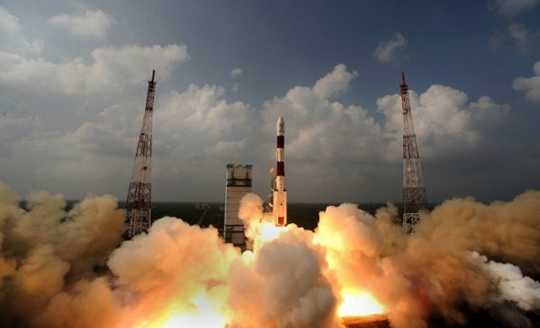
This uplifting news comes ahead of the Indian Space Research Organisation (ISRO) attempting to undertake its mega launch where it will drop off into space not one, two or three but a full load of 104 satellites in space in a single mission.
No other country has ever tried to hit a century in a single mission. The last world record is held by Russia which in 2014 rocketed 37 satellites in a single launch using a modified inter-continental ballistic missile.
If all goes according to plan, on the morning of February 15, ISRO will hurl into space using the Polar Satellite Launch Vehicle (PSLV) three Indian satellites and a 101 small foreign satellites.
India is hoping to better the previous world record by a whopping two-and-a-half times. ISRO, considered the new kid on the block in the multi-billion dollar world launcher market, hopes to set an enviable benchmark for the space fairing nations.
Prime Minister Narendra Modi's love affair with space is quite evident. The government, it seems, is rather pleased with the Indian space agency as Finance Minister Arun Jaitley gave the Department of Space a whopping 23 per cent increase in its budget. Under the space sciences section, the budget mentions provisions "for Mars Orbiter Mission II and Mission to Venus".
The second mission to Mars is tentatively slated for in 2021-2022 timeframe and as per existing plans it may well involve putting a robot on the surface of the Red Planet.
While India's first mission to Mars undertaken in 2013 was a purely Indian mission, the French space agency wants to collaborate in making the Mars rover.
In fact on a visit to India this month, Michael M Watkins, Director of the Jet Propulsion Laboratory of NASA, said they would be keen to at least put a telematics module so NASA's rovers and the Indian satellites are able to talk to each other.
The second Indian mission to Mars is likely to be all about doing good science since the first one had a nationalistic streak on it in trying to beat China to the orbit of Mars which the Mars Orbiter Mission (MOM) did magnificently.
India's maiden mission to Venus, the second planet of the Solar System named after the Roman goddess of love and beauty, is in all probability going to be a modest orbiter mission.
Watkins said a mission to Venus is very-very worthwhile as so little is understood about that planet and NASA would definitely be willing to partner in India's maiden voyage to Venus.
Towards that, NASA and ISRO have already initiated talks this month on trying to jointly undertake studies on using electrical propulsion for powering this mission.
India's original inter-planetary dreamer K Kasturirangan, former chairman of ISRO, says, "India should be part of this global adventure and exploring Venus and Mars is very worthwhile since humans definitely need another habitation beyond Earth."
Closer to home on its 39th launch India's workhorse rocket the PSLV will lift off carrying 1378 kg of robots to be deployed in space.
The first to be let off will be India's high resolution Cartosat-2 series satellite made especially to monitor activities of India's hostile neighbours at a resolution of less than a metre keeping a bird's eye view on both Pakistan and China.
This earth imaging capability is not unusual but the rest of the passengers are unique. There are two small Indian satellites each weighing less than 10 kg that are forerunners of a new class of satellites called ISRO Nano Satellites which the engineers seek to master.
What follows next is a trailblazing performance by the PSLV when at an altitude of over 500 km in space it will release from its womb, 101 co-passengers one each from Israel, Kazakhstan, The Netherlands, Switzerland, the UAE and a whopping 96 from the US. It is only recently American private companies have warmed up to ISRO as India offers cheap and reliable option.
Eighty-eight of the American satellites belong to a San Francisco based start-up company Planet Inc which is sending a swarm of small 4.7 kg each satellite it calls 'Doves'. This constellation will image earth like never before and with a high repeat rate providing satellite imagery at an affordable cost.
This suite of 101 small satellites all together weighing 664 kg will be released in space in a manner akin to a typical school bus which drops of its passengers namely children at their respective bus stops in a sequential manner, avoiding squabbling and elbowing in near zero gravity is not easy.
Ensuring that no collisions take place even is an art that ISRO has mastered from previous launches. In less than 600 seconds all 101 satellites will be released into space each travelling at whopping velocity of over 27,000 km per hour or at 40 times the speed of an average passenger airliner.
Some experts are suggesting that in a bid to earn some money ISRO is actually contributing significantly to the creation of space junk as these small satellites are really not very useful.
But Laura Grego, Senior Scientist, Global Security Program, Union of Concerned Scientists, Cambridge, USA says, "I think that these launches can be done responsibly and provide benefits to all people. Developing a culture of responsible space launch and operations is key as more and more countries become space-faring.
"While the number of countries that can launch satellites independently is still quite small, many dozens of countries own and operate satellites."
Kasturirangan says, "India has the capability putting several satellites in a single launch and demonstrating that capability is certainly not bad as it adds to India's credibility and then later if ISRO deploys this capability of formation flying in a constellation of its own satellites it would be a useful addition to its arsenal."

Comments
@9 hahaha ... pakistanis posing as indians commenting about toilets ... FYI ... first ask your community to pay tax ... kaka antha bitti sigo benefits ge baayi tegedu kondu nillodakke bidodakke heli , we can understand frustration boss , not even 0.01% ar
Add new comment