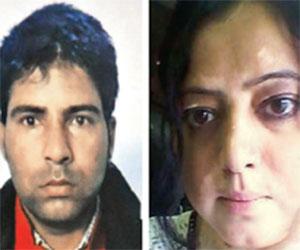
Facebook friend held for murdering IBM techie with laptop cord

[email protected] (CD Network)
January 22, 2016

Bengaluru, Jan 21: Two days after a 31-year-old woman employee of IBM was found murdered in her apartment in Bangalore, the police arrested the suspected killer near Gurgaon. Kusuma Rani Singla was transferred to the Karnataka capital six months ago from Noida.

Sukhbir SinghPolice sources said Singla, a divorcee hailing from Punjab, had befriended the suspected killer, identified as Sukhbir Singh, on Facebook few weeks ago.

According to Additional Commissioner (Bengaluru-East) P Harishekaran, Singh, during his meeting with Singla, apparently demanded Rs 50,000 and a flight ticket from her which she denied. He then used a laptop charge cord to strangle her.

Angered by this, he strangulated her to death using a laptop charger cord. A pen was also used in the crime, and an about two-inch deep wound is seen on her right eyebrow, he said. "On January 19, Singh flew into Bangalore from Delhi and went to Singla's house by 12.15pm. He was there till 3.30 pm," Harishekaran said.

An altercation erupted between the two that led to the murder of Singla, he said. Singh collected Singla's ATM cards and chequebooks and even withdrew Rs 11,000 using one of the cards before leaving to Delhi via Mumbai.

He hails from Haryana and has worked as a software engineer with MNCs but is currently unemployed, he said. He said the motive of the murder was yet to be ascertained.

Comments

Wel wisher
 - 
Sunday, 24 Jan 2016

Crazy Man. He should be under the bar for 20 years. Then only knows the value of once life.

Add new comment

  • Coastaldigest.com reserves the right to delete or block any comments.
  • Coastaldigset.com is not responsible for its readers’ comments.
  • Comments that are abusive, incendiary or irrelevant are strictly prohibited.
  • Please use a genuine email ID and provide your name to avoid reject.
coastaldigest.com news network
May 14,2020

Kuwait: The COVID-19 pandemic has affected all sections of the community in Kuwait, hundreds of NRIs are stranded due to unavailability of flights to fly back home. Leaders of associations belonging to Karnataka state in Kuwait and other part of Gulf countries have initiated a collective effort to discuss the challenges and issues faced by Kannadigas in Gulf Countries during COVID-19 pandemic.    

Mr. Ramesh S Bhandary – President of Tulu Koota Kuwait and Mr. Rajesh Vittal KKK president along with Other Gulf Karnataka Association leaders held video conference meeting arranged by GULF NRI Forum with Hon. Chief Minister of Karnataka Sri B.S. Yediyurappa to discuss the issue of COVID19 in Kuwait.

During this video conference, association leaders briefly explained various issues, statistics of emergency cases which include pregnant women, Senior citizens, visit visa expired cases and urgent medical treatment requirement cases who wish to travel back to Karnataka.

Evacuation flights to Bengaluru and Mangalore from Kuwait and other Gulf countries, request for free airline tickets or free quarantine facility at Bengaluru and Mangaluru also requested during this video call.

Dedicated Covid - 19 Helpline number for Karanataka NRIs- Nominate One line Contact person in Karnataka to co-ordinates all Covid related issues of NRI.

Responding to leaders requests, B.S Yediyurappa promised to address GCC Kannadigas concerns during this humanitarian crisis.

On Behalf of Kannadigaru Dubai & KNRI Forum , Gulf Kannadigas & Gulf Karantaka associations leaders expressed the happiness with BS Yadiyurappa - Hon Chief Minister of Karnataka, Raghavendra Yadiyurappa - Member of Parliament - Shivamogga constituency, for hearing problems of NRI and giving assurance of immediate action plan to repatriate needy Kannadigas from Gulf region to Karnataka.

Video conference was attended by Karnataka association leaders of Gulf Countries.

Karnataka NRI  Forum Kuwait committee comprising  representatives of leading associations of Karnataka in Kuwait such as Tulu Koota Kuwait (TKK), Kuwait Canara Welfare Association (KCWA), Kuwait Kannada Koota (KKK), Buntara Sangha Kuwait (BSK), Billava Sangha Kuwait (BSK), KKMA Karnataka Branch , Indian Doctors Forum and Karnataka Muslim Welfare Association Kuwait (KMWA).

Comments

Add new comment

  • Coastaldigest.com reserves the right to delete or block any comments.
  • Coastaldigset.com is not responsible for its readers’ comments.
  • Comments that are abusive, incendiary or irrelevant are strictly prohibited.
  • Please use a genuine email ID and provide your name to avoid reject.
News Network
April 8,2020

Bengaluru, Apr 8: A 65-year-old man from Kalaburagi district became the fifth COVID-19 fatality in Karnataka, where six new positive cases were confirmed, pushing the tally in the state to 181, the health department said on Wednesday.

The man with Severe Acute Respiratory Infection (SARI), died at a designated hospital in Kalaburagi on Tuesday, a day after being shifted from a private hospital where he was initially treated for two days.

"On April 4, he had got admitted to a private hospital, on April 6 he was shifted to ESI hospital, where he passed away," Primary and Secondary Education Minister Suresh Kumar told reporters here.

The private hospital had been locked and its entire medical team quarantined, he said, adding a notice had been served on it for act of "criminal negligence" (by not referring the patient to designated hospital) and will be followed with a police case.

"He was suffering from SARI, on collecting his sample, tests have revealed that he was positive....investigation is on to find how he got infected," the Minister said.

Noting that the hospital in this case did not refer the patient to the designated hospital and kept treating him for two days, he appealed to all private healthcare facilities to inform authorities if anyone showed any indications for COVID-19.

"As of 5 PM on April 8, cumulatively 181 COVID-19 positive cases have been confirmed in the state, it includes 5 deaths and 28 discharges," the health department said in a bulletin.

Out of the positive cases, 71 are those who had come back from foreign countries, while remaining 110 are contacts and those who had gone to Delhi, the Minister said.

Kumar also said an expert committee comprising Narayana Health founder-chairman Dr Devi Prasad Shetty and Jayadeva Institute of Cardiovascular Sciences director Dr C N Manjunath among others, constitutedto devise an exit strategy for the lockdown, has submitted its reports with various recommendations to Chief Minister B S Yediyurappa.

The chief minister and officials were examining it which was likely to come up before the cabinet meeting on Thursday after which the details will be shared, he added.

The health department said the six fresh cases reported on Wednesday included the elderly man from Kalaburagi who died.

Among the positive cases are a woman from Uttara Kannada with history of SARI and contact of a Dubai returnee, a 72- year-old woman from Kalaburagi, who is mother of a patient that tested positive for the disease; a man from Mandya with contact to two patients.

Others include a man from Chikkaballapura with travel history to Delhi and a woman from Bengaluru also with a travel history to the national capital.

Contact tracing is in progress for all the cases, the bulletin added.

The department said out of 148 active cases in the state, 146 COVID-19 positive patients (including 1 pregnant woman) are in isolation at designated hospitals are stable and two in ICU (one each on oxygen and ventilators).

It said out of total 181 cases in the state, six are transit passengers of Kerala.

Bengaluru accounted for the highest in the state with 63 cases, followed by Mysuru (35), Dakshina Kannada (12) Bidar (ten), Uttara Kannada and Kalaburagi (9 each), Chikkaballapur (8) Belagavi (7), Ballari (6), Bagalkote (5), Mandya (4) Davangere, Bengaluru Rural and Udupi (three each), and Kodagu, Tumakuru, Gadag and Dharwad one each.

Those discharged include 16 from Bengaluru, four from Dakshina Kannada, two each from Uttara Kannada, Kalaburagi and Davangere, and one from Bengaluru Rural; while among those dead are two from Kalaburgari and one each are reported from Bengaluru, Bagalkote and Tumakuru.

Comments

Add new comment

  • Coastaldigest.com reserves the right to delete or block any comments.
  • Coastaldigset.com is not responsible for its readers’ comments.
  • Comments that are abusive, incendiary or irrelevant are strictly prohibited.
  • Please use a genuine email ID and provide your name to avoid reject.
News Network
July 28,2020

Hounde, Jul 28: Coronavirus and its restrictions are pushing already hungry communities over the edge, killing an estimated 10,000 more young children a month as meager farms are cut off from markets and villages are isolated from food and medical aid, the United Nations warned Monday.

In the call to action shared with The Associated Press ahead of publication, four UN agencies warned that growing malnutrition would have long-term consequences, transforming individual tragedies into a generational catastrophe.

Hunger is already stalking Haboue Solange Boue, an infant from Burkina Faso who lost half her former body weight of 5.5 pounds (2.5 kilograms) in just a month. Coronavirus restrictions closed the markets, and her family sold fewer vegetables. Her mother was too malnourished to nurse.

“My child,” Danssanin Lanizou whispered, choking back tears as she unwrapped a blanket to reveal her baby's protruding ribs.

More than 550,000 additional children each month are being struck by what is called wasting, according to the UN — malnutrition that manifests in spindly limbs and distended bellies. Over a year, that's up 6.7 million from last year's total of 47 million. Wasting and stunting can permanently damage children physically and mentally.

“The food security effects of the COVID crisis are going to reflect many years from now,” said Dr. Francesco Branca, the WHO head of nutrition. “There is going to be a societal effect.”

From Latin America to South Asia to sub-Saharan Africa, more poor families than ever are staring down a future without enough food.

In April, World Food Program head David Beasley warned that the coronavirus economy would cause global famines “of biblical proportions” this year. There are different stages of what is known as food insecurity; famine is officially declared when, along with other measures, 30% of the population suffers from wasting.

The World Food Program estimated in February that one Venezuelan in three was already going hungry, as inflation rendered salaries nearly worthless and forced millions to flee abroad. Then the virus arrived.

“Every day we receive a malnourished child,” said Dr. Francisco Nieto, who works in a hospital in the border state of Tachira.

In May, Nieto recalled, after two months of quarantine, 18-month-old twins arrived with bodies bloated from malnutrition. The children's mother was jobless and living with her own mother. She told the doctor she fed them only a simple drink made with boiled bananas.

“Not even a cracker? Some chicken?” he asked.

“Nothing,” the children's grandmother responded. By the time the doctor saw them, it was too late: One boy died eight days later.

The leaders of four international agencies — the World Health Organization, UNICEF, the World Food Program and the Food and Agriculture Organization — have called for at least dollar 2.4 billion immediately to address global hunger.

But even more than lack of money, restrictions on movement have prevented families from seeking treatment, said Victor Aguayo, the head of UNICEF's nutrition program.

“By having schools closed, by having primary health care services disrupted, by having nutritional programs dysfunctional, we are also creating harm,” Aguayo said. He cited as an example the near-global suspension of Vitamin A supplements, which are a crucial way to bolster developing immune systems.

In Afghanistan, movement restrictions prevent families from bringing their malnourished children to hospitals for food and aid just when they need it most. The Indira Gandhi hospital in the capital, Kabul, has seen only three or four malnourished children, said specialist Nematullah Amiri. Last year, there were 10 times as many.

Because the children don't come in, there's no way to know for certain the scale of the problem, but a recent study by Johns Hopkins University indicated an additional 13,000 Afghans younger than 5 could die.

Afghanistan is now in a red zone of hunger, with severe childhood malnutrition spiking from 690,000 in January to 780,000 — a 13% increase, according to UNICEF.

In Yemen, restrictions on movement have blocked aid distribution, along with the stalling of salaries and price hikes. The Arab world's poorest country is suffering further from a fall in remittances and a drop in funding from humanitarian agencies.

Yemen is now on the brink of famine, according to the Famine Early Warning Systems Network, which uses surveys, satellite data and weather mapping to pinpoint places most in need.

Some of the worst hunger still occurs in sub-Saharan Africa. In Sudan, 9.6 million people live from one meal to the next — a 65% increase from the same time last year.

Lockdowns across Sudanese provinces, as around the world, have dried up work and incomes for millions. With inflation hitting 136%, prices for basic goods have more than tripled.

“It has never been easy but now we are starving, eating grass, weeds, just plants from the earth,” said Ibrahim Youssef, director of the Kalma camp for internally displaced people in war-ravaged south Darfur.

Adam Haroun, an official in the Krinding camp in west Darfur, recorded nine deaths linked with malnutrition, otherwise a rare occurrence, over the past two months — five newborns and four older adults, he said.

Before the pandemic and lockdown, the Abdullah family ate three meals a day, sometimes with bread, or they'd add butter to porridge. Now they are down to just one meal of “millet porridge” — water mixed with grain. Zakaria Yehia Abdullah, a farmer now at Krinding, said the hunger is showing “in my children's faces.”

“I don't have the basics I need to survive,” said the 67-year-old, who who hasn't worked the fields since April. “That means the 10 people counting on me can't survive either.”


Comments

Add new comment

  • Coastaldigest.com reserves the right to delete or block any comments.
  • Coastaldigset.com is not responsible for its readers’ comments.
  • Comments that are abusive, incendiary or irrelevant are strictly prohibited.
  • Please use a genuine email ID and provide your name to avoid reject.