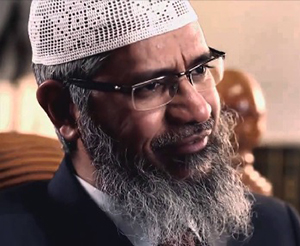
Fearing arrest Dr Zakir Naik writes to ED to send questionnaire

[email protected] (News Network)
February 26, 2017

Mumbai, Feb 26: Physician-turned-Islamic preacher Dr Zakir Naik, against whom the Enforcement Directorate has issued a summons in a money laundering case, has sent another letter stating the agency can send a questionnaire to him as he fears arrest in case of personal appearance.Zakir-Naik

"Our apprehension regarding the probe stood fortified with the arrest of Aamir Gazdar (Naik's confidante), which we are afraid will be the fate of our client in case of personal appearance," Naik said in a letter sent through his lawyer Mahesh Mule. The televangelist stated the agency can send him a questionnaire and that he would respond to it.

Dr Naik stated though he was an NRI, the ED still told the court that he was not joining the investigation and was trying to mislead the probe. ED is probing the preacher and his now proscribed Islamic Research Foundation (IRF) under anti-money laundering laws.

In the summons last month, Dr Naik was asked to appear before the Investigating Officer of the case under the provisions of the Prevention of Money Laundering Act (PMLA) by January end. The agency wants to record the statement of Naik, who is understood to be abroad.

The ED had registered a criminal case against Naik and IRF last month after taking cognisance of a complaint booked by the NIA under the Unlawful Activities (Prevention) Act against them. The agency is looking into the charges of alleged illegal funds laundered by the accused and the subsequent proceeds of crime thus generated.

Responding to the summons earlier this week, Dr Naik had sent a communication stating he was willing to give statement via any electronic media facility. "My client is willing and ready to give any statement before you via Skype or any other mode of electronic media to assist you in your investigation," he stated in the letter sent through his lawyer.

Comments

Althaf
 - 
Monday, 27 Feb 2017

Andha Kanoon.. Ya allah be with Zakir naik and bestow your mercy on him. Open the doors of easy for ZAKIR NAIK.

Shaad
 - 
Sunday, 26 Feb 2017

ZN, stay abroad only and world knows your valuve except monkeys in banana republic. India is the only loser if you quit Indian citizenship and it was long planned by monkeys.

shaji
 - 
Sunday, 26 Feb 2017

Most wanted criminals / killers are free in India whereas law is focusing on common citizen for no mistake of them. How can we trust the LAW ans law enforcing authorities.

Wake up
 - 
Sunday, 26 Feb 2017

HOw can we believe when the most of the judges and the authorities are cheddi lickers.. If YOU really want to investigate ... try openly in skype... he will answer all your queries.. and whole of india and world knows how indian cheddis are deceiving and looting honest people of india.

Add new comment

  • Coastaldigest.com reserves the right to delete or block any comments.
  • Coastaldigset.com is not responsible for its readers’ comments.
  • Comments that are abusive, incendiary or irrelevant are strictly prohibited.
  • Please use a genuine email ID and provide your name to avoid reject.
Ram Puniyani
January 14,2020

In the beginning of January 2020 two very disturbing events were reported from Pakistan. One was the attack on Nankana Sahib, the holy shrine where Sant Guru Nanak was born. While one report said that the place has been desecrated, the other stated that it was a fight between two Muslim groups. Prime Minister of Pakistan Imran Khan condemned the incident and the main accused Imran Chisti was arrested. The matter related to abduction and conversion of a Sikh girl Jagjit Kaur, daughter of Pathi (One who reads Holy Guru Granth Sahib in Gurudwara) of the Gurudwara. In another incident one Sikh youth Ravinder Singh, who was out on shopping for his marriage, was shot dead in Peshawar.

While these condemnable attacks took place on the Sikh minority in Pakistan, BJP was quick enough to jump to state that it is events like this which justify the Citizenship Amendment Act (CAA). Incidentally CAA is the Act which is discriminatory and relates to citizenship with Religion, which is not as per the norms of Indian constitution. There are constant debates and propaganda that population of Hindus has come down drastically in Pakistan and Bangla Desh. Amit Shah, the Home minister stated that in Pakistan the population of Hindus has come down from 23% at the time of partition to 3.7% at present. And in Bangla Desh it has come down from 22% to present 8%.

While not denying the fact that the religious minorities are getting a rough deal in both these countries, the figures which are presented are totally off the mark. These figures don’t take into consideration the painful migrations, which took place at the time of partition and formation of Bangla Desh later. Pakistan census figures tell a different tale. Their first census was held in 1951. As per this census the overall percentage of Non Muslim in Pakistan (East and West together) was 14.2%, of this in West Pakistan (Now Pakistan) it was 3.44 and in Eat Pakistan it was 23.2. In the census held in Pakistan 1998 it became 3.72%. As far as Bangla Desh is concerned the share of Non Muslims has gone down from 23.2 (1951) to 9.6% in 2011.

The largest minority of Pakistan is Ahmadis, (https://minorityrights.org/country/pakistan/) who are close to 4 Million and are not recognised as Muslims in Pakistan. In Bangla Desh the major migrations of Hindus from Bangla Desh took place in the backdrop of Pakistan army’s atrocities in the then East Pakistan.

As far as UN data on refugees in India it went up by 17% between 2016-2019 and largest numbers were from Tibet and Sri Lanka.  (https://www.un.org/en/development/desa/population/migration/publication…)

The state of minorities is in a way the index of strength of democracy. Most South Asian Countries have not been able to sustain democratic values properly. In Pakistan, the Republic began with Jinnah’s classic speech where secularism was to be central credo of Pakistan. This 11th August speech was in a way what the state policy should be, as per which people of all faiths are free to practice their religion. Soon enough the logic of ‘Two Nation theory” and formation of Pakistan, a separate state for Muslim took over. Army stepped in and dictatorship was to reign there intermittently. Democratic elements were suppressed and the worst came when Zia Ul Haq Islamized the state in collusion with Maulanas. The army was already a strong presence in Pakistan. The popular formulation for Pakistan was that it is ruled by three A’s, Army, America and Allah (Mullah).

Bangla Desh had a different trajectory. Its very formation was a nail in the coffin of ‘two nation theory’; that religion can be the basis of a state. Bangla Desh did begin as a secular republic but communal forces and secular forces kept struggling for their dominance and in 1988 it also became Islamic republic. At another level Myanmar, in the grip of military dictatorship, with democratic elements trying to retain their presence is also seeing a hard battle. Democracy or not, the army and Sanghas (Buddhist Sang has) are strong, in Myanmar as well. The most visible result is persecution of Rohingya Muslims.

Similar phenomenon is dominating in Sri Lanka also where Budhhist Sanghas and army have strong say in the political affairs, irrespective of which Government is ruling. Muslim and Christian minorities are a big victim there, while Tamils (Hindus, Christians etc.) suffered the biggest damage as ethnic and religious minorities. India had the best prospect of democracy, pluralism and secularism flourishing here. The secular constitution, the outcome of India’s freedom struggle, the leadership of Gandhi and Nehru did ensure the rooting of democracy and secularism in a strong way.

India so far had best democratic credentials amongst all the south Asian countries. Despite that though the population of minorities rose mainly due to poverty and illiteracy, their overall marginalisation was order of the day, it went on worsening with the rise of communal forces, with communal forces resorting to identity issues, and indulging in propaganda against minorities.

While other South Asian countries should had followed India to focus more on infrastructure and political culture of liberalism, today India is following the footsteps of Pakistan. The retrograde march of India is most visible in the issues which have dominated the political space during last few years. Issues like Ram Temple, Ghar Wapasi, Love Jihad, Beef-Cow are now finding their peak in CAA.

India’s reversal towards a polity with religion’s identity dominating the political scene was nicely presented by the late Pakistani poetess Fahmida Riaz in her poem, Tum bhi Hum Jaise Nikle (You also turned out to be like us). While trying to resist communal forces has been an arduous task, it is becoming more difficult by the day. This phenomenon has been variously called, Fundamentalism, Communalism or religious nationalism among others. Surely it has nothing to do with the religion as practiced by the great Saint and Sufi traditions of India; it resorts mainly to political mobilization by using religion as a tool.

Comments

Ashi
 - 
Tuesday, 14 Jan 2020

If Malaysia implement similar NRC/CAA, India and China are the loser.

Add new comment

  • Coastaldigest.com reserves the right to delete or block any comments.
  • Coastaldigset.com is not responsible for its readers’ comments.
  • Comments that are abusive, incendiary or irrelevant are strictly prohibited.
  • Please use a genuine email ID and provide your name to avoid reject.
News Network
April 12,2020

New Delhi, Apr 12: Ramping up efforts to "stamp out" coronavirus cases in the state, Kerala Finance Minister Thomas Isaac has said that not only lockdown but intense testing of people and tracing of their contacts are also equally important in the fight against the outbreak.

Kerala, which was the first state in the country to report a coronavirus infection in late January, has also prepared a time table for coming out of the lockdown and there would be district-specific strategies to tackle the situation while the number of cases are on the decline.

In efforts to curb spreading of coronavirus infections, the country is under a 21-day lockdown till April 14 and many states have sought an extension amid rising number of cases. Kerala has proposed extending the lockdown and gradual phasing out after proper assessment.

"Lockdown should go on till we stamp out entire infections. Now, it is not enough to have lockdown. Equally important is that we should have intense testing, tracing and isolating (of people with coronavirus infections)," he said in a telephonic interview.

The government is closely monitoring the situation and there would be region-specific or district-specific strategies in place to tackle the outbreak, he said.

Against the backdrop of the lockdown that has also disrupted economic activities, Isaac said an exit strategy is being prepared and restrictions are being relaxed in certain segments, including agriculture.

Coronavirus India update: State-wise total number of confirmed cases, deaths on April 12

"The number of patients is coming down (in the state). We hope that in the coming days, the decline will be much more faster," he said during the interview late Friday.

On Saturday, the Kerala government said there were a total of 373 confirmed cases of coronavirus infections and 228 patients were under treatment in various hospitals in the state.

Keeping the trend in the last few days, the number of people under observation has come down to 1,23,490. So far, 14,613 samples from people with symptoms were sent for testing and the results of 12,818 samples have come negative, the government said in a statement on Saturday.

Indicating that there would be a calibrated exit from the lockdown, Isaac said the withdrawal would depend on three main factors, including the count of cases and the percentage of people who are under observation.

While emphasising that people must also be fed during the lockdown period, Isaac also said a time table is being prepared by the state to come out of the lockdown.

Even as strict measures are being implemented to deal with the current situation, the state is also preparing for a possible third wave of coronavirus cases.

Three students, who had returned from the Chinese city of Wuhan, were tested positive. They were also the first such cases, to be reported in January-February period, and have recovered. Wuhan was the epicentre of coronavirus infections before it spread to other countries.

Later, there was a second wave of infections in Kerala.

According to the minister, the possibility of a third wave has also been considered for the exit strategy.

"A lot of Malayalees are expected to come back from outside the state. We will welcome them... before that, we want to stamp out all Covid cases in Kerala. Flatten the curve completely so that when these people from outside, they will be quarantined, they will be tested and only then they will be able to integrate with the rest of the community," he said.

The Kerala government's measures, including extensive testing and efforts to trace people who came in contact with coronavirus-infected persons, have helped in curbing spreading of infections.

The state's public healthcare system has also been appreciated in various quarters.

"People are health conscious. There is a demand for quality healthcare services and the response to this demand has been strengthening of the public healthcare system. We have a robust public healthcare system," the minister emphasised.

On April 9, Isaac tweeted about low level of coronavirus spreading in the state.

"International norm for Covid spread is 2.6 per 1 Covid patient. Total number of primary Covid infected who arrived in Kerala from abroad is 254. The secondary spread has been limited to 91. The international mortality rate is 5.75. With just 2 deaths, rate in Kerala is 0.58," he had tweeted.

Death toll due to the coronavirus increased to 273 and the number of cases to 8,356 in the country on Sunday.


Comments

Add new comment

  • Coastaldigest.com reserves the right to delete or block any comments.
  • Coastaldigset.com is not responsible for its readers’ comments.
  • Comments that are abusive, incendiary or irrelevant are strictly prohibited.
  • Please use a genuine email ID and provide your name to avoid reject.
News Network
June 22,2020

Bengaluru, Jun 22: The Central Crime Branch (CCB) of Bengaluru Police has obtained the custody of an associate of gangster Ravi Pujari and is questioning him about his role in several cases against the gangster, the police said on Monday.

According to the police, Khan is convicted in the case related to the murder of a builder named Subba Rao in the year 2017. The accused has been identified as Yousuf Bacha Khan.

"Continuing the investigation of Ravi Poojary, CCB had obtained custody of Yousuf Bacha Khan, who is associate of Pujari. Khan was convicted in the Subba Rao murder case. He is being questioned about his role in other cases," Joint Commissioner of Police (Crime) Sandeep Patil said.

The CCB had recently filed two charge sheets against gangster Ravi Pujari in Shabnam developers double murder case and an extortion case.

Pujari, who was wanted in several cases including ones related to heinous crimes like murder and extortion, was extradited to Bengaluru earlier this year from Senegal.

The gangster, who parted ways with underworld don Chhota Rajan, had jumped bail after he was arrested in Senegal in 2019 and had escaped to South Africa, where he was involved in drug trafficking and extortion.

According to sources in the Indian intelligence, Ravi Pujari was hiding under the false identity of Anthony Fernandes, a Burkina Faso passport holder, in a remote village in South Africa.

Comments

Add new comment

  • Coastaldigest.com reserves the right to delete or block any comments.
  • Coastaldigset.com is not responsible for its readers’ comments.
  • Comments that are abusive, incendiary or irrelevant are strictly prohibited.
  • Please use a genuine email ID and provide your name to avoid reject.