Fertilize your imagination with research, Kunal Basu tells aspiring writers

[email protected] (CD Network)
February 24, 2016

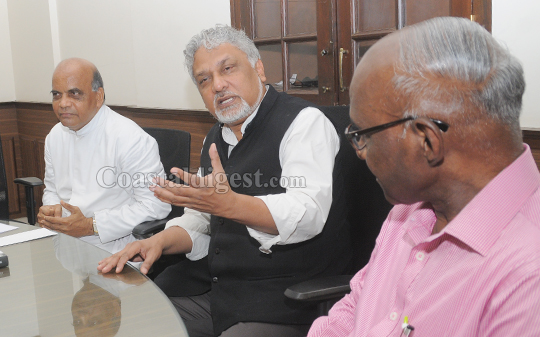
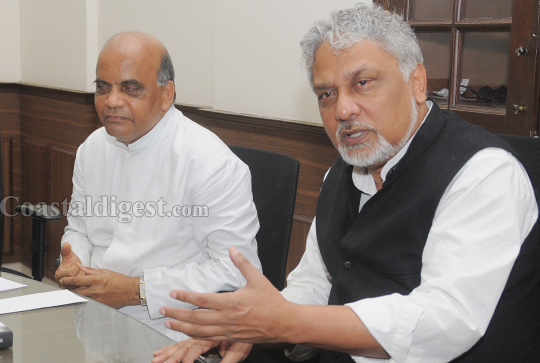
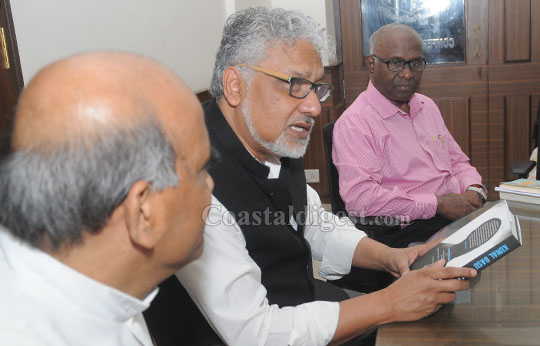
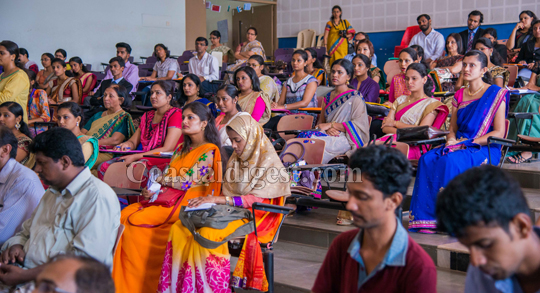
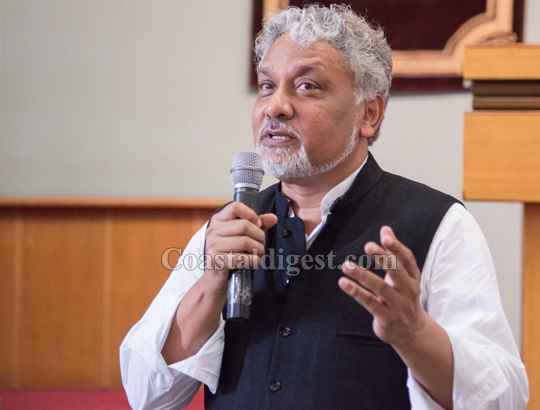
Mangaluru, Feb 24: “Good stories are a product of daydreaming and to be a good writer one needs to continuously feed the daydreaming mind,” said internationally acclaimed author Dr Kunal Basu. He was addressing the delegates of National Seminar on Dislocation, Identities, Multiculturism and the Diaspora' organized by the Post Graduate Department of English, St Aloysius College in association with Pan Macmillan India publishing house.
farmers 1

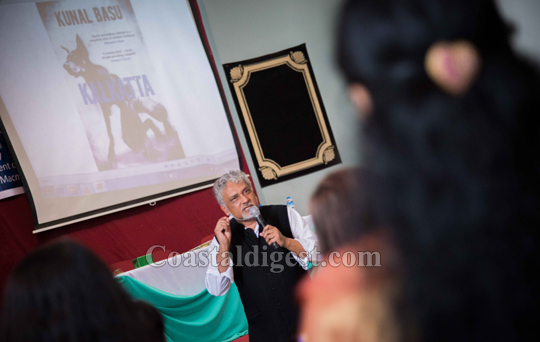
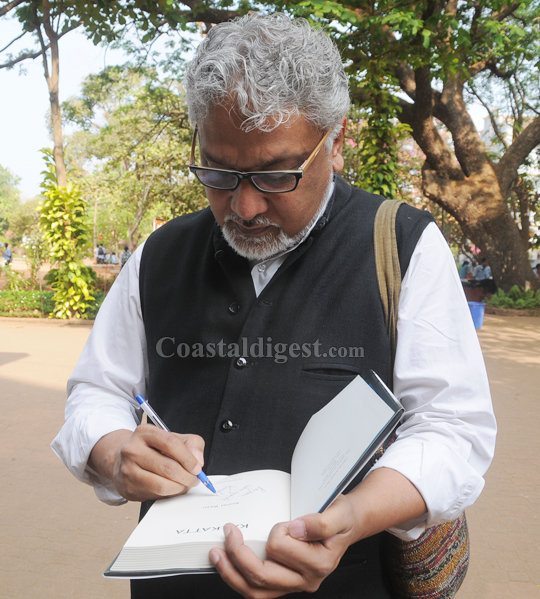
Speaking on the creative process involved in writing, the author of five critically acclaimed novels including the recently released bestseller Kalkatta' said writing has no formula or standardized tool kit.

“Writing is a discipline developed on one's own. So I cannot tell you how to write, only how I write,” he said, “For me writing comprises three things – Impulse, Method and Appraisal. In order to generate fodder for my imagination, I expose myself to unfamiliar experiences in a planned manner. The excitement and curiosity create stories in mind, which I then put on paper.”

In exposing oneself of unfamiliar experiences, it important that one is not judgmental, he added. “I try to be more accepting of the world around me and the research in turn fertilizes my imagination.”

Besides being an author, Dr. Kunal Basu is a management educator presently serving as University Reader in Marketing at Saïd Business School, University of Oxford and a fellow of Green-Templeton College.

Earlier in his welcome address, Dr. Lourdusamy Arputhem, the chairman of the Post Graduate Department of English, said, “As teachers, we should know the undercurrents and nuances of the author, which may not be known to the lay reader.”

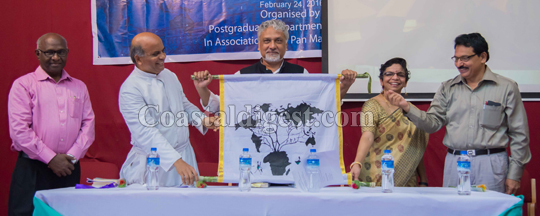
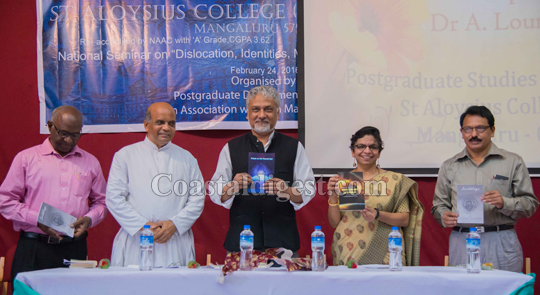
Dr Kunal Basu also released Scribblings', an anthology of poems written by the department students.

Fr Swebert D'Silva, Principal of the college presided over the inauguration ceremony of the seminar. Dr AM Narahari, Registrar of the college and a seminar resource person Dr Padma Baliga, Associate Professor of English, St Joseph's Autonomous College, Bangalore officiated on stage during the inauguration.

Another resource person Dr Rajalakshmi NK, Associate Professor of English, University College, Mangaluru and Vasant Kamat, Head of Product at Pan Macmillan India were present on the occasion. Dr Melisa Goveas proposed vote of thanks.

farmers 7

farmers 2

farmers 4

farmers 5

farmers 6

farmers 8

farmers 9

aloysiusBook 1

aloysiusBook 2

aloysiusBook 3

aloysiusBook 4

aloysiusBook 5

Comments

Honest
 - 
Thursday, 25 Feb 2016

Dear Writers,
Please read the QURAN atleast once in your life time. There are many helpful thoughts to you and the society which U and the society can benefits.

Add new comment

  • Coastaldigest.com reserves the right to delete or block any comments.
  • Coastaldigset.com is not responsible for its readers’ comments.
  • Comments that are abusive, incendiary or irrelevant are strictly prohibited.
  • Please use a genuine email ID and provide your name to avoid reject.
News Network
July 14,2020

Kasaragod, Jul 14: Kerala State Excise department officials confiscated hawala money to the tune of Rs 2.85 crore from a person hailing from Mangaluru.

According to sources, the officials of the Kumbala Range Excise had noticed the huge baggage containing hundreds of bundles of unaccounted currencies when they intercepted a vehicle at the border check-post at Thoominad in Manjeshwar early on Tuesday morning.

The accused Shamsudheen, who was trying to transport the illegal money into Kerala has been arrested and handed over to the Manjeshwar police authorities for further action, sources added.

Comments

Add new comment

  • Coastaldigest.com reserves the right to delete or block any comments.
  • Coastaldigset.com is not responsible for its readers’ comments.
  • Comments that are abusive, incendiary or irrelevant are strictly prohibited.
  • Please use a genuine email ID and provide your name to avoid reject.
News Network
March 24,2020

Bangalore , Mar 24: Bizom, India's leading retail intelligence platform, announced free subscription of its retailer app and tele-ordering solutions for consumer businesses in India and other emerging economies. Both solutions enable retailers to send their orders directly to the brand.
In COVID-19 times of social distancing and prophylactic measures, brands are conscious about the safety of their salespersons. Also, retailers don't want travelling salespeople to enter their premises. Consequently, many retail stores are facing stockout situations of fast-moving product categories. Bizom's self-ordering solutions help brands to avoid stockouts of their products.
Bizom trends, which analyses consumption and demand for consumer brands, showed how a near-complete shutdown during the Janta Curfew followed panic buying in early March. The asymmetrical demand and a lack of salespeople for order-taking are driving the industry towards social-distancing-based store-stocking mechanisms.
Bizom provides social-distancing-based store-stocking solutions for consumer businesses. They include the Bizom Retailer App and the Bizom Tele-ordering.
The Bizom Retailer App enables self-ordering for a brand's key retail outlets and can be implemented in under two weeks. The mobile app, a B2B shopping app, is a simple installation for retailers. It lists and groups the brand's products as per its product categories. The app's interface is no different from that of leading e-commerce apps. All the user has to do is select the preferred SKUs and add them to their shopping carts.
The app also allows brands to customize the app to meet the requirements of their continually changing product categories. For instance, if an SKU runs out of stock, the brand can disable the given SKU from the app.
With the Bizom Retailer App, brands can take orders directly from retailers instead of the traditional order-taking approach, which requires high-touch from a salesperson. Some of the key features of the app are, the ability to provide product information directly through retailers including SKUs, competitor comparison and pricing.
It also enables self-ordering from the retailer to maintain the flow of products as per demand, enables scheme rollout information through a notification on the app rather than through salespeople, tracks delivery of goods to the retailer and enables incentive payments to retailers directly rather than through distributor claims.
With Bizom Tele-ordering, as the sales teams go remote, the tele-ordering solution will become useful for brands who want to get salespeople to take orders from retailers, remotely. It ensures continued service to outlets despite not being physically present in the market.
Here, salespeople can discuss product requirements with retailers and enter orders based on specific outlet types (grocery, chemist etc.), outlet class (Class A, Class B etc.) or based on their beat or as per a distributor.
The key features of the Bizom Tele-ordering solution are, its ability to help salespeople collect orders from retailers remotely and enter it for fulfilment into Bizom using a tool, the flexibility offered to salespeople for remote servicing of retailers as per outlet type, beat, distributor area etc., secondary schemes get applied automatically, variable discounts will get applied as applicable at an SKU level.
"At Bizom, we are conscious of our responsibility to help brands run faster during these COVID-19 times. Our solutions of Bizom Retailer App and Bizom Tele-ordering have been built to ensure that brands can leverage this situation of low direct touch with retailers to enable a better way of working, remotely. I am trying to help brands go live in a few days so that they, in turn, can serve consumers better during these testing times," said Lalit Bhise, CEO, Bizom.

Comments

Add new comment

  • Coastaldigest.com reserves the right to delete or block any comments.
  • Coastaldigset.com is not responsible for its readers’ comments.
  • Comments that are abusive, incendiary or irrelevant are strictly prohibited.
  • Please use a genuine email ID and provide your name to avoid reject.
News Network
March 8,2020

Bengaluru, Mar 8: The economic slowdown in the country had a cascading effect on Karnataka, as its growth rate for outgoing fiscal 2019-20 is projected to be 6.8 per cent against 7.8 per cent in the last fiscal (2018-19), a senior official said on Saturday.

"The Gross State Domestic Product (GSDP) is estimated to be 1 per cent less at 6.8 per cent for this fiscal from 7.8 per cent in the last fiscal due to slowdown in manufacturing (industry) and services sectors," an official of the state finance department told media.

Though the agriculture sector has revived from 1.6 per dent in the drought-hit last fiscal (2018-19) to register 3.9 per cent this fiscal, growth rates of industries and services will be 4.8 per cent and 7.9 per cent for 2019-20 against 5.6 per cent and 9.8 per cent respectively in 2018-19.

"The GSDP is projected to grow at 6.3 per cent in the ensuing fiscal of 2020-21 due to continued slowdown in the national economy," the official hinted.

According to the state's economic survey for 2019-20, the farm sector grew more than double to 3.9 per cent from 1.6 per cent a year ago due to increase in the production of foodgrains, dairy products and fish catch.

Foodgrain production across the state rose to 136 lakh tonnes from 128 lakh tonnes a year ago, the survey revealed.

"In line with the national Gross Domestic Product (GDP) growth rate decline, Karnataka's GSDP has declined from a high of 13.3 per cent in 2016-17 to a low of 6.8 per cent in 2019-20.

"The GSDP has declined from a double-digit growth of 10.8 per cent in 2017-18 to 7.8 per cent in 2018-19 and 6.8 per cent in 2019-20," the survey pointed out.

The survey has adopted the all-India growth rate for the services sector growth in the state, which reflects the impact of slowdown in the key sector.

At current prices, the southern state's GSDP is expected to be Rs 16,99,115 crore (budget estimates) with a 10 per cent growth rate in the next fiscal (2020-21).

"Real estate, professional services and ownership of dwellings contributed 35.31 per cent to the GSDP in 2019-20, followed by manufacturing with 15.32 per cent, trade and repair services 9.51 per cent and crops 7.44 per cent," said the survey findings.

Per capital income in the state at current prices is estimated to be Rs 2,31,246 in 2019-20, an increase of 8.8 per cent from Rs 2,12,477 in 2018-19.

"The per capita income in the state is 58.4 per cent more than that of all-India rate at Rs 1,35,050 in this fiscal," the survey added.

Comments

Add new comment

  • Coastaldigest.com reserves the right to delete or block any comments.
  • Coastaldigset.com is not responsible for its readers’ comments.
  • Comments that are abusive, incendiary or irrelevant are strictly prohibited.
  • Please use a genuine email ID and provide your name to avoid reject.