Fertilize your imagination with research, Kunal Basu tells aspiring writers

[email protected] (CD Network)
February 24, 2016

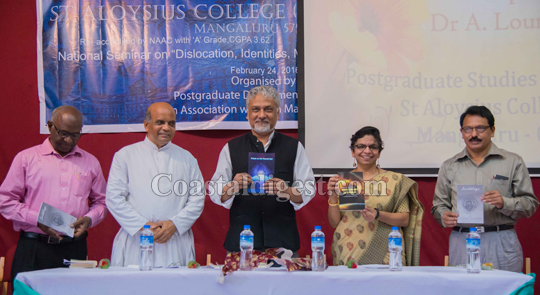
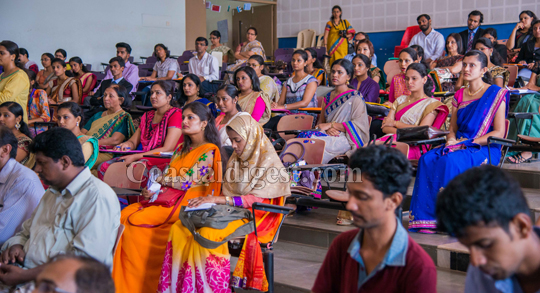
Mangaluru, Feb 24: “Good stories are a product of daydreaming and to be a good writer one needs to continuously feed the daydreaming mind,” said internationally acclaimed author Dr Kunal Basu. He was addressing the delegates of National Seminar on Dislocation, Identities, Multiculturism and the Diaspora' organized by the Post Graduate Department of English, St Aloysius College in association with Pan Macmillan India publishing house.
farmers 1

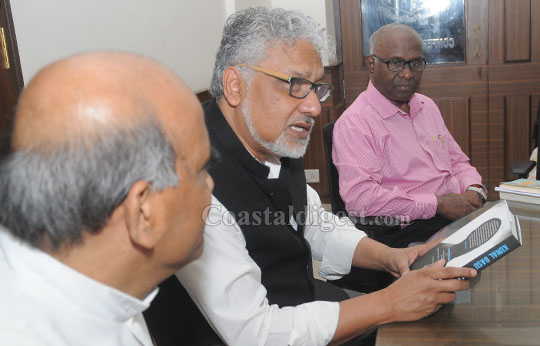
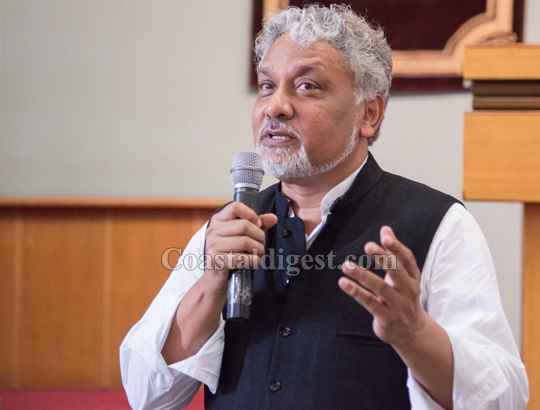
Speaking on the creative process involved in writing, the author of five critically acclaimed novels including the recently released bestseller Kalkatta' said writing has no formula or standardized tool kit.

“Writing is a discipline developed on one's own. So I cannot tell you how to write, only how I write,” he said, “For me writing comprises three things – Impulse, Method and Appraisal. In order to generate fodder for my imagination, I expose myself to unfamiliar experiences in a planned manner. The excitement and curiosity create stories in mind, which I then put on paper.”

In exposing oneself of unfamiliar experiences, it important that one is not judgmental, he added. “I try to be more accepting of the world around me and the research in turn fertilizes my imagination.”

Besides being an author, Dr. Kunal Basu is a management educator presently serving as University Reader in Marketing at Saïd Business School, University of Oxford and a fellow of Green-Templeton College.

Earlier in his welcome address, Dr. Lourdusamy Arputhem, the chairman of the Post Graduate Department of English, said, “As teachers, we should know the undercurrents and nuances of the author, which may not be known to the lay reader.”

Dr Kunal Basu also released Scribblings', an anthology of poems written by the department students.

Fr Swebert D'Silva, Principal of the college presided over the inauguration ceremony of the seminar. Dr AM Narahari, Registrar of the college and a seminar resource person Dr Padma Baliga, Associate Professor of English, St Joseph's Autonomous College, Bangalore officiated on stage during the inauguration.

Another resource person Dr Rajalakshmi NK, Associate Professor of English, University College, Mangaluru and Vasant Kamat, Head of Product at Pan Macmillan India were present on the occasion. Dr Melisa Goveas proposed vote of thanks.

farmers 7

farmers 2

farmers 4

farmers 5

farmers 6

farmers 8

farmers 9

aloysiusBook 1

aloysiusBook 2

aloysiusBook 3

aloysiusBook 4

aloysiusBook 5

Comments

Honest
 - 
Thursday, 25 Feb 2016

Dear Writers,
Please read the QURAN atleast once in your life time. There are many helpful thoughts to you and the society which U and the society can benefits.

Add new comment

  • Coastaldigest.com reserves the right to delete or block any comments.
  • Coastaldigset.com is not responsible for its readers’ comments.
  • Comments that are abusive, incendiary or irrelevant are strictly prohibited.
  • Please use a genuine email ID and provide your name to avoid reject.
News Network
April 29,2020

New Delhi, Apr 29: WhatsApp on Tuesday said it will now allow up to eight people to connect on a group video call as an increasing number of people turn to digital platforms to connect with friends and family amid the COVID-19 pandemic.

The Facebook-owned company said over the last month, people on average are spending over 15 billion minutes talking each day on WhatsApp calls, well above a typical day before the pandemic.

"...we see that people all over the world are turning to voice and video calling on WhatsApp more than ever before. Group calling has been particularly useful and our users have asked to connect with more people at once," WhatsApp said in a blogpost.

Starting Tuesday, the company is doubling the number of participants one can have on a WhatsApp video or voice call from 4 to 8 people at a time, it added.

WhatsApp emphasised that like written messages, all calls on its platform are protected with end-to-end encryption.

"We have built group calling in a way that makes it available for as many users as possible, including people on lower-end devices and slow network conditions," it added.

Also Read: Coronavirus India update: State-wise total number of confirmed cases, deaths

WhatsApp said that to access the new, higher participant limit on WhatsApp calls, all participants in a call need to update to the latest version of WhatsApp available on iPhone or Android.

Video calling tools like Google Meet, Microsoft Teams, Zoom and others have also seen a significant jump in userbase and traffic as people connect while maintaining social distancing amid the coronavirus outbreak.

Last week, Facebook had introduced Messenger Rooms that will soon hold up to 50 people with no time limit.

It had added that the company will also add ways to create rooms from Instagram Direct, WhatsApp and Portal.

Noting that between WhatsApp and Messenger, more than 700 million accounts participate in calls every day, Facebook had said, adding that video calling on Messenger and WhatsApp more than doubled in many countries.

Also, views of Facebook Live and Instagram Live videos have also increased significantly in March, it said.

Comments

Add new comment

  • Coastaldigest.com reserves the right to delete or block any comments.
  • Coastaldigset.com is not responsible for its readers’ comments.
  • Comments that are abusive, incendiary or irrelevant are strictly prohibited.
  • Please use a genuine email ID and provide your name to avoid reject.
News Network
March 30,2020

Bengaluru, Mar 30: The nationwide lockdown has left the state on the brink of a fresh agrarian crisis.

The lack of transport facilities spells doom for ready-to-harvest grapes worth Rs 500-600 crore in Bengaluru Rural, Chikkaballapur and Kolar districts. Unable to find buyers, several farmers have begun dumping their produce into compost pits.

On Sunday, Munishamappa, a farmer in Chikkaballapur, emptied four truckloads of grapes into the pit as buyers didn’t turn up due to the lockdown. “If the grapes wither and fall to the ground, it will affect the soil’s fertility and I will be forced to dispose of them,” he said.

Venkata Krishnappa, Munishamappa’s son, said their 1.5-acre vineyard yielded 25 tonnes of grapes. “Just before the lockdown, 10 tonnes were harvested and delivered to the market. Due to lack of transport, buyers haven’t turned up for the remaining 15 tonnes which we are dumping into the pit.”

For latest updates on coronavirus outbreak, click here

Anjaneya Reddy, a farmer leader, said that in Chikkaballapur alone, they have cultivated grapes on 2,000 acres. “Even if you consider 15 tonnes per acre as yield, there are about 30,000 tonnes ready to be harvested in the district. At a market rate of Rs 50 to Rs 60 per kilogram, the net worth will be Rs 200 crore to Rs 300 crore. And if you consider the crop in Kolar and Bengaluru Rural, grapes worth Rs 500 to Rs 600 crore are at stake,” he explained.

The ‘Dilkush’ grapes is the most preferred variety of domestic consumption, according to the farmers.

This apart, farmers would have invested about Rs 3 lakh to 4 lakh per acre on fertilisers, pesticide and labour. “With markets being shut and no of the transport facilities available, farmers are forced to dump their produce into pits. It is high time the government intervened and provided us with market options so that farmers can sell at an affordable price of Rs 30 to 40,” Reddy said.

Somu, a farmer in Ganjam village of Srirangapattana, dumped two tonnes of chikku (sapota) citing market shutdown in Mandya. Reddy appealed to the government to emulate the Maharashtra model where the government is helping farmers market fruits through Hopcoms or dairy units as nutrient supplements to people.

Comments

Add new comment

  • Coastaldigest.com reserves the right to delete or block any comments.
  • Coastaldigset.com is not responsible for its readers’ comments.
  • Comments that are abusive, incendiary or irrelevant are strictly prohibited.
  • Please use a genuine email ID and provide your name to avoid reject.
News Network
March 29,2020

Bengaluru, Mar 29: Escoms have been directed neither to penalise its customers nor go for disconnection if one fails to pay the bill. The relief is applicable till June. However, the entire bill will have to be paid at the end of three months.

The revised power tariff, which was to be announced on April 1, has also been deferred.

A similar three-month relief has been given on rentals for APMC and BBMP shops.

Comments

Add new comment

  • Coastaldigest.com reserves the right to delete or block any comments.
  • Coastaldigset.com is not responsible for its readers’ comments.
  • Comments that are abusive, incendiary or irrelevant are strictly prohibited.
  • Please use a genuine email ID and provide your name to avoid reject.