


Fidel Castro, who defied 10 US presidents in his 50 year rule, dies aged 90

November 26, 2016

Havana, Nov 26: Former President Fidel Castro, who led a rebel army to improbable victory in Cuba, embraced Soviet-style communism and defied the power of 10 US presidents during his half century rule, has died at age 90.
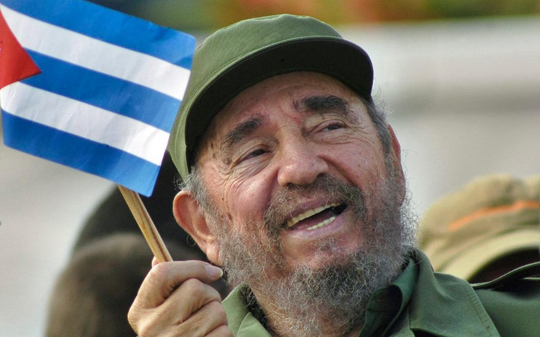
fc

With a shaking voice, his younger brother, Raul Castro, announced on state television that his brother died at 10:29 p.m. on Friday night.

Castro's reign over the island-nation 90 miles from Florida was marked by the US-backed Bay of Pigs invasion in 1961 and the Cuban Missile Crisis a year later that brought the world to the brink of nuclear war.

The bearded revolutionary, who survived a crippling US trade embargo as well as dozens, possibly hundreds, of assassination plots, died eight years after ill health forced him to formally hand power over to Raul.

Castro overcame imprisonment at the hands of dictator Fulgencio Batista, exile in Mexico and a disastrous start to his rebellion before triumphantly riding into Havana in January 1959 to become, at age 32, the youngest leader in Latin America. For decades, he served as an inspiration and source of support to revolutionaries from Latin America to Africa.

His commitment to socialism was unwavering, though his power finally began to fade in mid-2006 when a gastrointestinal ailment forced him to hand over the presidency to Raul in 2008, provisionally at first and then permanently.

His defiant image lingered long after he gave up his trademark Cohiba cigars for health reasons and his tall frame grew stooped. "Socialism or death" remained Castro's rallying cry even as Western-style democracy swept the globe and other communist regimes in China and Vietnam embraced capitalism, leaving this island of 11 million people an economically crippled Marxist curiosity.

He survived long enough to see Raul Castro negotiate an opening with US President Barack Obama on December 17, 2014, when Washington and Havana announced they would move to restore diplomatic ties for the first time since they were severed in 1961.

He cautiously blessed the historic deal with his lifelong enemy in a letter published after a month-long silence. "It's a tragedy," said Dayan Montalvo, a 22-year-old nurse. "We all grew up with him. I feel really hurt by the news that we just heard."

Fidel Castro Ruz was born August 13, 1926, in eastern Cuba's sugar country, where his Spanish immigrant father worked first recruiting labor for US sugar companies and later built up a prosperous plantation of his own.

Castro attended Jesuit schools, then the University of Havana, where he received law and social science degrees. His life as a rebel began in 1953 with a reckless attack on the Moncada military barracks in the eastern city of Santiago. Most of his comrades were killed and Fidel and his brother Raul went to prison.

Castro cobbled revolutionary groups together into the new Cuban Communist Party, with him as first secretary. Labor unions lost the right to strike. The Catholic Church and other religious institutions were harassed. Neighborhood "revolutionary defence committees" kept an eye on everyone.

Castro exported revolution to Latin American countries in the 1960s, and dispatched Cuban troops to Africa to fight Western-backed regimes in the 1970s. Over the decades, he sent Cuban doctors abroad to tend to the poor, and gave sanctuary to fugitive Black Panther leaders from the US.

But the collapse of the Soviet bloc ended billions in preferential trade and subsidies for Cuba, sending its economy into a tailspin. Castro briefly experimented with an opening to foreign capitalists and limited private enterprise.

As the end of the Cold War eased global tensions, many Latin American and European countries re-established relations with Cuba. In January 1998, Pope John Paul II visited a nation that had been officially atheist until the early 1990s.

Aided by a tourism boom, the economy slowly recovered and Castro steadily reasserted government control, stifling much of the limited free enterprise tolerated during harder times.

As flamboyant as he was in public, Castro tried to lead a discreet private life. He and his first wife, Mirta Diaz Balart, had one son before divorcing in 1956. Then, for more than four decades, Castro had a relationship with Dalia Soto del Valle. They had five sons together and were said to have married quietly in 1980.

By the time Castro resigned 49 years after his triumphant arrival in Havana, he was the world's longest ruling head of government, aside from monarchs. In retirement, Castro voiced unwavering support as Raul slowly but deliberately enacted sweeping changes to the Marxist system he had built.

His longevity allowed the younger brother to consolidate control, perhaps lengthening the revolution well past both men's lives. In February 2013, Raul announced that he would retire as president in 2018 and named newly minted Vice President Miguel Diaz-Canel as his successor.

"I'll be 90 years old soon," Castro said at an April 2016 communist party congress where he made his most extensive public appearance in years. "Soon I'll be like all the others.

The time will come for all of us, but the ideas of the Cuban Communists will remain as proof that on this planet, if one works with fervor and dignity, they can produce the material and cultural goods that human beings need and that need to be fought for without ever giving up."

Comments

Congi Shan
 - 
Saturday, 26 Nov 2016

The whole nation suffered because of this man. Not different from dictators Saddam, Gaddafi & Kim Kong Un

Fawad
 - 
Saturday, 26 Nov 2016

CIA tried 500 times to kill him .....Americans are real terrorists

Fedrick
 - 
Saturday, 26 Nov 2016

Red salute to fidel castro and his revolution!

karthik
 - 
Saturday, 26 Nov 2016

Indians can expect the biggest party in the world issuing membership to the expired revolutionary.

Kavya
 - 
Saturday, 26 Nov 2016

Real communism was followed by Karl Marx who envisaged an egalitarian society unlike the Ambanis and Mallyas of today.

Veerendra Hegde
 - 
Saturday, 26 Nov 2016

He kept an enviable and long record as the only leader who ruled a state for more than 50 years! He fought the mighty US and was recognised as one of the tall leaders in the world, with his demise, it is the end of an era! RIP comrade!

Jayaraj
 - 
Saturday, 26 Nov 2016

it is the end of a long innings.. made colorful by his continued anti US stance...... his cigar and the beard made him a recognizable figure who it is said has survived many number of attempts on his life ....MAY HIS SOUL REST IN PEACE......

Add new comment

  • Coastaldigest.com reserves the right to delete or block any comments.
  • Coastaldigset.com is not responsible for its readers’ comments.
  • Comments that are abusive, incendiary or irrelevant are strictly prohibited.
  • Please use a genuine email ID and provide your name to avoid reject.
News Network
May 30,2020

Washington, May 30: President Donald Trump said Friday he would strip several of Hong Kong's special privileges with the United States and bar some Chinese students from US universities in anger over Beijing's bid to exert control in the financial hub.

In a day of concerted action, the United States and Britain also raised alarm at the UN Security Council over a controversial new security law for Hong Kong, angering Beijing which said the issue had no place at the world body.

In a White House appearance that Trump had teased for a day, the US president attacked China over its treatment of the former British colony, saying it was "diminishing the city's longstanding and proud status."

"This is a tragedy for the people of Hong Kong, the people of China and indeed the people of the world," Trump said.

Trump also said he was terminating the US relationship with the World Health Organization, which he has accused of pro-China bias in its management of the coronavirus crisis.

But Trump was light on specifics and notably avoided personal criticism of President Xi Jinping, with whom he has boasted of having a friendship even as the two powers feud over a rising range of issues.

"I am directing my administration to begin the process of eliminating policy that gives Hong Kong different and special treatment," Trump said.

"This will affect the full range of agreements, from our extradition treaty to our export controls on dual-use technologies and more, with few exceptions," he said.

Secretary of State Mike Pompeo on Wednesday informed Congress that the Trump administration would no longer consider Hong Kong to be separate under US law, but it was up to Trump to spell out the consequences.

China this week pressed ahead on a law that would ban subversion and other perceived offenses against its rule in Hong Kong, which was rocked by months of massive pro-democracy protests last year.

US restricts students

In one move that could have long-reaching consequences, Trump issued an order to ban graduate students from US universities who are connected to China's military.

"For years, the government of China has conducted elicit espionage to steal our industrial secrets, of which there are many," Trump said.

Hawkish Republicans have been clamoring to kick out Chinese students enrolled in sensitive fields. The FBI in February said it was investigating 1,000 cases of Chinese economic espionage and technological theft.

But any move to deter students is unwelcome for US universities, which rely increasingly on tuition from foreigners and have already been hit hard by the COVID-19 shutdown.

China has been the top source of foreign students to the United States for the past decade with nearly 370,000 Chinese at US universities, although Trump's order will not directly affect undergraduates.

Critics say Trump has been eager to fan outrage about China to deflect attention from his own handling of the coronavirus pandemic that has killed more than 100,000 people in the United States, the highest number of deaths of any country.

Chuck Schumer, the top Democrat in the Senate, called Trump's announcement "just pathetic."

Eliot Engel, a Democrat who heads the House Foreign Affairs Committee, noted that Trump treaded lightly on Hong Kong during last year's protests as he sought a trade deal with Xi.

"Now, the president wants to shift the blame for his failures onto China, so he's doing the right thing for the wrong reason," Engel said.

Trump's order could also trigger retaliation. China in March expelled US journalists after the Trump administration tightened visa rules for staff at Chinese state media.

Clash at UN

The United States and Britain earlier in the day urged China to reconsider the Hong Kong law during talks at the UN Security Council, where China wields a veto -- making any formal session, let alone action against Beijing, impossible.

The Western allies raised Hong Kong in an informal, closed-door videoconference where China cannot block the agenda.

They said China was violating an international commitment as the 1984 handover agreement with Britain, in which Beijing promised to maintain the financial hub's separate system until at least 2047, was registered with the United Nations.

"The United States is resolute, and calls upon all UN members states to join us in demanding that the PRC immediately reverse course and honor its international legal commitments to this institution and to the Hong Kong people," said US Ambassador Kelly Craft, referring to the People's Republic of China.  

China demanded that the United States and Britain "immediately stop interfering in Hong Kong affairs," saying the law did not fall under the Security Council's mandate.

"Any attempt to use Hong Kong to interfere in China's internal matters is doomed to fail," warned a statement from China's UN mission.

"There was no consensus, no formal discussion in the Security Council, and the US and the UK's move came to nothing," it said.

Comments

Add new comment

  • Coastaldigest.com reserves the right to delete or block any comments.
  • Coastaldigset.com is not responsible for its readers’ comments.
  • Comments that are abusive, incendiary or irrelevant are strictly prohibited.
  • Please use a genuine email ID and provide your name to avoid reject.
Agencies
January 21,2020

Fifty-six journalists were killed in 2019 and most of them died outside conflict zones, a United Nations spokesperson said.

The number dropped by nearly half from the year 2018, but perpetrators enjoyed almost total impunity, Xinhua news agency quoted Stephane Dujarric, spokesperson for UN Secretary-General Antonio Guterres, as saying on Monday citing Unesco figures.

The figure was published in the 'Unesco Observatory of Killed Journalists' on Monday.

In total, Unesco recorded 894 journalist killings in the decade from 2010 to 2019, an average of almost 90 per year. The number in 2019 was 99.

Journalists were murdered in all regions of the world, with Latin America and the Caribbean recording 22 killings, the highest number, followed by 15 in Asia-Pacific, and 10 in Arab States.

"The figures show that journalists not only suffer extreme risks when covering violent conflict, but that they are also targeted when reporting on local politics, corruption and crime - often in their hometowns," the Unesco said.

Almost two thirds (61 per cent) of the cases in 2019 occurred in countries not experiencing armed conflict, a notable spike in a wider trend in recent years, and a reversal of the situation of 2014, when this figure was one third.

More than 90 per cent of cases recorded in 2019 concerned local journalists, consistent with previous years, it added.

In response to these figures, Audrey Azoulay, the Director-General of Unesco, said: "Unesco remains deeply troubled by the hostility and violence directed at all too many journalists around the world.

"As long as this situation lasts, it will undermine democratic debate."

Comments

Add new comment

  • Coastaldigest.com reserves the right to delete or block any comments.
  • Coastaldigset.com is not responsible for its readers’ comments.
  • Comments that are abusive, incendiary or irrelevant are strictly prohibited.
  • Please use a genuine email ID and provide your name to avoid reject.
News Network
July 25,2020

Madrid, Jul 25: Spain is witnessing a new surge in virus" coronavirus infections with nearly a thousand cases daily, a month after lifting the pandemic lockdown.

The country is reinstating both voluntary guidelines and mandatory restrictions that it had lifted on June 21, The Washington Post reported.

Spain on Wednesday reported over 224 outbreaks and 2,622 virus" coronavirus cases. According to a report in Washington Post, the new surge is attributed primarily to seasonal farmworkers, people attending family get-togethers and nightclub partyers.

On Thursday, the health ministry reported an additional 971 cases.

"The majority are related to fruit collection and also to the spaces where measures to avoid contact are relaxed," Spain Health Minister Salvador Illa told parliament. "We have to call on citizens to not lose respect for the virus not to be afraid of it, but not to lose respect for it either."

The government of Spain lifted all restrictions put in place to combat virus" coronavirus on June 21 and declared 'a new normal'. 

The virus" coronavirus pandemic till then had killed 24,000 people and infected more than 2,70,166.

Countries around the world are witnessing the second surge of virus" coronavirus. The resurgence could threaten the economic bounce Spain was hoping to get from vacationers eager for summer fun.

The surge in cases has been greatest in the northeastern region of Catalonia with more than 7,953 new confirmed cases since July 10.

Spain's National Epidemiological Survey has predicted that the rate of increase more than doubled in the past three weeks.

Meanwhile, the Catalan government reverted to pre-June 21 confinement rules in Barcelona and a dozen other municipalities in the metropolitan area, as well as in Figueras, Vilafant, La Noguera and Lleida.

Authorities have ordered bars and restaurants to limit indoor occupancy to 50 per cent, reduced sports to fewer than 10 people, closed night clubs and gyms and blocked some cultural activities.

The epidemiologist in charge of the region's biggest hospital warned in an interview last week with the Spanish daily El Pais that the situation in the agricultural hub of Lleida, located about 100 miles west of Barcelona, "had clearly gotten out of hand."

"Nobody foresaw that there would be a number of people coming from abroad to pick fruit in unfavourable conditions and that they might be infected," said epidemiologist Magda Campins of Vall d'Hebron in Barcelona. "And when the infections began to be detected, it was hard to keep tabs on the cases and their contacts because some of them, although they should have been in isolation, got away because they needed to earn money."

Catalonia's Department of Labour, Social Affairs and Family is using a hotel in Lleida to quarantine fruit workers who test positive for COVID-19 but are unable to isolate at home.

In the capital of Madrid, which was the epicentre during the pandemic's first wave in the spring, authorities reported 710 new cases in the past week. The use of face masks is widespread, but the region has shied away from making them mandatory in public.

Madrid's regional health secretary, Enrique Ruiz Escudero, defended that position while citing an uptick in infections in the under-40 age group. He told young people not to let down their guard.

"We can't take even one step backwards. Young people have to be aware of the responsibility they have," Ruiz Escudero said in a news conference Thursday. "I ask them to use the face mask and to maintain a safe distance."

Comments

Add new comment

  • Coastaldigest.com reserves the right to delete or block any comments.
  • Coastaldigset.com is not responsible for its readers’ comments.
  • Comments that are abusive, incendiary or irrelevant are strictly prohibited.
  • Please use a genuine email ID and provide your name to avoid reject.