


Finally CM breaks silence on Eid, condemns lynching of Muslim boy

Agencies
June 26, 2017

Chandigarh, Jun 26: Three days after 16-year old Muslim boy Junaid was lynched by a mob on board a moving train in Haryana, Chief Minister Manohar Lal Khattar broke silence on Monday finally condemning the incident. Khattar has been silent on the incident all these days even as he was active tweeting on various other issues, including congratulating his counterpart in Uttarakhand on completing 100-days in power.cm
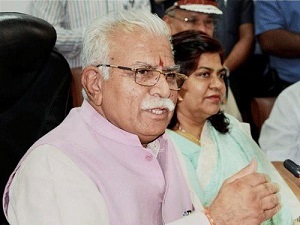
On Monday he said the state government has already provided financial assistance of Rs 10 lakh to the victim’s family. He said while the police have arrested one accused involved in the Junaid killing case, a search was on to nab the other accused.

Khattar said this on the sidelines of a meeting held under the chairmanship of the union minister of state for skill development and entrepreneurship Rajiv Pratap Rudy. Khattar urged people to maintain peace. According to reports, not a single BJP leader has visited the family of the accused.

Meanwhile, village Khandoa near Ballabhgarh in Haryana, the native place of Junaid, observed a Black Eid today in protest. In fact, almost all area in Muslim dominated Haryana, including Mewat and Alwar observed a 'Black Eid'. Eid prayers were a low-key affair. Muslims wore black bands in protest. Families are protesting being labelled as ‘slaughterers of cows’. In fact, early this month as a goodwill gesture over half a dozen Iftaar parties were held in Muslim dominated Mewat during Ramzan where cow milk was used to prepare dishes.

On Saturday, one person identified as Ramesh was arrested by the police in connection with the murder of Junaid. He confessed to beef bigotry and said he was in an inebriated state and was instigated by his friends to beat up the Muslim youth. The accused said he was not the one who made the beef slur at the Muslim youth. Instead, he said, ‘his friends did’.

Comments

Yaseen Baig
 - 
Tuesday, 27 Jun 2017

No visit by Government officials or politicians suggests the actions are state sponsored. Steadfastness and perseverance shall prevail

Add new comment

  • Coastaldigest.com reserves the right to delete or block any comments.
  • Coastaldigset.com is not responsible for its readers’ comments.
  • Comments that are abusive, incendiary or irrelevant are strictly prohibited.
  • Please use a genuine email ID and provide your name to avoid reject.
News Network
July 26,2020

Bengaluru, Jul 26: A year-long probe by Coffee Day Enterprises Ltd (CDEL) has found that its late founder V G Siddhartha routed Rs 2,693 crore out of the company to Mysore Amalgamated Coffee Estates Ltd (MACEL), another privately-owned entity of him.

The MACEL owes Rs 3,535 crore to subsidiaries of Coffee Day Enterprises as of July 31, 2019 of which only Rs 842 crore was accounted.

"Therefore, a sum of Rs 2,693 crore is the incremental outstanding that needs to be addressed," said the report of an investigation headed by Ashok Kumar Malhotra, a retired DIG of Central Bureau of Investigation (CBI) and assisted by law firm Agastya Agastya Legal.

Siddhartha was found dead in early August 2019, and many suspected that he had committed suicide.

Steps are being taken by subsidiaries of CDEL for recovery of dues from MACEL, the company said.

"The board authorised the Chairman to appoint an ex-judge of the Supreme Court or the High Court, or any other person of eminence, to suggest and oversee actions for recovery of the dues from MACEL and to help on any other associated matters," it said in regulatory filings at stock exchanges late on Friday.

The probe further gives clean chits to the Income Tax Department and the private equity firms who Siddhartha in his parting letter had alleged of harassment.

"We have not been provided with any documentary evidence to draw an inference that there may have been any advertent or inadvertent harassment from the Income Tax Department," said the probe report.

The probe also highlighted severe liquidity crunch at CDEL in the build-up to Siddhartha's death.

A committee supported by senior professionals was formed to protect the interest of all stakeholders. CDEL said the debt levels which were about Rs 7,200 crore on March 31, 2019 have been brought down significantly by Rs 4,000 crore. The present debt of the group is around Rs 3,200 crore.

"The disinvestment process in the group continues and we are confident to have effective solution to all stakeholders," it said.

Comments

Add new comment

  • Coastaldigest.com reserves the right to delete or block any comments.
  • Coastaldigset.com is not responsible for its readers’ comments.
  • Comments that are abusive, incendiary or irrelevant are strictly prohibited.
  • Please use a genuine email ID and provide your name to avoid reject.
News Network
February 26,2020

Feb 26: The Tamil Nadu government on Tuesday claimed that it prevented Karnataka from discussing the contentious Mekedatu reservoir issue at the Cauvery Water Management Authority (CWMA) meeting held in New Delhi.

Besides the representatives of Tamil Nadu and Karnataka at the fifth meeting of CWMA, presided over by Central Water Commission Chairman R K Jain, officials of Kerala and Puducherry also participated.

CWMA member and TN PWD Secretary K Manivasan told reporters after the meeting that the state government prevented Karnataka from discussing the dam issue by pointing out the pending petitions in the Supreme Court against the project filed by the E Palaniswami government.

"We have told participants of the meeting that Mekedatu reservoir will be against the interests of Tamil Nadu and its farmers. Our consistent stand is that it should not be built at any cost. Finally the issue was not discussed in the meeting," Manivasan said.

The Mekedatu reservoir is proposed to be constructed by Karnataka across Cauvery river near Mekedatu, about 110 km from Bengaluru, in Kanakapura taluk.

It was first proposed along with Shivanasamudra hydro power project at Shimsa in 2003 with an intention to use the water for a hydro power station and supply drinking water to Bengaluru city. It was designed to store 67 tmc feet of water.

While Tamil Nadu is claiming that the construction of a balancing reservoir will disturb Cauvery water flow to the state affecting irrigation, Karnataka says the project is basically designed to take care of the drinking water needs of Bengaluru after releasing water to Tamil Nadu as per the quantum specified by the Cauvery water disputes tribunal.

Comments

Add new comment

  • Coastaldigest.com reserves the right to delete or block any comments.
  • Coastaldigset.com is not responsible for its readers’ comments.
  • Comments that are abusive, incendiary or irrelevant are strictly prohibited.
  • Please use a genuine email ID and provide your name to avoid reject.
News Network
February 23,2020

The euphoria over the claim that around 3,000 tonnes of gold reserves, worth Rs 12 trillion, have been discovered in Uttar Pradesh’s Sonbhadra district could not last even 24 hours, with the Geological Survey of India (GSI) clarifying on Saturday there had been no such discovery.

The GSI, headquartered in Kolkata, rebutted the claims of the Uttar Pradesh Directorate of Geology and Mining (UPDGM), and said “miscommunication” must have led to the wrong reporting of facts.

M Sridhar, director general of the GSI, said nobody in the agency gave any such data. He said 52,806 tonnes of gold ore was found in Sonbhadra district during the exploration work in 1998-2000. From this reserve, only 160 kg of gold can be extracted.

“There must have been some miscommunication of facts because of which the gold ore deposits have been overestimated. We have written a letter to Uttar Pradesh (UPDGM), stating the facts. The GSI has not estimated such kind of vast resource of gold deposits in Sonbhadra,” Sridhar said.

ALSO READ: 2,900-tonne gold mine found in Sonbhadra, 4 times that of India's reserves

The UPDGM had said on Friday that gold deposits were found in Son Pahadi and Hardi areas of the district. Sridhar said while gold ore was found in the area during the GSI’s exploration work in 1998-2000, it had told the state government about the discovery in November last year.

Under the new regulation, which came into effect from 2015, the GSI has to inform the state government when ore deposits are discovered. Earlier, no such action was mandatory. In its report, the GSI estimated that only 3.03 gm of gold can be extracted from a tonne of ore. It also clarified that even the extraction amount was tentative and could not be established for certain.

Moreover, Sridhar said the deposits were spread across only 0.5 sq km in forest land, which made the mining of ore economically unviable. “When there are several mines nearby, we can club it into a block and then it makes sense to mine the ore. But in this case, the deposits are too small to make it viable for any company to mine it,” he said. The GSI usually prioritises its exploration work based on the needs of the Centre. While strategic minerals like tin, cobalt, lithium, beryllium, germanium, gallium, indium, tantalum, niobium, selenium, and bismuth are atop the list in GSI exploration, gold is another commodity on its priority list.

According to the World Gold Council, India has reserves of 630 tonnes of gold.

Comments

Add new comment

  • Coastaldigest.com reserves the right to delete or block any comments.
  • Coastaldigset.com is not responsible for its readers’ comments.
  • Comments that are abusive, incendiary or irrelevant are strictly prohibited.
  • Please use a genuine email ID and provide your name to avoid reject.