Fishermen offer Samudra puja' in Mangalore

[email protected] (CD Network, Photos by Suresh)
August 11, 2014

SAMUDRA POOJA 10 1

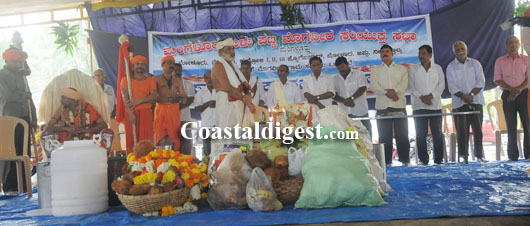
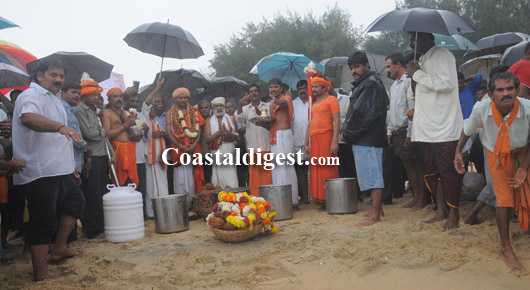
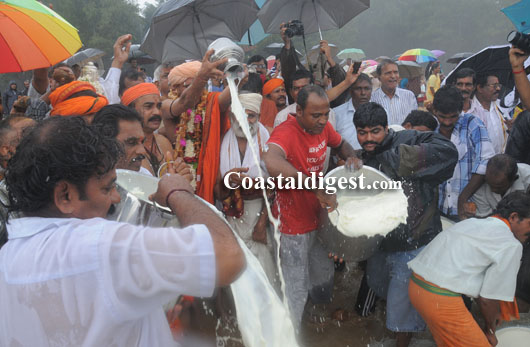
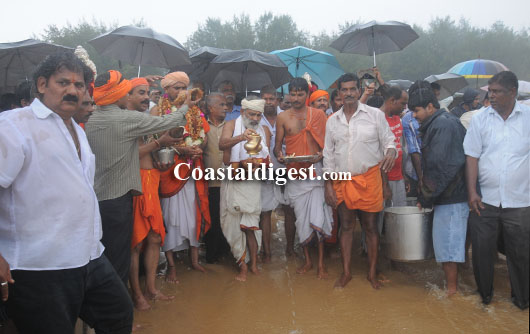
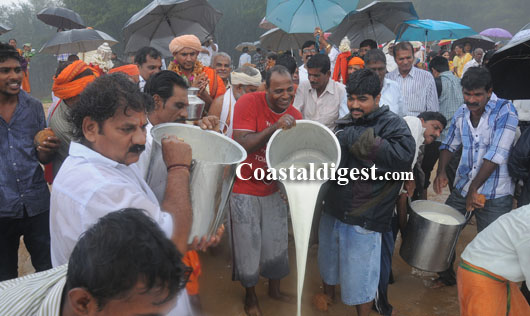
Mangalore, Aug 11: The fishermen of Mangalore offered Samudra Pooja (sea worship) by offering milk to at Thannirbhavi in Mangalore on Sunday.

The puja is offered by fishermen before resuming fishing activities after the monsoon break.

Fishermen consider the day as auspicious as a large number of them offer prayers, to safeguard their family members from all evil spirit when they venture into sea for fishing for weeks together.

Mangalooru Yelu Patna Mogaveera Samyuktha Sabha comprising Boloor, Bokkapatna, Kudroli, Hoige Bazaar, Bolar, Jeppu, Neereshwalya and Padu Hoige Mogaveera grama sabhas.

The day began with a Shoba Yatre from Karnal Garden Sri Rama Bhajana Mandira. It passed via Bokkapattana Brahma Babbarya Banta Daivastana, Boloor Ashwatha Katte Nagabrahma Sthana, Boloor Grama Chavadi before arriving on the banks of river Gurpura.

After crossing the river in boats, the fishermen waiting on the other end of the river received them and took the seer in a colourful procession to the beach at Thannirbavi where prayers were offered amidst bhajans. The seer offered the pooja, first by offering milk, fruits, tender coconuts, flowers and other commodities.

Simultaneously, a large number of fishermen taking part in the rituals too threw coconuts to sea, which is also one of the rituals.

After offering pooja to the Sea, prayers were offered at a pendal set up for the purpose. The programme ended with distribution of prasadam.

Though heavy rain played a spoilsport, it did not deter fishermen from performing prayers and rituals.

Speaking after offering pooja, Suvarna Kadali Mutt Head Nareshnathaji wished for the better catch for fishermen during the season.

Fisherman R C Bolara said, “We need to ensure that fish populations do not decline. Fishermen should have a feeling of sacrednedss to the sea.”

“It is the sea alone that protects us during sudden unforseen crisis in the sea. When we are sailing, it is only sea that is visible. Hence, we offer prayers to Sea God to protect us during our venture in sea,” he said.

Prior to the pooja, various teams performed bhajans.

Mangalooru Yelu Patna Mogaveera Samyuktha Sabha President Madhava Salian, General Secretary Panduranga Suvarna, Vice President Diwakar Anchan, among others were present.
SAMUDRA POOJA 10 1

SAMUDRA POOJA 10 1

SAMUDRA POOJA 10 1

SAMUDRA POOJA 10 1

SAMUDRA POOJA 10 1

SAMUDRA POOJA 10 1

SAMUDRA POOJA 10 1

SAMUDRA POOJA 10 1

SAMUDRA POOJA 10 1

SAMUDRA POOJA 10 1

SAMUDRA POOJA 10 1

Comments

Kirsten Brunsgaard
 - 
Sunday, 6 Mar 2016

I feel thankful for the witnessing of this beautiful ceremony of giving thanks and honoring Mother Earth and Mother Sea - the mothers who give us food every day. It seems to me that these ceremonies of thanks-giving to the mothers and natural forces sustaining us on this common planet, is a beautiful fundament for peace making. The world is so hurt and weary by fights and wars because of a belief in a distant, invisible father somewhere in heaven, waiting to punish us all.
Blessed be the Mother Earth sustaining us and the fishermen in India remembering these traditions of old - long before any god was ever invented.

Kirsten Brunsgaard
 - 
Sunday, 6 Mar 2016

This is so beautiful.
A big yes to LIFE and a loving honoring of Mother Earth and Mother Sea, the mothers who provide food for all her children. We need to see more of these beautiful ceremonies of thanks-giving from all over the world. Honoring the natural life-forces as Mothers sustaining us on this planet seems to result in more peaceful living together here on Earth than the constant fights over a distant, invisible father in heaven going to punish us all one day.... With love and respect and gratitude to you fishing people carrying out these ancient traditions since any god was ever invented.

Add new comment

  • Coastaldigest.com reserves the right to delete or block any comments.
  • Coastaldigset.com is not responsible for its readers’ comments.
  • Comments that are abusive, incendiary or irrelevant are strictly prohibited.
  • Please use a genuine email ID and provide your name to avoid reject.
News Network
April 3,2020

Bengaluru, April 3: Karnataka Chief Minister BS Yediyurappa on Friday held a meeting with Muslim leaders and legislators, seeking their cooperation in containing COVID-19.

In a press statement, the Chief Minister BS Yediyurappa said that the Muslim leaders have agreed to give details of persons who visited Tablighi Markaz in Nijamuddin and has also assured that they will convince the attendees to undergo tests for coronavirus and also follow quarantine rules.

CM Yediyurappa also informed media that the Muslim leaders are also advising the members of their community to offer prayers at home and also to stay indoors to maintain social distancing during "azan".

Also, an appeal has been made to the Muslim community to cooperate with the health workers during the treatment.

The Karnataka Chief Minister also appealed the masses not to pay heed to any sort of rumours pertaning to COVID-19. "Let all of us strictly follow precautionary measures and win the battle over caronavirus."

Comments

Add new comment

  • Coastaldigest.com reserves the right to delete or block any comments.
  • Coastaldigset.com is not responsible for its readers’ comments.
  • Comments that are abusive, incendiary or irrelevant are strictly prohibited.
  • Please use a genuine email ID and provide your name to avoid reject.
coastaldigest.com news network
May 20,2020

Mangaluru/Udupi, May 20: Islamic scholars belonging to different schools of thoughts including two prominent Qadis have issued special guidelines asking all Muslims in the region to offer prayers and celebrate Eid al-Fitr at home this year in keeping with the extended covid-19 lockdown.

Eid al-Fitr which marks the end of the month-long dawn-to-sunset fasting of Ramadan is rather a ‘humanitarian event’ than a fiesta. This year Eid is likely to be observed in coastal Karnataka on May 23 or May 24 depending on sighting of the new moon.  

Amid the Covid-19 pandemic, the Muslims are preparing for — and reconciling itself to — a most unusual Eid bereft of all the usual trappings like huge prayer congregations, ceaseless shopping, social visits and the inviting warmth of an Eid Mubarak embrace.

In their separate messages, Udupi Qadi Bekal Ibrahim Musliyar and Mangaluru Qadi Twaqa Ahmed Musliyar have urged Muslims to refrain from all kinds of public gatherings during Eid. Noting that Muslims in the region have followed all the advisories in issued by the government to contain the spread of coronavirus in the blessed month of Ramadan, they have urged them to follow the guidelines during Eid too.

On social media groups, messages like “no new clothes, just wear your best clothes” are being circulated among family and friends, urging people to fill the festive void with the spirit of giving. The suggestions range from paying a needy child’s school fee or someone’s rent to helping a lockdown-hit trader revive his business.

Following guidelines are issued by the top clerics ahead Eid

1) There will be no Eid prayer in mosques or Eid-gahs. Hence, Muslims should offer Eid al-Fitr prayer in their homes with family members.

2) Distributing Zakat al-Fitr among needy is mandatory. However necessary safety measures should be taken while going out such as wearing masks and maintaining physical distance. As there is lockdown from 7 p.m. to 7 a.m. every day, Zakat al-Fitr can be distributed a day before Eid or on the day of Eid before evening. 

3) Women, children and elderly people should not step out of the houses.

4) Avoid visiting graveyards or other places.

5) All mosques are closed due to lockdown. Hence, observe Eid in a simple way and set an example for the society. 

6) Strictly follow all the guidelines issued by the state and central governments

Comments

Add new comment

  • Coastaldigest.com reserves the right to delete or block any comments.
  • Coastaldigset.com is not responsible for its readers’ comments.
  • Comments that are abusive, incendiary or irrelevant are strictly prohibited.
  • Please use a genuine email ID and provide your name to avoid reject.
Wafa Sultana
April 4,2020

Over the last couple of days when the world was occupied with unifying efforts to fight the deadly Covid19 pandemic, sections of Indian media provided viewers a familiar scapegoat – the Indian Muslims – who are often stereotyped as a community being constantly at loggerheads with the citizenry and the State. Biased media channels were quick to resort to blaming the entire Muslim community for the spread of the disease in the country, thanks to an ill-timed Tablighi Jamaat gathering at its international headquarters in Delhi’s Nizamuddin. Unsurprisingly, the opprobrium was also marked by a sudden spike in WhatsApp forwards of videos with people wearing skullcaps licking spoons and performing Sufi breathing rituals, suggesting some sort of wild conspiracy on the part of the community to spread the virus.  Some media channels were quick to formulate, hypothesize and provide loose definitions of a newly discovered form of Jihad i.e. ‘Corona Jihad ’ thereby vilifying the Islamic faith and its followers.

While the investigation on the culpability of the organizers of the Nizamuddin event is still ongoing, there is enough information to suggest that the meeting was held before any lockdown was in force, and the problem began when there was no way of getting people out once the curfew was announced. Be that as it may, there is little doubt that organizing a meet of such a scale when there is a global pandemic smacks of gross misjudgment, and definitely the organizers should be held accountable if laws or public orders were defied. Attendees who attempt to defy quarantine measures must be dealt with strictly. However, what is alarming is that the focus and narrative have now shifted from the unfortunate event at Nizamuddin to the Tablighi Jamaat itself.

For those not familiar with the Tablighi Jamaat, the organization was founded in 1926 in Mewat by scholar Maulana Mohammad Ilyas. The Jamaat’s main objective was to get Muslim youth to learn and practice pristine Islam shorn of external influences. This is achieved through individuals dedicating time for moral and spiritual upliftment secluded from the rest of the world for a brief period of time. There is no formal membership process. More senior and experienced participants typically travel from one mosque to other delivering talks on religious topics, inviting local youth to attend and then volunteer for a spiritual retreat for a fixed number of days to a mosque in a nearby town or village to present the message to their co-religionists. Contrary to ongoing Islamophobic rhetoric, the movement does not actively proselytize. The focus is rather on getting Muslims to learn the teachings and practices of Islam.  This grassroots India-based movement has now grown to almost all countries with substantial Muslim populations. Its annual meets, or ‘ijtemas’ are among the largest Islamic congregations in the world after the annual Haj. One of the reasons for its popularity and wide network in the subcontinent and wordwide is the fact that it has eschewed the need for scholarly intervention, focusing on peer learning of fundamental beliefs and practice rather than high-falutin ideological debates. The Tablighi Jamaat also distinguishes itself from other Islamic movements through its strictly apolitical nature, with a focus on individual self-improvement rather than political mobilization. Hardships and difficulty in the world are expected to be face through ‘sabr’ (patience) and ‘dua’ (supplication),  than through quest for political power or influence. In terms of ideology, it is very much based on mainstream Sunni Islamic principles derived from the Deobandi school.

So, why is all this background important in the current context? While biased media entities have expectedly brought out their Islamophobic paraphernalia out for full display, more neutral commentators have tried to paint the Tablighi Jamaat as a fringe group and have tried to distance it from 'mainstream Muslims'. While the intent is no doubt innocent, this is a trap we must not fall into. This narrative, unfortunately, is also gaining ground due to apathy some Muslims have for the group, accusing it of being “disconnected from the realities of the world”. Unlike other Muslim organizations and movements, the Tablighi Jamat, by virtue of its political indifference, does not boast of high-profile advocates and savvy spokespersons who can defend it in mainstream or social media.  The use of adjectives such as 'outdated' and 'orthodox' by liberal columnists to describe the Jamaat feeds into the malignant attempt to change the narrative from the control of the spread of the pandemic due to the Nizamuddin gathering to 'raison d'etre' of the organization itself.

A large mainstream religious group like the Tablighi Jamaat with nearly a hundred-year history, normally considered to be peaceful, apolitical and minding its own business is now suddenly being villainized owing to unfortunate circumstances. Biased media reactions filled with disgust and hate seem to feed the Indian public conscience with a danngerous misconception - to be a nominal Muslim is okay but being a practicing one is not.  For those committed to the truth and fighting the spread of Islamophobia, the temptation to throw the entire Tablighi Jamaat under the bus must be resisted.

The writer is a lawyer and research scholar at Qatar University. Her research interests include Islamic law and politics.

Comments

zahoorahmed
 - 
Saturday, 4 Apr 2020

great article! provides a great perspective on tableeg jamat

Add new comment

  • Coastaldigest.com reserves the right to delete or block any comments.
  • Coastaldigset.com is not responsible for its readers’ comments.
  • Comments that are abusive, incendiary or irrelevant are strictly prohibited.
  • Please use a genuine email ID and provide your name to avoid reject.