Fishermen offer Samudra puja' in Mangalore

[email protected] (CD Network, Photos by Suresh)
August 11, 2014

SAMUDRA POOJA 10 1

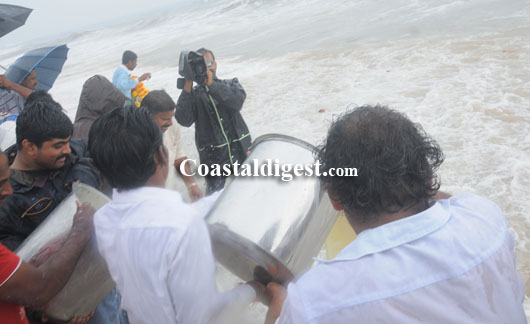
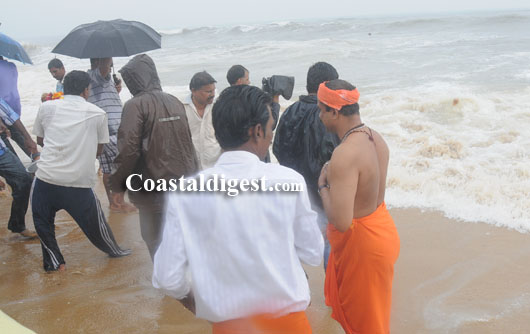
Mangalore, Aug 11: The fishermen of Mangalore offered Samudra Pooja (sea worship) by offering milk to at Thannirbhavi in Mangalore on Sunday.

The puja is offered by fishermen before resuming fishing activities after the monsoon break.

Fishermen consider the day as auspicious as a large number of them offer prayers, to safeguard their family members from all evil spirit when they venture into sea for fishing for weeks together.

Mangalooru Yelu Patna Mogaveera Samyuktha Sabha comprising Boloor, Bokkapatna, Kudroli, Hoige Bazaar, Bolar, Jeppu, Neereshwalya and Padu Hoige Mogaveera grama sabhas.

The day began with a Shoba Yatre from Karnal Garden Sri Rama Bhajana Mandira. It passed via Bokkapattana Brahma Babbarya Banta Daivastana, Boloor Ashwatha Katte Nagabrahma Sthana, Boloor Grama Chavadi before arriving on the banks of river Gurpura.

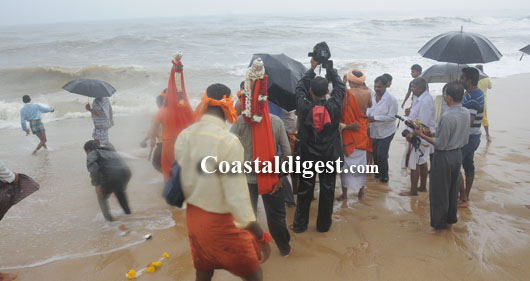
After crossing the river in boats, the fishermen waiting on the other end of the river received them and took the seer in a colourful procession to the beach at Thannirbavi where prayers were offered amidst bhajans. The seer offered the pooja, first by offering milk, fruits, tender coconuts, flowers and other commodities.

Simultaneously, a large number of fishermen taking part in the rituals too threw coconuts to sea, which is also one of the rituals.

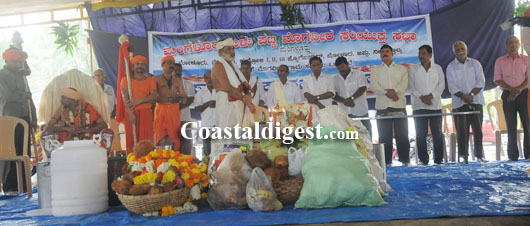
After offering pooja to the Sea, prayers were offered at a pendal set up for the purpose. The programme ended with distribution of prasadam.

Though heavy rain played a spoilsport, it did not deter fishermen from performing prayers and rituals.

Speaking after offering pooja, Suvarna Kadali Mutt Head Nareshnathaji wished for the better catch for fishermen during the season.

Fisherman R C Bolara said, “We need to ensure that fish populations do not decline. Fishermen should have a feeling of sacrednedss to the sea.”

“It is the sea alone that protects us during sudden unforseen crisis in the sea. When we are sailing, it is only sea that is visible. Hence, we offer prayers to Sea God to protect us during our venture in sea,” he said.

Prior to the pooja, various teams performed bhajans.

Mangalooru Yelu Patna Mogaveera Samyuktha Sabha President Madhava Salian, General Secretary Panduranga Suvarna, Vice President Diwakar Anchan, among others were present.


SAMUDRA POOJA 10 1

SAMUDRA POOJA 10 1

SAMUDRA POOJA 10 1

SAMUDRA POOJA 10 1

SAMUDRA POOJA 10 1

SAMUDRA POOJA 10 1

SAMUDRA POOJA 10 1

SAMUDRA POOJA 10 1

SAMUDRA POOJA 10 1

SAMUDRA POOJA 10 1

SAMUDRA POOJA 10 1

Comments

Kirsten Brunsgaard
 - 
Sunday, 6 Mar 2016

I feel thankful for the witnessing of this beautiful ceremony of giving thanks and honoring Mother Earth and Mother Sea - the mothers who give us food every day. It seems to me that these ceremonies of thanks-giving to the mothers and natural forces sustaining us on this common planet, is a beautiful fundament for peace making. The world is so hurt and weary by fights and wars because of a belief in a distant, invisible father somewhere in heaven, waiting to punish us all.
Blessed be the Mother Earth sustaining us and the fishermen in India remembering these traditions of old - long before any god was ever invented.

Kirsten Brunsgaard
 - 
Sunday, 6 Mar 2016

This is so beautiful.
A big yes to LIFE and a loving honoring of Mother Earth and Mother Sea, the mothers who provide food for all her children. We need to see more of these beautiful ceremonies of thanks-giving from all over the world. Honoring the natural life-forces as Mothers sustaining us on this planet seems to result in more peaceful living together here on Earth than the constant fights over a distant, invisible father in heaven going to punish us all one day.... With love and respect and gratitude to you fishing people carrying out these ancient traditions since any god was ever invented.

Add new comment

  • Coastaldigest.com reserves the right to delete or block any comments.
  • Coastaldigset.com is not responsible for its readers’ comments.
  • Comments that are abusive, incendiary or irrelevant are strictly prohibited.
  • Please use a genuine email ID and provide your name to avoid reject.
News Network
May 29,2020

Bengaluru, May 29: Seven out of ten (72 per cent) workers in Karnataka reported having lost their employment during the COVID-19-induced lockdown, according to findings of a survey by Azim Premji University, in collaboration with ten civil society organisations.

The university said in a statement it conducted "a detailed" phone survey of 5,000 workers across 12 states in the country, to gauge the impact of the COVID-19 lockdown on employment, livelihoods, and access to government relief schemes.

The survey covered self-employed, casual, and regular wage and salaried workers and it released the findings for Karnataka on Thursday.

Seventy-six per cent of urban workers and 66 per cent of rural workers lost their employment, the survey findings said.

For non-agricultural self-employed workers and wage workers, who were still employed, average weekly earnings fell by two-third.

More than four in ten salaried workers (44 per cent) saw either a reduction in their salary or received no salary during the lockdown.

Six out of ten households reported that they did not have enough money to buy even a weeks worth of essential items, according to the survey.

Eight out ten households reported a reduction in food intake, while less than three in ten vulnerable households (27 per cent) in urban Karnataka received any form of cash transfer from the government, it said.

In summary, the disruption in the Karnatakas economy and labour markets is enormous. Livelihoods have been devastated at unprecedented levels during the lockdown.

The recovery from this could be slow and very painful, the statement said.

As a response to the findings of this survey, the team which has conducted the survey suggested a universalisation of the PDS to expand its reach and implementation of expanded rations for at least the next six months.

It suggested cash transfers equal to at least Rs.7000 per month for two months, and proactive steps like expansion of MGNREGA, introduction of urban employment guarantee, and investment in universal basic services, among others.

Comments

Add new comment

  • Coastaldigest.com reserves the right to delete or block any comments.
  • Coastaldigset.com is not responsible for its readers’ comments.
  • Comments that are abusive, incendiary or irrelevant are strictly prohibited.
  • Please use a genuine email ID and provide your name to avoid reject.
coastaldigest.com news network
July 8,2020

Kasaragod, Jul 8: The meeting of Kasaragod district-level corona control core committee has resolved to make pass mandatory for vehicles to bring vegetables and fruits to Kasaragod from Dakshina Kannada and other parts of Karnataka.

Pass will be issued by RTO. Employees, including the driver of the vehicle, must visit the nearest primary health facility once in seven days and undergo a health check and submit a medical officer's certificate.

District Collector Dr D Sajith Babu, who presided over the meeting, said that only those vegetable and fruit vehicles that produce medical officer's certificate and RTO's passes will be allowed to cross the border.

Meeting, the RTO has decided to convene an emergency meeting of vegetable and fruit merchants.

Comments

Add new comment

  • Coastaldigest.com reserves the right to delete or block any comments.
  • Coastaldigset.com is not responsible for its readers’ comments.
  • Comments that are abusive, incendiary or irrelevant are strictly prohibited.
  • Please use a genuine email ID and provide your name to avoid reject.
Agencies
May 8,2020

Washington D.C., May 8: The prime time for brain development in a child's life is the first year, where the infant spends most of the time asleep. It is the time when neural connections form and sensory memories are encoded.

However, when sleep is disrupted, as occurs more often among children with autism, brain development may be affected, too.

New research led by the University of Washington finds that sleep problems in a baby's first 12 months may not only precede an autism diagnosis but also may be associated with altered growth trajectory in a key part of the brain, the hippocampus.

The study, which was published in the American Journal of Psychiatry, researchers report that in a sample of more than 400 taken of 6- to 12-month-old infants, those who were later diagnosed with autism were more likely to have had difficulty falling asleep.

It also states that this sleep difficulty was associated with altered growth trajectories in the hippocampus.

"The hippocampus is critical for learning and memory, and changes in the size of the hippocampus have been associated with poor sleep in adults and older children.

As many as 80 per cent of the children with autism spectrum disorder have sleep problems," said Annette Estes, director of the UW Autism Center and senior author of the study.

"In our clinical experience, parents have a lot of concerns about their children's sleep, and in our work on early autism intervention, we observed that sleep problems were holding children and families back," added Estes, who is also a UW professor of speech and hearing sciences.

"It could be that altered sleep is part-and-parcel of autism for some children. One clue is that behavioural interventions to improve sleep don't work for all children with autism, even when their parents are doing everything just right. This suggests that there may be a biological component to sleep problems for some children with autism," said Estes.

To consider links among sleep, brain development, and autism, researchers at the IBIS Network looked at MRI scans of 432 infants, surveyed parents about sleep patterns, and measured cognitive functioning using a standardized assessment.

At the outset of the study, infants were classified according to their risk for developing autism: Those who were at higher risk of developing autism -- about two-thirds of the study sample -- had an older sibling who had already been diagnosed.

Infant siblings of children with autism have a 20 per cent chance of developing autism spectrum disorder -- a much higher risk than children in the general population.

In the current study, 127 of the 432 infants were identified as "low risk" at the time the MRI scans were taken because they had no family history of autism.

They later evaluated all the participants at 24 months of age to determine whether they had developed autism. Of the roughly 300 children originally considered "high familial risk," 71 were diagnosed with autism spectrum disorder at that age.

Problems with sleep were more common among the infants later diagnosed with an autism spectrum disorder, as were larger hippocampi. No other subcortical brain structures were affected, including the amygdala, which is responsible for certain emotions and aspects of memory, or the thalamus, a signal transmitter from the spinal cord to the cerebral cortex.

The authors note that while parents reported more sleep difficulties among infants who developed autism compared to those who did not, the differences were very subtle and only observed when looking at group averages across hundreds of infants.

Sleep patterns in the first years of life change rapidly as infants transition from sleeping around the clock to a more adult-like sleep/wake cycle. Until further research is completed, Estes said, it is not possible to interpret challenges with sleep as an early sign of increased risk for autism.

Comments

Add new comment

  • Coastaldigest.com reserves the right to delete or block any comments.
  • Coastaldigset.com is not responsible for its readers’ comments.
  • Comments that are abusive, incendiary or irrelevant are strictly prohibited.
  • Please use a genuine email ID and provide your name to avoid reject.