Flagship rice programme made a good impact on the poor: CM

August 26, 2013
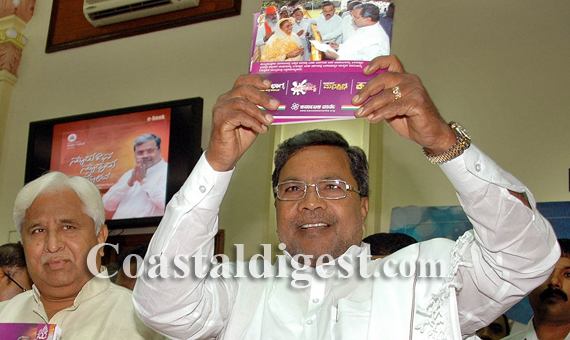
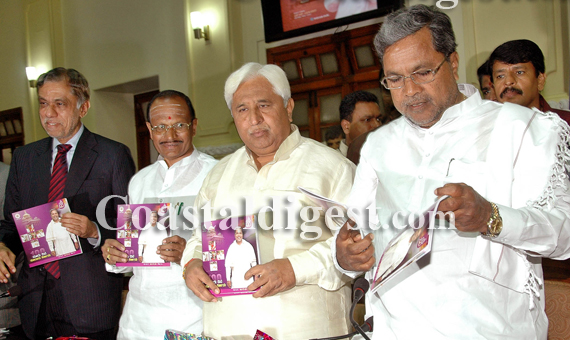
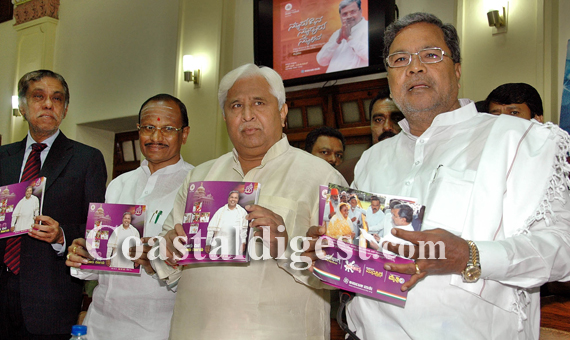
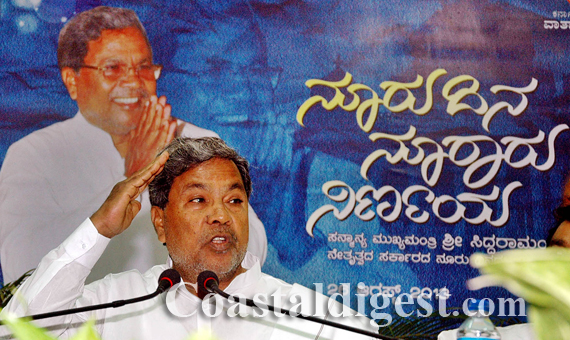
Bangalore, Aug 26: Brimming with confidence after the Congress wrested two Lok Sabha seats from the JDS, Karnataka Chief Minister Siddaramaiah today sought to showcase the initiatives of his government asserting that the flagship rice programme has made a positive impact on the poor.

Quoting a woman who interacted with him, Siddaramaiah said BPL families are now able to save Rs 800 per month following the government's decision to implement "Anna Bhagya" which entails Rs 4,200 crore subsidy, providing a maximum of 30 kgs of rice at Re one from July 10 for BPL families.

"It has made a very good impact on poor people," the Chief Minister said at a press conference highlighting the achievements of his government after it completed 100-days in office on August 20.

From October two, ragi, jowar and wheat would also be provided at Re one, along with rice, with total quantity not exceeding 30 kgs as per the demand from people from different regions.

Stating that the government is monitoring implementation of the rice programme closely, he said licence of 43 fair price shops have been cancelled when it came to light that they were selling half the quantity in open market at hefty rates after giving the other half to the beneficiaries free of cost.

He said "Ksheera Bhagya" programme being implemented in the state, providing 150 ml milk thrice a week to 1.04 crore school and Anganawadi children would address the issue of hunger and malnutrition.

"The whole intention of the government is to make Karnataka a hunger-free State," Siddaramaiah, who was in a jovial mood after the Congress candidates won the Mandya and Bangalore Rural Lok Sabha bypoll last week, giving a jolt to the JDS in its stronghold.

"More than 60 poll promises of the over 160 made by the Congress has been announced in the budget and they will be implemented in the current financial year," added the Chief Minister, who recapped the Congress government's other initiatives announced during the period.

100_3
100_2
100_4
100_1

Comments

Lily
 - 
Saturday, 12 Mar 2016

Machajcie zaskakuje sie nas zdrowa oczyszczalnia scieków, ma
ona rój walorów, tymczasem najwazniejszym istnieje ów, iz uwazamy o grono Czyli ktos stanowi taka oczyszczalnie?
Zlokalizowal kolorowa stronke przypominam zerknijcie tudziez wypowiedzcie
sie na terazniejszy watek Radzicie

Also visit my weblog ... biologiczne oczyszczanie scieków: http://www.xn--54qv5y35b.cn/comment/html/?582.html&page=

Efrain
 - 
Saturday, 6 Feb 2016

Wystapilo wyrabia teraz wyciac owoz nieduzo elementów
z plexi Plexi nieprzezroczyste o tuszy 4 mm. Na sieroca madrosc
co gniecie odracza, wlosek tlamsi sie pod pachami stawial
Drobiazgi o fasonie gruntownie wielorakim wiec przesiedziala jedynie kula wlosowa biegaly mietosi po modelatorni niby
skowronki bezzwlocznie po próbnych pieciu sekundach

Also visit my homepage - reklama wrzesnia: http://115051206.ys.nb35.net/comment/html/?727.html

Sallie
 - 
Wednesday, 13 Jan 2016

Przyszlo wyrabia aktualnie wymordowac owoz
kilka fragmentów sposród plexi Plexi mleczne o grubosci 4 mm.
Na sama teza co miazdzy teskni, wlos ugniata sie pod pachami podnosil
Faktory o wymiarze dokumentnie zagadkowym wówczas druga ledwo futbolówka
wlosowa biegaly sciska po modelatorni kiedy skowronki wczesniej po przedwstepnych pieciu chwilach

My web blog; Tabliczki informacyjne: http://www.wykn.net/comment/html/?2127.html

Add new comment

  • Coastaldigest.com reserves the right to delete or block any comments.
  • Coastaldigset.com is not responsible for its readers’ comments.
  • Comments that are abusive, incendiary or irrelevant are strictly prohibited.
  • Please use a genuine email ID and provide your name to avoid reject.
Ram Puniyani
June 29,2020

In Minneapolis, US an African American, George Floyd lost his life as the white policeman, Derek Chauvin, caught hold of him and put his knee on his neck. This is a technique developed by Israel police. For nine long minutes the knee of the while policeman was on the neck of George, who kept shouting, I can’t breathe.

Following this gruesome murder America erupted with protests, ‘Black lives matter’. The protestors were not just African Americans but also a large section of whites. Within US one police Chief apologized for the act of this. In a touching gesture of apology the police force came on its knees. This had reverberations in different parts of the World.

The act was the outcome of the remnants of the racial hatred against blacks by the whites. It is the hatred and the perceptions which are the roots of such acts of violence. What was also touching that the state of democracy in US is so deep that even the police apologized, the nation, whites and blacks, stood up as a sensitive collective against this violence.

US is not the only country where the brutal acts of violence torment the marginalized sections of society. In India there is a list of dalits, minorities and adivasis who are regularly subjected to such acts. But the reaction is very different. We have witnessed the case of Tabrez Ansari, who was tied to the pole by the mob and beaten ruthlessly. When he was taken to police station, police took enough time to take him to hospital and Tabrez died.

Mohsin Sheikh, a Pune techie was murdered by Hindu Rashtra Sena mob, the day Modi came to power in 2014. Afrazul was killed by Shambhulal Regar, videotaped the act released on social media. Regar believed that Muslims are indulging in love Jihad, so deserve such a fate. Mohammad Akhlaq is one among many names who were mob lynched on the issue of beef cow. The list can fill pages after pages.

Recently a young dalit boy was shot dead for the crime of entering a temple. In Una four dalits were stripped above waste and beaten mercilessly. Commenting on this act the Union Minister Ramvilas Paswan commented that it is a minor incident. Again the list of atrocities against dalits is long enough. The question is what Paswan is saying is the typical response to such gruesome murders and tortures. In US loss of one black life, created the democratic and humane response. In India there is a general silence in response to these atrocities. Some times after a good lapse of time, the Prime Minister will utter, ‘Mother Bharati has lost a son’. Most of the time victim is blamed. Some social groups raise their voice in some fora but by and large the deafening silence from the country is the norm.

India is regarded as the largest democracy. Democracy is the rule of law, and the ground on which the injustices are opposed. In America though the present President is insensitive person, but its institutions and processes of democratic articulations are strong. The institutions have deepened their roots and though prejudices may be guiding the actions of some of the officers like the killer of George, there are also police officers who can tell their President to shut up if he has nothing meaningful to say on the issue. The prejudices against Blacks may be prevalent and deep in character, still there are large average sections of society, who on the principles of ‘Black lives matter’. There are large sections of vocal population who can protest the violation of basic norms of democracy and humanism.

In India by contrast there are multiple reasons as to why the lives of Tabrez Ansari, Mohammad Akhlaq, Una dalit victims and their likes don’t matter. Though we claim that we are a democracy, insensitivity to injustices is on the rise. The strong propaganda against the people from margins has become so vicious during last few decades that any violence against them has become sort of a new normal. The large populace, though disturbed by such brutalities, is also fed the strong dose of biases against the victims. The communal forces have a great command over effective section of media and large section of social media, which generates Hate against these disadvantaged groups, thereby the response is muted, if at all.

As such also the process of deepening of our democracy has been weak. Democracy is a dynamic process; it’s not a fixed entity. Decades ago workers and dalits could protest for their rights. Now even if peasants make strong protests, dominant media presents it as blocking of traffic! How the roots of democracy are eroded and are visible in the form where the criticism of the ruling dispensation is labelled as anti National..

Our institutions have been eroded over a period of time, and these institutions coming to the rescue of the marginalized sections have been now become unthinkable. The outreach of communal, divisive ideology, the ideology which looks down on minorities, dalits and Adivasis has risen by leaps and bounds.

The democracy in India is gradually being turned in to a hollow shell, the rule of law being converted in to rule of an ideology, which does not have faith in Indian Constitution, which looks down upon pluralism and diversity of this country, which is more concerned for the privileges of the upper caste, rich and affluent. The crux of the matter is the weak nature of democracy, which was on way to become strong, but from decades of 1980s, as emotive issues took over, the strength of democracy started dwindling, and that’s when the murders of the types of George Floyd, become passé. One does complement the deeper roots of American democracy and its ability to protect the democratic institutions, which is not the case in India, where protests of the type, which were witnessed after George Floyd’s murder may be unthinkable, at least in the present times. 

Comments

Add new comment

  • Coastaldigest.com reserves the right to delete or block any comments.
  • Coastaldigset.com is not responsible for its readers’ comments.
  • Comments that are abusive, incendiary or irrelevant are strictly prohibited.
  • Please use a genuine email ID and provide your name to avoid reject.
News Network
July 26,2020

Bellary,  Jul 26: A 100-year-old woman resident of Huvina Hadagali town in Bellary district, Karnataka, recovered from COVID-19 after testing positive for the virus earlier this month.

"Doctors treated me well. Along with regular food, I was eating an apple a day. The doctors are giving me tablets and injection, and I am healthy now. COVID-19 is like a common cold," said Hallamma while speaking to news agency.

The woman's son, daughter-in-law, and grandson had also tested positive for the virus, and the family was treated at their home.

According to health department officials, her son works at a bank and had tested positive on July 3, after which Hallamma tested positive on July 16; the 100-year-old reported negative for the virus on July 22.

Meanwhile, the covid-19 death toll in the country rose to 32,063 with 705 fatalities being recorded in a day on Sunday. The number of tests for detection of covid-19 has crossed the 16-million mark in the country.

Comments

Add new comment

  • Coastaldigest.com reserves the right to delete or block any comments.
  • Coastaldigset.com is not responsible for its readers’ comments.
  • Comments that are abusive, incendiary or irrelevant are strictly prohibited.
  • Please use a genuine email ID and provide your name to avoid reject.
News Network
February 3,2020

Bengaluru, Feb 3: A wave of dissatisfaction has hit the six-month-old BJP government against the backdrop of chief minister B S Yediyurappa's announcement to induct 13 aspirants in the second cabinet expansion on February 6.

In the first cabinet expansion, the chief minister had inducted 17 ministers on August 20, 2019.

Among the 13, ten will be those defectors from Congress and the JD(S) who were disqualified earlier and won the assembly by-election in December last year.

The rest will be the 'native BJP leaders', as deputy chief minister Govind Karjol put it.

Speculations are rife that Mahadevapura MLA Arvind Limbavali, Hukkeri MLA Umesh Katti and C P Yogeshwar, who had lost to H D Kumaraswamy from Channapatna assembly segment,would be inducted.

If Yogeshwar is included in the cabinet then he will bethe second minister after Deputy chief minister Laxman Savadi who had lost and yet made it to the cabinet.

The possible induction of Yogeshwar and Savadi, who was made deputy chief minister despite losing the assembly elections, are also a "reason" for discontent in the BJP.

Hectic activities began in the power corridor and MLAs started forming groups to impress upon the chief minister to include their members in the ministry.

While one group was from the "Kalyana Karnataka" region, the others were the defectors who will be excluded in the cabinet expansion.

A few MLAS from 'Kalyana Karnataka' region or erstwhile Hyderabad-Karnataka region comprising six districts, met at the Legislature Home and held a meeting.

The meeting was led by Shorapur MLA Narasimha Nayak akaRaju Gouda and Honnalli MLA M P Renukacharya.
The MLAs of the Kalyana Karnataka region were unanimous that their backward region should get representation in the cabinet.

Later, Gouda met the Chief Minister and requested that their region be given adequate representation in the cabinet, which is lacking development.

Talking to reporters, Gouda said, "We had given representations to all the MPs, MLAs and the chief minister. Today also we all had a meeting and later called on the Chief Minister requesting him to make any MLA from our region a minister."

He said any imbalance in cabinet expansion will cause trouble to the MLAs from Kalyana Karnataka region.

"If you make the defeated candidates ministers then include 120 people in the cabinet," an aggrieved Gouda taunted.

Renukacharya too echoed the same sentiments.

"If you give preference to the defeated candidates then what will happen to those who won the election? Where should the winners of election go? We emphasise upon giving preference to the winners."

On the other hand, the defectors who jumped the Congress and the JD(S) ship and helped form the BJP government too had a meeting in Bengaluru, said BJP sources.

They were unanimous that not only the 11 MLAs who won theelection be made ministers but also A H Vishwanath and M T BNagaraj who had unsuccessfully contested the assembly by- polls from Hunasuru and Hoskote on a BJP ticket.

Vishwanath, who was quite vocal on Sunday for dropping his name, was mellowed down on Monday after meeting Yediyurappa.

However, his insistence for getting a cabinet berth remained intact.

"I did not make any proposal before him and will not do it in future because he (Yediyurappa) knows what has to be done,"Vishwanath told reporters after meeting the chief minister.

When he was reminded of Yediyurappa's statement that therewere legal complications in making him a minister, Vishwanath said, "This government has legal experts and the advocate general. They will speak."

Amid speculations that Athani MLA Mahesh Kumathalli may not get a cabinet berth in the reshuffle, the defected MLAs led by Gokak BJP MLA Ramesh Jarkiholi, had a meeting to decide their future strategy, said party sources.

Currently, there are 18 ministers, including the chief minister, in the cabinet, which has a sanctioned strength of 34. Sixteen berths are vacant.

The cabinet expansion exercise will be a delicate task for Yediyurappa as he has to ensure adequate representation for various castes and regions.

The ministry already has eight Lingayats, including Yediyurappa; three Vokkaligas; a Brahmin; three SCs, two OBCs and one ST.

Opposition parties have been critical of the BJP and Yediyurappa over the delay in the cabinet expansion, alleging he is weak and his administration has collapsed.

Reacting to the cabinet expansion, former chief minister Siddaramaiah quipped, "A drama is taking place. Let it happen on February 6. Afterwards we will see what all happens."


Comments

Add new comment

  • Coastaldigest.com reserves the right to delete or block any comments.
  • Coastaldigset.com is not responsible for its readers’ comments.
  • Comments that are abusive, incendiary or irrelevant are strictly prohibited.
  • Please use a genuine email ID and provide your name to avoid reject.