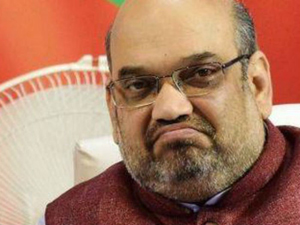
Forget 50,000 Dalits, BJP's Yatra fails to attract 500; Amit Shah escapes

[email protected] (CD Network)
August 1, 2016

Agra, Aug 1: The Uttar Pradesh unit of Bharatiya Janata Party is in shock after its much hyped Dhamma Chetna Yatra failed to draw even 500 Dalit supporters in the city of Agra. In fact, the saffron party had expected 50,000 supporters to welcome the Yatra which entered the city on Sunday.

amit-shahThe welcome function, which was earlier scheduled to be held at one of city's the biggest grounds, was shifted to Saraswati Shishu Mandir after the party realised that the number of participants including outsiders will not exceed 400.

BJP supremo escapes

This forced BJP chief Amit Shah, who was earlier scheduled to address the event, to cancel his plan. Mr Shah's rally was aimed at targeting the OBCs and Dalits by focusing on Prime Minister Narendra Modi's messages for the community and his views on Dr Bhimrao Ambedkar.

While local BJP leaders claim that the "inclement weather" has forced them to cancel Mr Shah's rally, insiders admit that the real reason behind it is the lacklustre response it received from the Dalit community and also the looming threat of protests against the chetna yatra in the city. The yatra had earlier faced opposition on its arrival in Hathras, Aligarh and Mathura.

Street beggars invited to fill the hall!

Even after shifting the venue, the BJP members failed to fill the hall of the small school located in the Agra's Kamla Nagar area.

“It was quite shocking that most people in the hall were either monks or BJP workers. They even called street children and beggars to the venue as the older audience wasn't available,” said an eyewitness, who stays in Kamla Nagar and attended the event.

While party workers were busy in clicking selfies, the monks present were either asleep or least interested in what the political leaders had to say.

Comments

TR
 - 
Tuesday, 2 Aug 2016

Beggars Janatha Party = B J P................... Even beggars are not interested ............................. What a Fate BJP ???

REALITY
 - 
Tuesday, 2 Aug 2016

Finally UP public are recognizing the Culprits & Liars of the society.

abdullah mohammed
 - 
Monday, 1 Aug 2016

Beggers are invited for beggers meeting yatra

Mohidin
 - 
Monday, 1 Aug 2016

Finally BJP's funeral procession begins from UP.

Rikaz
 - 
Monday, 1 Aug 2016

They must have paid street beggars to attend....what a pathetic condition of useless BJP position....they will suffer....

Anyway GOU MATA is not helping them at all......

VOX POPULI
 - 
Monday, 1 Aug 2016

ANTHIMA YATRA OF BJP & RSS. ONE MORE NAIL ON THE COFFINS OF
FEKU AND DAAKU? EVERY DOG HAS A DAY. MAADIDUNNO MAHAPAPI.
MAY ALMIGHTY PROTECT INDIA AND INDIANS FROM THESE EVILS & MONSTERS WITH DUBIOUS MENTALITY. JAI HO INDIA AND INDIANS.

Satyameva jayate
 - 
Monday, 1 Aug 2016

Ha ha.......phaad diya dalits bhi....next election even shiv sena and other Hindu parties will leave BJP and modi.....

Irfan
 - 
Monday, 1 Aug 2016

Karara Jawab milega in 2019,
To win the election BJP may issue voter Id for Go-Mata.....LOL

Add new comment

  • Coastaldigest.com reserves the right to delete or block any comments.
  • Coastaldigset.com is not responsible for its readers’ comments.
  • Comments that are abusive, incendiary or irrelevant are strictly prohibited.
  • Please use a genuine email ID and provide your name to avoid reject.
News Network
April 29,2020

Washington, Apr 29: A US government panel on Tuesday called for India to be put on a religious freedom blacklist over a "drastic" downturn under Prime Minister Narendra Modi, triggering a sharp rebuttal from New Delhi.

The US Commission on International Religious Freedom recommends but does not set policy, and there is virtually no chance the State Department will follow its lead on India, an increasingly close US ally.

In an annual report, the bipartisan panel narrowly agreed that India should join the ranks of "countries of particular concern" that would be subject to sanctions if they do not improve their records.

"In 2019, religious freedom conditions in India experienced a drastic turn downward, with religious minorities under increasing assault," the report said.

It called on the United States to impose punitive measures, including visa bans, on Indian officials believed responsible and grant funding to civil society groups that monitor hate speech.

The commission said that Modi's Hindu nationalist government, which won a convincing election victory last year, "allowed violence against minorities and their houses of worship to continue with impunity, and also engaged in and tolerated hate speech and incitement to violence."

It pointed to comments by Home Minister Amit Shah, who notoriously referred to mostly Muslim migrants as "termites," and to a citizenship law that has triggered nationwide protests.

It also highlighted the revocation of the autonomy of Kashmir, which was India's only Muslim-majority state, and allegations that Delhi police turned a blind eye to mobs who attacked Muslim neighborhoods in February this year.

Coronavirus state-wise India update: Total number of confirmed cases, deaths on April 29

The Indian government, long irritated by the commission's comments, quickly rejected the report.

"Its biased and tendentious comments against India are not new. But on this occasion, its misrepresentation has reached new levels," foreign ministry spokesman Anurag Srivastava said.

"We regard it as an organization of particular concern and will treat it accordingly," he said in a statement.

The State Department designates nine "countries of particular concern" on religious freedom -- China, Eritrea, Iran, Myanmar, North Korea, Pakistan, Saudi Arabia, Tajikistan and Turkmenistan.

The commission asked that all nine countries remain on the list. In addition to India, it sought the inclusion of four more -- Nigeria, Russia, Syria and Vietnam.

Pakistan, India's historic rival, was added by the State Department in 2018 after years of appeals by the commission.

In its latest report, the commission said that Pakistan "continued to trend negatively," voicing alarm at forced conversions of Hindus and other minorities, abuse of blasphemy prosecutions and a ban on the Ahmadi sect calling itself Muslim.

India's citizenship law fast-tracks naturalization for minorities from neighbouring countries -- but not if they are Muslim.

Modi's government says it is not targeting Muslims but rather providing refuge to persecuted people and should be commended.

But critics consider it a watershed move by Modi to define the world's largest democracy as a Hindu nation and chip away at independent India's founding principle of secularism.

Tony Perkins, the commission's chair, called the law a "tipping point" and voiced concern about a registry in the northeastern state of Assam, under which 1.9 million people failed to produce documentation to prove that they were Indian citizens before 1971 when mostly Muslim migrants flowed in during Bangladesh's bloody war of independence.

"The intentions of the national leaders are to bring this about throughout the entire country," Perkins told an online news conference.

"You could potentially have 100 million people, mostly Muslims, left stateless because of their religion. That would be, obviously, an international issue," said Perkins, a Christian activist known for his opposition to gay rights who is close to President Donald Trump's administration.

Three of the nine commissioners dissented -- including another prominent Christian conservative, Gary Bauer, who voiced alarm about India's direction but said the ally could not be likened to non-democracies such as China.

"I am deeply concerned that this public denunciation risks exactly the opposite outcome than the one we all desire," Bauer said.

Trump, who called for a ban on Muslim immigration to the US when he ran for president, hailed Modi on a February visit to New Delhi.

Comments

Add new comment

  • Coastaldigest.com reserves the right to delete or block any comments.
  • Coastaldigset.com is not responsible for its readers’ comments.
  • Comments that are abusive, incendiary or irrelevant are strictly prohibited.
  • Please use a genuine email ID and provide your name to avoid reject.
News Network
May 4,2020

Bengaluru, May 4: Booze lovers ushered in the resumption of liquor sales in a spirited fashion in Karnataka onMonday thronging stores hours before shutters went up at severalplaces and made no secret of their celebratory mood.

At some places, they flocked liquor shops even before day-break and performed "special prayers" with flowers, coconuts,incense sticks, camphor and crackers in front of the stores.

Liquor outlets had been shut in the State from March 25 following the lockdown due to the COVID-19 pandemic.

Excise revenue loss during the period was about Rs 2,500 crore, according to government sources.

About 4,500 standalone liquor outlets (CL-2 and CL- 11licence holders), which comprise wine stores and those owned bystate-run Mysore Sales International Limited, outside containmentzones were allowed to be opened from Monday from 9 am to 7 pm withsome restrictions.

Free Games on Deccan Chronicle. No Installing, No Charges. Stay Home Stay Safe. Click the Banner to play Now.
These include customers compulsorily wearing of facemasks andmaintaining social distancing with not more than five people inside liquor shops.

Many customers were indeed well-prepared.

At many places, they came with umbrella, raincoat, newspapers and books and queued up as early as 3 am.

At a liquor shop in Salegame Road in Hassan, the tipplers lit the traditional lamp and incense sticks, performed 'aarati'with camphor and decorated the store with the garland of flowers.

With folded hands, they all performed 'special prayers'.

In Mandya, the tipplers queued up before Martaanda liquor shop before dawn.

An hour before the sales were to resume, a few people burst crackers in celebration.

Some tipplers in Belagavi were more "enterprising."

They wentto a liquor store on Sunday night itself, performed special prayersand placed their "representatives" in the form of slippers, bags and stones in the "social distancing boxes" they themselves had drawn sothat they don't have to stand in queue in the morning.

An elderly woman Dakamma was the centre of attraction in Shivamogga.

The bent body did not bend the determination of this spirited lady, claimed to be 96-year-old, who was heard saying "liquor is goodfor health."

At the taluk headquarters town of Brahmavara in the coastal Udupi district, the queue of the booze lovers was reported to be almost half-a-kilometre.

Long queues were seen at liquor stores at Mariyappana Palya and K R Puram, among others, in Bengaluru.

The store managers too were no less cautious while dealing with customers in the COVID era.

They let the customers enter after spraying sanitisers in their hands, and allowed only those who hadworn masks and maintained social distancing.

To maintain law and order, authorities had deployed policemen in good numbers at these stores and they were seen on duty ensuring  that customers maintained social distancing.

Comments

Add new comment

  • Coastaldigest.com reserves the right to delete or block any comments.
  • Coastaldigset.com is not responsible for its readers’ comments.
  • Comments that are abusive, incendiary or irrelevant are strictly prohibited.
  • Please use a genuine email ID and provide your name to avoid reject.
News Network
July 28,2020

Hounde, Jul 28: Coronavirus and its restrictions are pushing already hungry communities over the edge, killing an estimated 10,000 more young children a month as meager farms are cut off from markets and villages are isolated from food and medical aid, the United Nations warned Monday.

In the call to action shared with The Associated Press ahead of publication, four UN agencies warned that growing malnutrition would have long-term consequences, transforming individual tragedies into a generational catastrophe.

Hunger is already stalking Haboue Solange Boue, an infant from Burkina Faso who lost half her former body weight of 5.5 pounds (2.5 kilograms) in just a month. Coronavirus restrictions closed the markets, and her family sold fewer vegetables. Her mother was too malnourished to nurse.

“My child,” Danssanin Lanizou whispered, choking back tears as she unwrapped a blanket to reveal her baby's protruding ribs.

More than 550,000 additional children each month are being struck by what is called wasting, according to the UN — malnutrition that manifests in spindly limbs and distended bellies. Over a year, that's up 6.7 million from last year's total of 47 million. Wasting and stunting can permanently damage children physically and mentally.

“The food security effects of the COVID crisis are going to reflect many years from now,” said Dr. Francesco Branca, the WHO head of nutrition. “There is going to be a societal effect.”

From Latin America to South Asia to sub-Saharan Africa, more poor families than ever are staring down a future without enough food.

In April, World Food Program head David Beasley warned that the coronavirus economy would cause global famines “of biblical proportions” this year. There are different stages of what is known as food insecurity; famine is officially declared when, along with other measures, 30% of the population suffers from wasting.

The World Food Program estimated in February that one Venezuelan in three was already going hungry, as inflation rendered salaries nearly worthless and forced millions to flee abroad. Then the virus arrived.

“Every day we receive a malnourished child,” said Dr. Francisco Nieto, who works in a hospital in the border state of Tachira.

In May, Nieto recalled, after two months of quarantine, 18-month-old twins arrived with bodies bloated from malnutrition. The children's mother was jobless and living with her own mother. She told the doctor she fed them only a simple drink made with boiled bananas.

“Not even a cracker? Some chicken?” he asked.

“Nothing,” the children's grandmother responded. By the time the doctor saw them, it was too late: One boy died eight days later.

The leaders of four international agencies — the World Health Organization, UNICEF, the World Food Program and the Food and Agriculture Organization — have called for at least dollar 2.4 billion immediately to address global hunger.

But even more than lack of money, restrictions on movement have prevented families from seeking treatment, said Victor Aguayo, the head of UNICEF's nutrition program.

“By having schools closed, by having primary health care services disrupted, by having nutritional programs dysfunctional, we are also creating harm,” Aguayo said. He cited as an example the near-global suspension of Vitamin A supplements, which are a crucial way to bolster developing immune systems.

In Afghanistan, movement restrictions prevent families from bringing their malnourished children to hospitals for food and aid just when they need it most. The Indira Gandhi hospital in the capital, Kabul, has seen only three or four malnourished children, said specialist Nematullah Amiri. Last year, there were 10 times as many.

Because the children don't come in, there's no way to know for certain the scale of the problem, but a recent study by Johns Hopkins University indicated an additional 13,000 Afghans younger than 5 could die.

Afghanistan is now in a red zone of hunger, with severe childhood malnutrition spiking from 690,000 in January to 780,000 — a 13% increase, according to UNICEF.

In Yemen, restrictions on movement have blocked aid distribution, along with the stalling of salaries and price hikes. The Arab world's poorest country is suffering further from a fall in remittances and a drop in funding from humanitarian agencies.

Yemen is now on the brink of famine, according to the Famine Early Warning Systems Network, which uses surveys, satellite data and weather mapping to pinpoint places most in need.

Some of the worst hunger still occurs in sub-Saharan Africa. In Sudan, 9.6 million people live from one meal to the next — a 65% increase from the same time last year.

Lockdowns across Sudanese provinces, as around the world, have dried up work and incomes for millions. With inflation hitting 136%, prices for basic goods have more than tripled.

“It has never been easy but now we are starving, eating grass, weeds, just plants from the earth,” said Ibrahim Youssef, director of the Kalma camp for internally displaced people in war-ravaged south Darfur.

Adam Haroun, an official in the Krinding camp in west Darfur, recorded nine deaths linked with malnutrition, otherwise a rare occurrence, over the past two months — five newborns and four older adults, he said.

Before the pandemic and lockdown, the Abdullah family ate three meals a day, sometimes with bread, or they'd add butter to porridge. Now they are down to just one meal of “millet porridge” — water mixed with grain. Zakaria Yehia Abdullah, a farmer now at Krinding, said the hunger is showing “in my children's faces.”

“I don't have the basics I need to survive,” said the 67-year-old, who who hasn't worked the fields since April. “That means the 10 people counting on me can't survive either.”


Comments

Add new comment

  • Coastaldigest.com reserves the right to delete or block any comments.
  • Coastaldigset.com is not responsible for its readers’ comments.
  • Comments that are abusive, incendiary or irrelevant are strictly prohibited.
  • Please use a genuine email ID and provide your name to avoid reject.