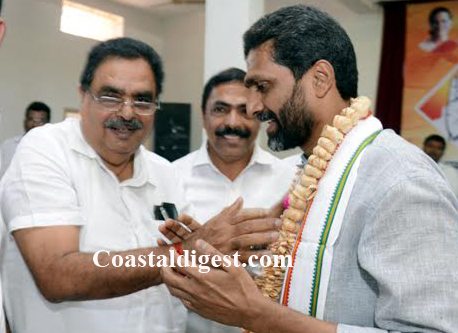
Former Mangaluru Mayor Ashraf joins Congress party once again!

[email protected] (CD Network)
January 23, 2016

Mangaluru, Jan 23: K Ashraf, the former Mangaluru Mayor and founder of United Muslim Association of Dakshina Kannada, has once again rejoined the Congress party during its district level convention held in the city on Saturday.

ashraf

Known for his frequent tirade against veteran Congress leader B Janardhana Poojary, Mr Ashraf had quit and rejoined the Congress party around half a dozen times in recent years.

He had also predicted the end of Congress party in the coastal Karnataka after he quit the party for the last time in January 2014 questioning the appointment of a non-Congressman as the chairman of district Wakf advisory committee.

Dakshina Kannada district-in-charge minister B Ramanth Rai formally re-inducted Mr Ashraf to the Congress in the presence of other party leaders.

Also Read: Former Mayor Ashraf quits Congress, rejoins, quits, joins, quits, joins, quits…

Comments

Pavvi Addoor
 - 
Sunday, 24 Jan 2016

I always doubted this guy. He was a reject piece in congRSS and then he started raising his voice for Muslims and then he was thrown out. Because, congRSS never let a person grow with them who has a concern for muslims. After he was thrown out, he was brought into main stream by organizations like, PFI, SDPI and others who work for the Muslim community development. And then congRSS realized the danger that they has to face with with this. So, they bought this puppet again.

THINKERS
 - 
Sunday, 24 Jan 2016

When is your plan to Quit next? Is worldly power attracting YOU.. if so please THINK and work for the community & the society.

Add new comment

  • Coastaldigest.com reserves the right to delete or block any comments.
  • Coastaldigset.com is not responsible for its readers’ comments.
  • Comments that are abusive, incendiary or irrelevant are strictly prohibited.
  • Please use a genuine email ID and provide your name to avoid reject.
News Network
June 19,2020

Bengaluru, June 19: The throat swabs of a Bengaluru-based Kannada journalist, who passed away on June 18, were tested positive for the covid-19, officials said.

Gauripura Chandru (54), who was one of the sub-editors of Vijaya Karnataka Kannada daily newspaper, had reportedly suffered cardiac arrest.

It is learnt that Chandru wasn’t keeping well for past few days. He collapsed at his home on Thursday afternoon and was immediately rushed to a hospital, where doctors pronounced him dead.

A native of Gauripura in Chitradurga district, Chandru had completed graduation in engineering. However, he had chosen journalism as his profession.

Comments

Add new comment

  • Coastaldigest.com reserves the right to delete or block any comments.
  • Coastaldigset.com is not responsible for its readers’ comments.
  • Comments that are abusive, incendiary or irrelevant are strictly prohibited.
  • Please use a genuine email ID and provide your name to avoid reject.
News Network
April 4,2020

Bengaluru, Apr 4: As calamity struck the nation in the form of coronavirus, many philanthropists have generously opened their wallets to sustain the urban poor, especially the migrant labourers in the city and elsewhere in Karnataka.

These individuals either directly or through organisations opened up their kitchens to ensure that no one goes to bed hungry in this distressing time.

The Bruhat Bengaluru Mahanagara Palike, the nodal agency to feed urban poor, responded positively to requests by these organisations and individuals to supply food to the needy on their behalf.

"We had been serving food through our Indira canteens, which we continue to do even now. However, many philanthropists and corporates have come forward to feed the needy," the BBMP joint commissioner Sarfaraz Khan told reporters.

According to BBMP, Indira canteens used to provide two lakh meals a day on normal occasions.

However, since the lockdown has been clamped, the number swelled by almost 50 per cent.

"On Thursday alone, we served 2.85 lakh food, which comprises breakfast, lunch and breakfast," a Palike officer said.

The major aid came from Jain International Trade Organisation (JITO) and Azim Premji Foundation.

While JITO is feeding around 22,000 people, Azim Premji Foundation is taking care of 20,000 people.

Sajjanraj Mehta, an office bearer of JITO, told reporters that his organisation has been providing packaged cooked food since March 27.

"We got in touch with Bengaluru Mayor M Gautham Kumar, Police Commissioner Bhaskar Rao and the BBMP commissioner B H Anil Kumar. According to their list, 27,000 food packets were required daily," Mehta told.

The JITO members have arranged vehicles of their respective businesses to transport food packets to different locations as part of the campaign named as 'COVID-19 manav seva'.

The organisation has also decided to utilise the kitchen of Princess Golf, a marriage hall on Palace Grounds here to prepare food.

Palike officials said on Thursday alone JITO supplied 53,000 meals.

"We asked them to cover migrant labourers in those areas where Indira Canteen could not reach. We mapped the cluster and provided them info. Now, they are distributing it there," they said.

Another organisation engaged in charitable work is ISKCON Bengaluru.

Ever since the lockdown, it has been working in various parts of India providing food to various people.

"We are providing materials such as rice, wheat flour, Daal, oil, vegetables with long shelf life, salt, sugar and spices. Each packet can sustain for at least 21 days," Madhu Pandit Dasa, president of ISKCON Bengaluru.

The organisation has set a target to cover at least two lakh people but so far it has reached out to 30,000 people including 25,000 in Bengaluru alone.

"We are feeding about 50,000 people in Delhi, with the Telangana government we are feeding about 40,000 people in Hyderabad, about 10,000 people in Ahmedabad in association with the Gujarat government," Dasa told.

According to BBMP, other organisations providing food to the needy are KMFY, TVS Group, Vimal Bhandari, Radisson Blue Atria Hotel, Hitech Ecowood, Mohammed Shajid, Prestige Group.

Wipro Ltd also pitched in to feed the poor by opening up its industrial kitchen infrastructure.

In a statement, Global Head- Operations of the company Hariprasad Hegde said the humanitarian crisis we are faced with as part of the Covid-19 crisis has multiple dimensions to it, of which the need to deliver cooked meals to the stranded migrant workers and other vulnerable communities is probably the most critical and immediate one.

Recognising this, Wipro has decided to use the industrial kitchen infrastructure in our facilities to provide cooked meals, he said.

This kicked off on April 2 with the delivery of 43,000 meals from our Bangalore facility in Kodathi to the government.

"We have made use of our own procurement logistics to source the food provisions. This is a collaborative process, with the government taking responsibility for the logistics of last mile delivery to the communities that need it the most,” he said.

In the case of Bangalore, the Karnataka government has come forward to provide this kind of complementary delivery support. We are reaching out to other state governments and local administrations for similar efforts." he said.

Comments

Add new comment

  • Coastaldigest.com reserves the right to delete or block any comments.
  • Coastaldigset.com is not responsible for its readers’ comments.
  • Comments that are abusive, incendiary or irrelevant are strictly prohibited.
  • Please use a genuine email ID and provide your name to avoid reject.
Agencies
February 6,2020

Even more than three years after demonetisation and all-out efforts to make most transactions through electronic, cash is still king, as it thrives in a digital India, said fintech start-up Paytm founder Vijay Sekhar Sharma.

"While cashless economy is not possible in India, less cash economy will be in the future. Less cash is the only solution, not the elimination of cash," Sharma told IANS in an interview after unveiling an all-in-one payment gateway on Tuesday.

Asserting that it would take 5-10 years for India to make the transition to digital payments from the traditional mode of cash, Sharma, 41, said the e-payment industry benefitted more from the November 8, 2016 note ban and withdrawal of old Rs 1,000 and Rs 500 denominations.

"I think it (demonetisation) helped the industry despite lack of specific help. But the world has changed since then. It is about the scale of distribution of merchants that is what is propelling digital payments," said Sharma.

Most of the cash not only came back into circulation, but also remains as the mode of payment for the majority due to its convenience for the people used to such transactions.

Expounding Paytm's zero service charge, Sharma said the strategy is sustainable as it leads to acquiring more customers and merchants, enabling newer business opportunities.

Paytm also does not levy a service charge to small merchants for its payments services, unlike organised players like Uber.

"Though there is a monetisation model, the merchants who are small shopkeepers, become our financial services customers as they open a bank account, which is profitable."

Paytm secured a Payments Bank license from the Reserve Bank of India to offer a savings bank account, Rupay debit card and money transfer services.

"We are banking on payment services acquiring customers and merchants who avail banking, lending, insurance, wealth and software services like billing software and business ledger software services eventually," Sharma noted.

The mobile first bank services include zero balance and zero digital transaction charge accounts.

"Basically, payments, cloud, commerce and financial services are a cohort we follow. So, payments is our customer as well as merchant acquisition. If it breaks even, we are happy because other line items make more money, he affirmed.

Noting that in a market like India, one cannot price services at a premium unlike in a developed country like the US, the billionaire businessman said a consumer in a developing country would not be able to afford such a hefty charge.

Forbes ranked Sharma as India's youngest billionaire in 2017, with a net worth of $2.1 billion.

While several countries operate on the model of higher service charges, Sharma said newer business models have to be discovered in India, as customer lifecycle value is accounted for more stages than in other nations.

Asked about an upscale retailer like Zara not giving a wallet payment option during its recent end of season sale in Bengaluru, Sharma said Paytm was addressing such hiccups with its all-in-one payment solutions.

"It's an opportunity, because if the retailer has our all-in-one point of sale machine, where in they enter the amount, it shows both the Quick Response code (QR) and card payment options," he observed.

Sharma compared older swiping payment machine to feature phones and modern ones to feature-rich smartphones.

"If you notice, they look like feature phones and the modern day card machine is more a smartphone like. You can add the smatphone components, which can add the features," reiterated Sharma.

Though Paytm's all-in-one QR point of sale machine integrates the billing system, its chief executive said it was not ideal to have an independent QR feature.

Paytm has 16 million strong merchant user base, which Sharma aims to raise to 26 million base in the next one year.

Sharma has launched in this tech city an all-in-one payment gateway and Paytm Business Payments solution, which enable digital payments through multiple methods for small and medium enterprises (SMEs) and an Android point of sale machine.

With the new gateway solution, collecting digital payments through multiple methods can be achieved seamlessly while Paytm Business Payments solution enables automated vendor payments, including employee salaries and customer refunds among others.

The One97 Communications-owned Paytm aims to help SMEs streamline and digitise their business activities using its new solutions, which enhance the overall efficiency of both accepting and making payments.

Paytm has a data bank of over 200 million saved cards and bank accounts, a feature which enables partner apps to shorten transaction times and propel faster conversions while using the all-in-one payment gateway.

Complementing the two solutions, Sharma also launched an all-in-one Android point of sale machine, which can accept payments through all forms such as cards, wallets, UPI apps and even cash.

The device has a QR code that supports all contact and contactless payments, coming with integrated billing software customized solutions for different sectors such as catering, ticketing, parking and others.

The handheld Android device is equipped with an in-built printer, scanner and can also generate bills.

Valued at $16 billion, Paytm is not alone in the fiercely competitive Indian fintech space where a dozen players like PhonePe, MobiKwik, Kotak 811 and deep pocketed international giants Google Pay and Amazon Pay are in the fray.


Comments

Add new comment

  • Coastaldigest.com reserves the right to delete or block any comments.
  • Coastaldigset.com is not responsible for its readers’ comments.
  • Comments that are abusive, incendiary or irrelevant are strictly prohibited.
  • Please use a genuine email ID and provide your name to avoid reject.