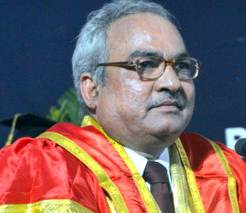
Former VC of Mangalore University Prof. TC Shivashankara Murthy dies

[email protected] (CD Network)
August 19, 2015

tcsmMangaluru, Aug 19: Former vice-chancellor of Mangalore University Prof TC Shivashankara Murthy died on Wednesday following a cardiac arrest in the state of Maharashtra.

The end came when 66-year-old educationist was on a trip to Pune for some educational work.

After retiring as a professor of Botany at the University of Mysore, Prof Murthy severed as the vice-chancellor of the prestigious Mangalore University from 2010 to 2014.

During this period he had greatly contributed towards the modernisation of the three decade old university.

He had also served as the acting Vice-Chancellor and Registrar (Evaluation) of Mysore University during his 37 years of service there. The Union Government sanctioned Rs. 100 crore to the University of Mysore for a proposal sent by it when Mr. Murthy was its acting Vice-Chancellor in 2008.

Comments

Dacia
 - 
Monday, 18 Jul 2016

Sin embargo, muy frecuentemente podemos hacerle un cambio de imagen a nuestra
casa aplicando pequeñas reformas rápidas y bajo
coste. A no ser que tengamos algún género de problema estructural
necesitemos reformas de obra, siempre y en todo momento
podemos renovar nuestra casa con pequeños cambios que podemos hacer nosotros mismos.

Here is my web site; reformas integrales madrid remodel [Clifford: http://wallinside.com/post-56151630-reformas-baratas-castellon.html]

Add new comment

  • Coastaldigest.com reserves the right to delete or block any comments.
  • Coastaldigset.com is not responsible for its readers’ comments.
  • Comments that are abusive, incendiary or irrelevant are strictly prohibited.
  • Please use a genuine email ID and provide your name to avoid reject.
News Network
January 25,2020

Bengaluru, Jan 25: The Karnataka government would hold a Global Investors' Meet (GIM 2020) in Bengaluru from November 3-5 to showcase the southern state's ecosystem for attracting investments from the world over, an official said on Friday.

"Our Chief Minister B.S. Yediyurappa held the first road show on the GIM at the 50th World Economic Forum (WEF) annual meeting, being held at Davos in Switzerland and invited global firms to participate in the 3-day event for investment opportunities," additional secretary P. Ravikumar told IANS.

At a curtain-raiser on "Invest Karnataka 2020" on Thursday, the BJP Chief Minister said the theme of the GIM would be "Innovate Now. Growth Forever" as the state had one of the best natural and human resources for investing in manufacturing, services and agriculture sectors and creating jobs.

"About 100 entrepreneurs, businessmen and heads of global firms participated in the roadshow to assess the state's industrial policies, incentives, infrastructure, tax system and its ease of doing business for investment potential," Ravikumar said.

Among the participants at the event were Swiss-India parliamentary group president Niklaus-Samuel Gugger, Uber Chief Executive Dara Khosrowshahi, General Electric (GE) executive William Cowan and heads of Gemini Corporation, Coca Cola, SAP Labs, Swiss Re and Mitsubishi Heavy Industries.

"Khosrowshahi discussed Uber's expansion plans in Bengaluru and assured the Chief Minister of investing more in the state. Cowen expressed interest in the development of healthcare, renewable energy and power distribution across the state through partnership with the state government," the official noted.

The US-based transnational firm (GE) has a large presence in Bengaluru with one its largest engineering and technology centres and two production plants.

"A Coca Cola executive told Yediyurappa that the soft beverage firm would initially invest $25 million in its plants in the state and enhance it to $200 million to benefit farmers and rural people with access to clean drinking water in their villages," Ravikumar said.

The Chief Minister also sought to know the investment or expansion plans of global firms present in the state, especially Bengaluru and assured their heads of the state support in creating hundreds of jobs and wealth.

About 100 members of the Indian delegation to the WEF, led by Union Commerce and Industries Minister Piyush Goyal, Confederation of Indian Industry (CII) director-general Chandrajit Bannerjee, Bharat Forge chairman Baba Kalyani, Kirloskar Systems Managing Director Vikram Kirloskar, also participated in the state's GIM roadshow.

State Industries Minister Jagdish Shettar, chief secretary T. M. Vijaya Bhaskar, additional chief secretary E.V. Ramana Reddy and industrial department principal secretary Gurav Gupta also attended the state event.

"Emiriti Lulu Group chairman M.A. Yusuf Ali discussed plans to invest $300 million (Rs 2,160 crore) in logistics, hospitality and health/wellness sectors across the state with Yediyurappa," said Ravikumar.

Ali, an NRI (non-resident Indian) migrated to the United Arab Emirates (UAE) from Kerala two decades ago and founded the Lulu Group at Abu Dhabi to operate a chain of hypermarkets and retail firms since 2000.

"The Chief Minister assured Ali of speedy approvals and incentives for investing in the state, with ease of doing business," the official said in an e-mail to IANS from the Swiss town.

Asserting that his proactive government would work overtime to facilitate global investments in the southern state, Yediyurappa said he was committed to create more jobs across sectors.

Dassault Systems executive Florene Verzelen told the chief minister about her company's plans to set up centres of excellence in smart manufacturing and smart cities in the southern state.

"The centres will train and equip the youth with skilled jobs in large corporations the world over," Ravikumar reiterated.

Yediyurappa apprised US aerospace behemoth Lockheed Martin executive Richard Ambrose of the ecosystem for aerospace and defence industry in the state, especially Bengaluru.

"I will soon visit Bengaluru to explore the possibilities of investing more in Karnataka and taking up research and development work," said Ambrose on the occasion.

A delegation from global automotive component maker Denso also called on the chief minister and interacted with the state delegation.

The Japanese firm has an excellence and research centre in New Delhi and a manufacturing unit at Nelamangala on the outskirts of Bengaluru.

Denso executive Hiroyuki Wakabasyi said he would visit Bengaluru soon to explore further investments in the state.

"Arcelor Mittal chairman Laxmi Mittal also met the chief minister and discussed his company's investment plans in the state," the official added.

Mittal backed out of setting up a steel plant in the state's northern region over a decade ago due to delays in acquiring land and mandatory approvals.

Drug maker Novo Nordisk chief executive Lars Fruergaard expressed readiness to work with the state government in taking up educative and awareness programmes for diabetic patients.


Comments

Add new comment

  • Coastaldigest.com reserves the right to delete or block any comments.
  • Coastaldigset.com is not responsible for its readers’ comments.
  • Comments that are abusive, incendiary or irrelevant are strictly prohibited.
  • Please use a genuine email ID and provide your name to avoid reject.
News Network
February 1,2020

Mangaluru, Feb 1: “1) Take necessary precautionary measures. 2) Don’t blindly believe in social media rumours.” These are the two important advisories issued by the authorities in Dakshina Kannada district in the wake of coronavirus scare.

According to DHO Dr Ramakrishna there is no specific antiviral treatment recommended for coronavirus infection. Supportive care for infected people can be highly effective, but, there is no vaccine available for coronavirus.

In a health meeting, he advised people to take precautionary measures to prevent the spread of the virus. Following are some of the precautionary measures.

1) Wash your hands often with soap and water or an alcohol-based sanitiser.

2) Avoid touching your eyes, nose and mouth with unwashed hands.

3) Avoid close contact with people who are sick.

4) Stay home when you are sick, and cover your mouth when you cough or use a tissue while sneezing.

5) Throw the used tissue in the dustbin. Clean and disinfect surfaces frequently.

Deputy commissioner Sindhu B Rupesh said there is no need for people to panic about coronavirus.

Dakshina Kannada zilla panchayat CEO R Selvamani said IEC programmes will be held to create awareness on possibilities of spread of diseases.

He also advised people not to follow blindly the advisories being shared on social media, especially WhatsApp without proper verification.

“Posts on cures for coronavirus which are not scientifically proven are being shared on social media. Do not follow such advisories without verifying facts,” he said.

Comments

Add new comment

  • Coastaldigest.com reserves the right to delete or block any comments.
  • Coastaldigset.com is not responsible for its readers’ comments.
  • Comments that are abusive, incendiary or irrelevant are strictly prohibited.
  • Please use a genuine email ID and provide your name to avoid reject.
Agencies
May 8,2020

Washington D.C., May 8: The prime time for brain development in a child's life is the first year, where the infant spends most of the time asleep. It is the time when neural connections form and sensory memories are encoded.

However, when sleep is disrupted, as occurs more often among children with autism, brain development may be affected, too.

New research led by the University of Washington finds that sleep problems in a baby's first 12 months may not only precede an autism diagnosis but also may be associated with altered growth trajectory in a key part of the brain, the hippocampus.

The study, which was published in the American Journal of Psychiatry, researchers report that in a sample of more than 400 taken of 6- to 12-month-old infants, those who were later diagnosed with autism were more likely to have had difficulty falling asleep.

It also states that this sleep difficulty was associated with altered growth trajectories in the hippocampus.

"The hippocampus is critical for learning and memory, and changes in the size of the hippocampus have been associated with poor sleep in adults and older children.

As many as 80 per cent of the children with autism spectrum disorder have sleep problems," said Annette Estes, director of the UW Autism Center and senior author of the study.

"In our clinical experience, parents have a lot of concerns about their children's sleep, and in our work on early autism intervention, we observed that sleep problems were holding children and families back," added Estes, who is also a UW professor of speech and hearing sciences.

"It could be that altered sleep is part-and-parcel of autism for some children. One clue is that behavioural interventions to improve sleep don't work for all children with autism, even when their parents are doing everything just right. This suggests that there may be a biological component to sleep problems for some children with autism," said Estes.

To consider links among sleep, brain development, and autism, researchers at the IBIS Network looked at MRI scans of 432 infants, surveyed parents about sleep patterns, and measured cognitive functioning using a standardized assessment.

At the outset of the study, infants were classified according to their risk for developing autism: Those who were at higher risk of developing autism -- about two-thirds of the study sample -- had an older sibling who had already been diagnosed.

Infant siblings of children with autism have a 20 per cent chance of developing autism spectrum disorder -- a much higher risk than children in the general population.

In the current study, 127 of the 432 infants were identified as "low risk" at the time the MRI scans were taken because they had no family history of autism.

They later evaluated all the participants at 24 months of age to determine whether they had developed autism. Of the roughly 300 children originally considered "high familial risk," 71 were diagnosed with autism spectrum disorder at that age.

Problems with sleep were more common among the infants later diagnosed with an autism spectrum disorder, as were larger hippocampi. No other subcortical brain structures were affected, including the amygdala, which is responsible for certain emotions and aspects of memory, or the thalamus, a signal transmitter from the spinal cord to the cerebral cortex.

The authors note that while parents reported more sleep difficulties among infants who developed autism compared to those who did not, the differences were very subtle and only observed when looking at group averages across hundreds of infants.

Sleep patterns in the first years of life change rapidly as infants transition from sleeping around the clock to a more adult-like sleep/wake cycle. Until further research is completed, Estes said, it is not possible to interpret challenges with sleep as an early sign of increased risk for autism.

Comments

Add new comment

  • Coastaldigest.com reserves the right to delete or block any comments.
  • Coastaldigset.com is not responsible for its readers’ comments.
  • Comments that are abusive, incendiary or irrelevant are strictly prohibited.
  • Please use a genuine email ID and provide your name to avoid reject.