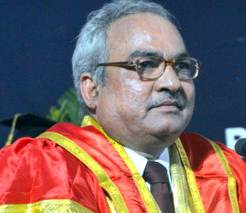
Former VC of Mangalore University Prof. TC Shivashankara Murthy dies

[email protected] (CD Network)
August 19, 2015

tcsmMangaluru, Aug 19: Former vice-chancellor of Mangalore University Prof TC Shivashankara Murthy died on Wednesday following a cardiac arrest in the state of Maharashtra.

The end came when 66-year-old educationist was on a trip to Pune for some educational work.

After retiring as a professor of Botany at the University of Mysore, Prof Murthy severed as the vice-chancellor of the prestigious Mangalore University from 2010 to 2014.

During this period he had greatly contributed towards the modernisation of the three decade old university.

He had also served as the acting Vice-Chancellor and Registrar (Evaluation) of Mysore University during his 37 years of service there. The Union Government sanctioned Rs. 100 crore to the University of Mysore for a proposal sent by it when Mr. Murthy was its acting Vice-Chancellor in 2008.

Comments

Dacia
 - 
Monday, 18 Jul 2016

Sin embargo, muy frecuentemente podemos hacerle un cambio de imagen a nuestra
casa aplicando pequeñas reformas rápidas y bajo
coste. A no ser que tengamos algún género de problema estructural
necesitemos reformas de obra, siempre y en todo momento
podemos renovar nuestra casa con pequeños cambios que podemos hacer nosotros mismos.

Here is my web site; reformas integrales madrid remodel [Clifford: http://wallinside.com/post-56151630-reformas-baratas-castellon.html]

Add new comment

  • Coastaldigest.com reserves the right to delete or block any comments.
  • Coastaldigset.com is not responsible for its readers’ comments.
  • Comments that are abusive, incendiary or irrelevant are strictly prohibited.
  • Please use a genuine email ID and provide your name to avoid reject.
Ram Puniyani
February 10,2020

Noam Chomsky is one of the leading peace workers in the world. In the wake of America’s attack on Vietnam, he brought out his classic formulation, ‘manufacturing consent’. The phrase explains the state manipulating public opinion to have the public approve of it policies—in this case, the attack of the American state on Vietnam, which was then struggling to free itself from French colonial rule.

In India, we are witness to manufactured hate against religious minorities. This hatred serves to enhance polarisation in society, which undermines India’s democracy and Constitution and promotes support for a Hindu nation. Hate is being manufactured through multiple mechanisms. For example, it manifests in violence against religious minorities. Some recent ghastly expressions of this manufactured hate was the massive communal violence witnessed in Mumbai (1992-93), Gujarat (2002), Kandhamal (2008) and Muzaffarnagar (2013). Its other manifestation was in the form of lynching of those accused of having killed a cow or consumed beef. A parallel phenomenon is the brutal flogging, often to death, of Dalits who deal with animal carcasses or leather.

Yet another form of this was seen when Shambhulal Regar, indoctrinated by the propaganda of Hindu nationalists, burned alive Afrazul Khan and shot the video of the heinous act. For his brutality, he was praised by many. Regar was incited into the act by the propaganda around love jihad. Lately, we have the same phenomenon of manufactured hate taking on even more dastardly proportions as youth related to Hindu nationalist organisations have been caught using pistols, while police authorities look on.

Anurag Thakur, a BJP minster in the central government recently incited a crowd in Delhi to complete his chant of what should happen to ‘traitors of the country...” with a “they should be shot”. Just two days later, a youth brought a pistol to the site of a protest at Jamia Millia Islamia university and shouted “take Azaadi!” and fired it. One bullet hit a student of Jamia. This happened on 30 January, the day Nathuram Godse had shot Mahatma Gandhi in 1948. A few days later, another youth fired near the site of protests against the CAA and NRC at Shaheen Bagh. Soon after, he said that in India, “only Hindus will rule”.

What is very obvious is that the shootings by those associated with Hindu nationalist organisations are the culmination of a long campaign of spreading hate against religious minorities in India in general and against Muslims in particular. The present phase is the outcome of a long and sustained hate campaign, the beginning of which lies in nationalism in the name of religion; Muslim nationalism and Hindu nationalism. This sectarian nationalism picked up the communal view of history and the communal historiography which the British introduced in order to pursue their ‘divide and rule’ policy.

In India what became part of “social common sense” was that Muslim kings had destroyed Hindu temples, that Islam was spread by force, and that it is a foreign religion, and so on. Campaigns, such as the one for a temple dedicated to the Hindu god Rama to be built at the site where the Babri masjid once stood, further deepened the idea of a Muslim as a “temple-destroyer”. Aurangzeb, Tipu Sultan and other Muslim kings were tarnished as the ones who spread Islam by force in the subcontinent. The tragic Partition, which was primarily due to British policies, and was well-supported by communal streams also, was entirely attributed to Muslims. The Kashmir conflict, which is the outcome of regional, ethnic and other historical issues, coupled with the American policy of supporting Pakistan’s ambitions of regional hegemony, (which also fostered the birth of Al-Qaeda), was also attributed to the Muslims.

With recurring incidents of communal violence, these falsehoods went on going deeper into the social thinking. Violence itself led to ghettoisation of Muslims and further broke inter-community social bonds. On the one hand, a ghettoised community is cut off from others and on the other hand the victims come to be presented as culprits. The percolation of this hate through word-of-mouth propaganda, media and re-writing of school curricula, had a strong impact on social attitudes towards the minorities.

In the last couple of decades, the process of manufacturing hate has been intensified by the social media platforms which are being cleverly used by the communal forces. Swati Chaturvedi’s book, I Am a Troll: Inside the Secret World of the BJP’s Digital Army, tells us how the BJP used social media to spread hate. Whatapp University became the source of understanding for large sections of society and hate for the ‘Other’, went up by leaps and bounds. To add on to this process, the phenomenon of fake news was shrewdly deployed to intensify divisiveness.

Currently, the Shaheen Bagh movement is a big uniting force for the country; but it is being demonised as a gathering of ‘anti-nationals’. Another BJP leader has said that these protesters will indulge in crimes like rape. This has intensified the prevalent hate.

While there is a general dominance of hate, the likes of Shambhulal Regar and the Jamia shooter do get taken in by the incitement and act out the violence that is constantly hinted at. The deeper issue involved is the prevalence of hate, misconceptions and biases, which have become the part of social thinking.

These misconceptions are undoing the amity between different religious communities which was built during the freedom movement. They are undoing the fraternity which emerged with the process of India as a nation in the making. The processes which brought these communities together broadly drew from Gandhi, Bhagat Singh and Ambedkar. It is these values which need to be rooted again in the society. The communal forces have resorted to false propaganda against the minorities, and that needs to be undone with sincerity.

Combating those foundational misconceptions which create hatred is a massive task which needs to be taken up by the social organisations and political parties which have faith in the Indian Constitution and values of freedom movement. It needs to be done right away as a priority issue in with a focus on cultivating Indian fraternity yet again.


Comments

Add new comment

  • Coastaldigest.com reserves the right to delete or block any comments.
  • Coastaldigset.com is not responsible for its readers’ comments.
  • Comments that are abusive, incendiary or irrelevant are strictly prohibited.
  • Please use a genuine email ID and provide your name to avoid reject.
News Network
July 23,2020

Bengaluru, Jul 23: The opposition party Congress on Thursday demanded a judicial enquiry in the alleged scam in coronavirus related medical equipment procurement by Karnataka government.

However, Deputy chief minister Ashwathnarayan and Home Minister Basavaraj Bommai denied all the allegations.

Leader of Opposition (LoP) and former Chief Minister of Karnataka Siddaramaiah and Karnataka Congress president DK Shivakumar addressed a press conference here and demanded a judiciary enquiry under a sitting High Court judge to investigate "BJP's Corona Scams."

"I made allegations on July 3. Nobody has denied it officially. On July 20, Karnataka Health Minister B Sriramulu and Deputy Chief Minister Ashwathnarayan in a press conference denied my allegations. Today, I furnished 14 documents. If you go through it, you will find corruption and misappropriation in medical equipment purchase," Siddaramaiah said.

"The documents are available with the government, how can they deny their own documents. They are telling that they have spent only Rs 324 crore but according to me the government has spent more than Rs 4,000 crore and nearly Rs 2,000 crore went in the minister and bureaucrats' pockets," he said.

He further said, "Centre has procured 50,000 ventilators under PM Cares at a cost of Rs 4, lakh per unit. Tamil Nadu has procured at Rs 4.78 lakh. But in our state, the price is between Rs 5.6 lakh to Rs 18.2 lakh. Is this not corruption?"

Siddaramaiah also dared the government to step up for an enquiry if they are "honest and transparent".

"I am demanding, constitute a judicial committee headed by sitting high court judge, let there be an enquiry in detail," he said.

DK Shivakumar said that his party has made the allegations based on government documents and media reports showing corruption.

"Karnataka government is purchasing equipment at high rates. We have exposed BJP's Rs 2,000 crore scams today. The government's main focus is to loot. They have paralysed the state administration," he said.
Denying the Congress' allegations, Deputy Chief Minister, Ashwathnarayan said that the government is ready to discuss this in the Assembly house.

"They have alleged Rs 700 crore misappropriation by health department but we have shown we have spent only Rs 290 crore," he said.

Giving details of the SDRF expenditure towards COVID-19 containment he said, "We have released Rs. 23,220.01 lakh in SDRF accounts and they have spent Rs Rs. 15, 918.99 lakh in various activities like migrant relief measures, measures for quarantine, sample collection, screening from March 14 to July 16."

Karnataka Home Minister, Basavaraj Bommai, said, "Karnataka government has spent Rs 506 crores for medical equipment and Rs 1,611 crores for other activities related to combatting COVID-19. So, we have spent Rs 2,117 crores as of now and there is no corruption in it."

Comments

Add new comment

  • Coastaldigest.com reserves the right to delete or block any comments.
  • Coastaldigset.com is not responsible for its readers’ comments.
  • Comments that are abusive, incendiary or irrelevant are strictly prohibited.
  • Please use a genuine email ID and provide your name to avoid reject.
News Network
July 16,2020

Belgaum: Canon, Epson and Nikon reside in a house named "Click" in Karnataka's Belgaum district.

The newly built house of photographer couple Ravi and Krupa Hongal, which resembles a giant DSLR camera, has not only enamoured locals but has become quite a sensation on social media.

The three-storied camera-shaped house located in Shastri Nagar is an expression of passion and love for the art of photography of the couple whose children- three boys- have all been named after the iconic camera brands.

Their names ''Canon'', ''Epson'' and ''Nikon'' feature prominently on the house whose exterior resembles a camera. Just like a camera, the building has a glass window shaped as a viewfinder and another as a lens. It sports a wide film strip, a flash and even a memory card.

The walls of the house walls and its interior have graphics related to photography.

"I have been photographing since 1986. Building this house is like a dream come true. We also named our 3 children-Canon, Nikon and Epson. These all are three camera names. I love the camera and hence named them on camera companies name. My family were opposed to it, but we remain adamant," photographer Ravi told media persons.

Karnataka: A photographer couple, Krupa Hongal&Ravi Hongal, has built a camera-shaped house in Belgaum. Krupa (pic3) says,"It's a dream come true. We also named our 3 children-Canon,Nikon&Epson." Ravi (pic4) says,"We borrowed money for it&also sold our previous house."(14.07.20) pic.twitter.com/8Mkh1JOUk1

— ANI (@ANI) July 14, 2020
The photographer says the couple had to borrow money from relatives and friend for constructing the house. "We also sold our previous house to build this house," he added.

Krupa said that it was their cherished dream to build a house like a camera.

"My husband is a photographer. It was our dream to build a house like a camera. We planned and built this house. We feel like we are living inside a different world, inside a camera. I am very proud of my husband," she said.

Canon, their elder child said, "My friends used to ask me whether it was my real name. Now, I tell them yes, photography is my father's passion and hence he named me Canon."

On social media, the picture of the unique shaped house has been shared widely.

"This is called love for the passion," said one user on Twitter.

Another user commented: "A camera-obsessed photographer from India builds a camera-shaped house! 49-year-old Ravi Hongal has spent over $95,000 building the 3-story house, which looks like a camera in the town of Belgaum in India."

The family seems to be indeed living a picture-perfect dream.

Comments

Add new comment

  • Coastaldigest.com reserves the right to delete or block any comments.
  • Coastaldigset.com is not responsible for its readers’ comments.
  • Comments that are abusive, incendiary or irrelevant are strictly prohibited.
  • Please use a genuine email ID and provide your name to avoid reject.