Four held for Moodbidri murder; top cop urges not to give communal tinge, says MP’s claim false

[email protected] (CD Network | Photos by Chakravarthi)
October 18, 2015

Mangaluru, Oct 18: In the sensational Prashanth Poojary murder case, Mangaluru CCB police have arrested one alleged main accused and three co-conspirators on Saturday.

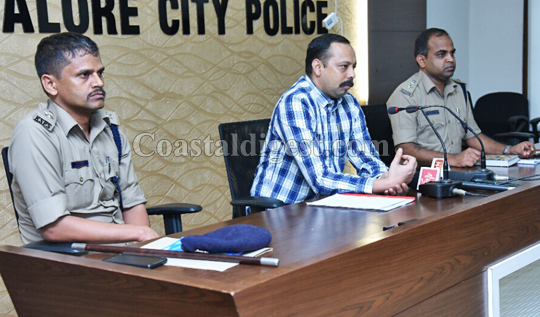
police meet 4

The arrested have been identified as Mohammed Haneef (24), resident of Bajpe Adyapady, Mohammed Ilyas (27), resident of Moodbidri, Ibrahim Liyaqat (26), resident of Naringana in Bantwal taluk and Abdul Rasheed (39), resident of Kilpady. Mohammed Haneef is one of the main accused in the murder case.

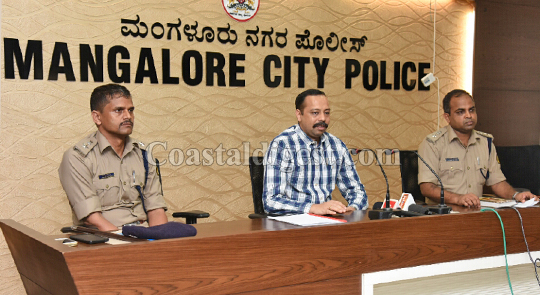
Addressing a press conference here on Sunday, Mangaluru City Police Commissioner S Murugan said that the investigating police team had identified five other main accused involved in the case who were absconding. The actual execution of the crime was done by six persons, he said.

On interrogation, the four arrested have confessed their involvement in two separate assault cases on Ashok and Vasu in Moodbidri police station limits and Jaya Kotian in Bajpe police station limits. In these cases, the police teams have collected evidence against the accused in this regard, he informed.

Mr Murugan said that the motive seemed to be communal, since the victim Prashanth was an activist belonging to a Hindutva outfit. The crime was a misguided venture by the accused, sparked by enmity due to previous communal attacks in the taluk, he said, adding that the crime should not be interpreted as a communal attack.

He also said that the police had not recorded the statement of eyewitness Vaman Poojary who allegedly committed suicide few days after the murder of Prashanth. The death may not be due to pressure from the police. There is no record of calls from overseas or persons involved in the murder, he told media persons.

It may be recalled that Dakshina Kannada MP Nalin Kumar kateel and other Sangh Parivar leaders had claimed that Vaman Poojary had received calls from Pakistan before he committed suicide.

police meet 1

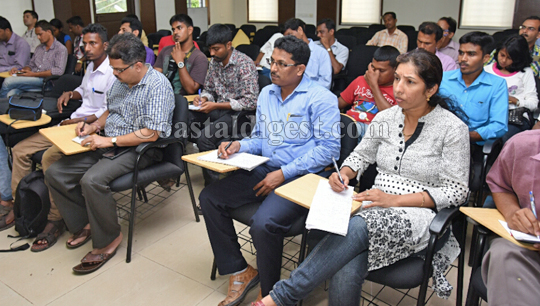
police meet 2

Comments

Eula
 - 
Friday, 12 Feb 2016

There are a few interesting things with time in this post but I don’t
know if I see these center to heart. There is some quality
but I will get hold opinion until I look into it further.
Good article, thanks and we wish more!

Also visit my weblog clash of lords
2 hack free: http://www.realhacks24.com/clash-of-lords-2-hack/

Brock
 - 
Friday, 12 Feb 2016

Next time I read a website, I really hope that it doesnt disappoint me as much as this one.
I mean, I know it had been my choice to learn, but I really
thought youd have something interesting to say.

Also visit my website; dungeon hunter 5
hack free download: http://Www.Darkhacks24.com/dungeon-hunter-5-hack/

Add new comment

  • Coastaldigest.com reserves the right to delete or block any comments.
  • Coastaldigset.com is not responsible for its readers’ comments.
  • Comments that are abusive, incendiary or irrelevant are strictly prohibited.
  • Please use a genuine email ID and provide your name to avoid reject.
Agencies
February 20,2020

India ranked 77th on a sustainability index that takes into account per capita carbon emissions and ability of children in a nation to live healthy lives and secures 131st spot on a flourishing ranking that measures the best chance at survival and well-being for children, according to a UN-backed report.

The report was released on Wednesday by a commission of over 40 child and adolescent health experts from around the world. It was commissioned by the World Health Organization (WHO), UN Children's Fund (UNICEF) and The Lancet medical journal.

In the report assessing the capacity of 180 countries to ensure that their youngsters can survive and thrive, India ranks 77th on the Sustainability Index and 131 on the Flourishing Index, it said.

Flourishing is the geometric mean of Surviving and Thriving. For Surviving, the authors selected maternal survival, survival in children younger than 5 years old, suicide, access to maternal and child health services, basic hygiene and sanitation, and lack of extreme poverty.

For Thriving, the domains were educational achievement, growth and nutrition, reproductive freedom, and protection from violence.

Under the Sustainability Index, the authors noted that promoting today's national conditions for children to survive and thrive must not come at the cost of eroding future global conditions for children's ability to flourish.

The Sustainability Index ranks countries on excess carbon emissions compared with the 2030 target. This provides a convenient and available proxy for a country's contribution to sustainability in future.

The report noted that under realistic assumptions about possible trajectories towards sustainable greenhouse gas emissions, models predict that global carbon emissions need to be reduced from 39·7 giga­ tonnes to 22·8 gigatonnes per year by 2030 to maintain even a 66 per cent chance of keeping global warming below 1·5°C.

It said that the world's survival depended on children being able to flourish, but no country is doing enough to give them a sustainable future.

"No country in the world is currently providing the conditions we need to support every child to grow up and have a healthy future," said Anthony Costello, Professor of Global Health and Sustainability at University College London, one of the lead authors of the report.

"Especially, they're under immediate threat from climate change and from commercial marketing, which has grown hugely in the last decade," said Costello – former WHO Director of Mother, Child and Adolescent health.

Norway leads the table for survival, health, education and nutrition rates - followed by South Korea and the Netherlands. Central African Republic, Chad and Somalia come at the bottom.

However, when taking into account per capita CO2 emissions, these top countries trail behind, with Norway 156th, the Republic of Korea 166th and the Netherlands 160th.

Each of the three emits 210 per cent more CO2 per capita than their 2030 target, the data shows, while the US, Australia, and Saudi Arabia are among the 10 worst emitters. The lowest emitters are Burundi, Chad and Somalia.

According to the report, the only countries on track to beat CO2 emission per capita targets by 2030, while also performing fairly – within the top 70 – on child flourishing measures are: Albania, Armenia, Grenada, Jordan, Moldova, Sri Lanka, Tunisia, Uruguay and Vietnam.

"More than 2 billion people live in countries where development is hampered by humanitarian crises, conflicts, and natural disasters, problems increasingly linked with climate change," said Minister Awa Coll-Seck from Senegal, Co-Chair of the commission.

The report also highlights the distinct threat posed to children from harmful marketing.

Evidence suggests that children in some countries see as many as 30,000 advertisements on television alone in a single year, while youth exposure to vaping (e-cigarettes) advertisements increased by more than 250 per cent in the US over two years, reaching more than 24 million young people.

Studies in Australia, Canada, Mexico, New Zealand and the US – among many others – have shown that self-regulation has not hampered commercial ability to advertise to children.

Children's exposure to commercial marketing of junk food and sugary beverages is associated with purchase of unhealthy foods and overweight and obesity, linking predatory marketing to the alarming rise in childhood obesity, it said.

The number of obese children and adolescents increased from 11 million in 1975 to 124 million in 2016 – an 11-fold increase, with dire individual and societal costs, the report said.

To protect children, the authors call for a new global movement driven by and for children.

Specific recommendations include stopping CO2 emissions with the utmost urgency, to ensure children have a future on this planet; placing children and adolescents at the centre of global efforts to achieve sustainable development, the report said.

New policies and investment in all sectors to work towards child health and rights; incorporating children's voices into policy decisions and tightening national regulation of harmful commercial marketing, supported by a new Optional Protocol to the UN Convention on the Rights of the Child, it said.


Comments

Add new comment

  • Coastaldigest.com reserves the right to delete or block any comments.
  • Coastaldigset.com is not responsible for its readers’ comments.
  • Comments that are abusive, incendiary or irrelevant are strictly prohibited.
  • Please use a genuine email ID and provide your name to avoid reject.
News Network
April 16,2020

Madikeri, Apr 16: A man from Ketumotte in Virajpet, who was cured of COVID-19 and returned to his home, has again been admitted to the hospital, following a complaint of fever, on Wednesday noon.

The man, who voluntarily got admitted to the hospital, is being treated in the isolation ward of the Covid-19 hospital. His throat swab and blood samples have been sent for testing. The report is likely to be out by Thursday morning.

After getting discharged from the hospital on April 7, he was home quarantined. After a week, he developed fever again. The person has not moved out of his house and the people need not fear, said Deputy Commissioner Annies Kanmani Joy.

Comments

Add new comment

  • Coastaldigest.com reserves the right to delete or block any comments.
  • Coastaldigset.com is not responsible for its readers’ comments.
  • Comments that are abusive, incendiary or irrelevant are strictly prohibited.
  • Please use a genuine email ID and provide your name to avoid reject.
News Network
May 17,2020

Bengaluru, May 17: Karnataka Deputy Chief Minister and Transport Minister Laxman Savadi on Sunday wrote to Union Minister Nitin Gadkari requesting to issue new lockdown guidelines including permission to operate public transport and said the lockdown has caused a financial loss of Rs 16,00 crore to all four Karnataka Transport Undertakings.

In view of these problems, the state Transport Minister requested Gadkari to permit the deployment of Non-AC buses on scheduled routes to ensure the adequacy of services.

The four State Transport Undertakings (STUs) in Karnataka which are providing bus-based public transport services within the state and to the neighbouring states are Karnataka State Road Transport Corporation (KSRTC), North West Karnataka Road Transport Corporation (NWKRTC), North Eastern Karnataka Road Transport Corporation (NEKRTC) and Bangalore Metropolitan Transport Corporation (BMTC).

"KSRTC, NWKRTC and NEKRTC operate buses for mofussil services i.e. Interdistrict, intradistrict and interstate, whereas BMTC operates only in urban and suburban areas in the city of Bengaluru. The four STUs put together hold a fleet of about 24,900 buses including 1,520 air-conditioned buses and operate about 71.00 lakh km. per day and carries about 98.00 lakh passengers every single day," Savadi outlined in the letter.

The Minister said due to the COVID-19 outbreak and the lockdown that ensued have brought regular bus operations and functioning to a grinding halt.

"This has caused a devastating impact on the operations of all the four STUs due to the combination of lack of revenue and continuing fixed costs such as salaries and pensions to staff, payables against existing loans etc. It has been estimated that the lockdown has caused a financial loss of INR 1,600/- crore to these four STUs," he added.

Savadi said even after post-COVID lockdown, operations and revenues won't reach its previous demand& supply patterns in the next six to eight months due to reduced economic activity and users' perceived risk of contacting COVID in public transport.

In addition to that, "occupancy should be allowed up to seating capacity (without standees). This is essential to meet minimal demand," he said in the letter.

"The crew should wear facemask and hand gloves. The crew with health issues should not be deployed. The face masks should be made mandatory for all the passengers. Only asymptomatic persons should be allowed to travel in public transport. The Government of India may consider staggering working hours for various sectors to reduce peak hour traffic demand," the minister listed out these recommendations in the letter.

Savadi said that with social distancing norm of reduced seating capacity in public transport, it will not be possible to provide transport facility to all the daily passengers. This will create demand for more buses, which cannot be met.

"Restrictions on public transport will lead to passenger commute by overcrowding in smaller vehicles like cars, maxi cabs, goods tempos etc. which will adversely affect preventive measures," he added.

Therefore, Savadi requested Union Minister to look into the above matter and issue fresh guidelines to all the states / UT's.

Comments

Add new comment

  • Coastaldigest.com reserves the right to delete or block any comments.
  • Coastaldigset.com is not responsible for its readers’ comments.
  • Comments that are abusive, incendiary or irrelevant are strictly prohibited.
  • Please use a genuine email ID and provide your name to avoid reject.