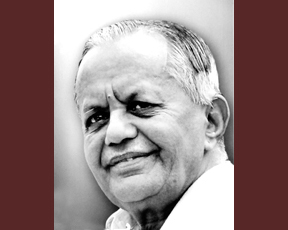
Freedom fighter, ‘Malnad Gandhi’ HG Govinde Gowda no more

[email protected] (CD Network)
January 6, 2016

Hassan, Jan 6: Freedom fighter, former Minister and well-known Gandhian HG Govinde Gowda breathed his last at his residence near Koppa in Chikkamagaluru district on Wednesday. He was 90.

malnadigandhiThe politician with a difference had been suffering from old-age-related health problems for the last few months. For the last one month, he was bed-ridden and was treated at his home ‘Manipura’.

Born on May 25, 1926, he was actively involved in the freedom struggle and got into politics later in Independent India through the town municipal council. He was known as ‘Malnad Gandhi’

He was elected president of Koppa Municipal Council in 1952. He was elected to the Legislative Assembly from Sringeri constituency for the first time in 1983. He was Minister for State for Primary Education and Adult Education between 1983 and 86.

Later in the Deve Gowda Cabinet, he was Primary and Secondary Education Minister. During his tenure, he was instrumental in introducing a common entrance test to recruit teachers. More than 90,000 teachers were appointed when he was the Minister. He quit politics in 1999, as his term as MLA came to an end.

He is survived by a wife and six children. The final rites would be held at his residence in Koppa on Thursday.

Comments

Iqbal
 - 
Wednesday, 6 Jan 2016

INNALILAHI WA INNA ILAYHI RAJIOON

Add new comment

  • Coastaldigest.com reserves the right to delete or block any comments.
  • Coastaldigset.com is not responsible for its readers’ comments.
  • Comments that are abusive, incendiary or irrelevant are strictly prohibited.
  • Please use a genuine email ID and provide your name to avoid reject.
Agencies
June 17,2020

Riyadh, Jun 17: Saudi Arabia is expected to scale back or call off this year's hajj pilgrimage for the first time in its modern history, observers say, a perilous decision as coronavirus cases spike.

Muslim nations are pressing Riyadh to give its much-delayed decision on whether the annual ritual will go ahead as scheduled in late July.

But as the kingdom negotiates a call fraught with political and economic risks in a tinderbox region, time is running out to organise logistics for one of the world's largest mass gatherings.

A full-scale hajj, which last year drew about 2.5 million pilgrims, appears increasingly unlikely after authorities advised Muslims in late March to defer preparations due to the fast-spreading disease.

"It's a toss-up between holding a nominal hajj and scrapping it entirely," a South Asian official in contact with Saudi hajj authorities said.

A Saudi official said: "The decision will soon be made and announced."

Indonesia, the world's most populous Muslim nation, withdrew from the pilgrimage this month after pressing Riyadh for clarity, with a minister calling it a "very bitter and difficult decision".

Malaysia, Senegal and Singapore followed suit with similar announcements.

Many other countries with Muslim populations -- from Egypt and Morocco to Turkey, Lebanon and Bulgaria -- have said they are still awaiting Riyadh's decision.

In countries like France, faith leaders have urged Muslims to "postpone" their pilgrimage plans until next year due to the prevailing risks.

The hajj, a must for able-bodied Muslims at least once in their lifetime, represents a major potential source of contagion as it packs millions of pilgrims into congested religious sites.

But any decision to limit or cancel the event risks annoying Muslim hardliners for whom religion trumps health concerns.

It could also trigger renewed scrutiny of the Saudi custodianship of Islam's holiest sites -- the kingdom's most powerful source of political legitimacy.

A series of deadly disasters over the years, including a 2015 stampede that killed up to 2,300 worshippers, has prompted criticism of the kingdom's management of the hajj.

"Saudi Arabia is caught between the devil and the deep blue sea," Umar Karim, a visiting fellow at the Royal United Services Institute in London, told AFP.

"The delay in announcing its decision shows it understands the political consequences of cancelling the hajj or reducing its scale."

"Buying time"

The kingdom is "buying time" as it treads cautiously, the South Asian official said.

"At the last minute if Saudi says 'we are ready to do a full hajj', (logistically) many countries will not be in a position" to participate, he said.

Amid an ongoing suspension of international flights, a reduced hajj with only local residents is a likely scenario, the official added.

A decision to cancel the hajj would be a first since the kingdom was founded in 1932.

Saudi Arabia managed to hold the pilgrimage during previous outbreaks of Ebola and MERS.

But it is struggling to contain the virus amid a serious spike in daily cases and deaths since authorities began easing a nationwide lockdown in late May.

In Saudi hospitals, sources say intensive care beds are fast filling up and a growing number of health workers are contracting the virus as the total number of cases has topped 130,000. Deaths surpassed 1,000 on Monday.

To counter the spike, authorities this month tightened lockdown restrictions in the city of Jeddah, gateway to the pilgrimage city of Mecca.

"Heartbroken"

"The hajj is the most important spiritual journey in the life of any Muslim, but if Saudi Arabia proceeds in this scenario it will not only exert pressure on its own health system," said Yasmine Farouk from the Carnegie Endowment for International Peace.

"It could also be widely held responsible for fanning the pandemic."

A cancelled or watered-down hajj would represent a major loss of revenue for the kingdom, which is already reeling from the twin shocks of the virus-induced slowdown and a plunge in oil prices.

The smaller year-round umrah pilgrimage was already suspended in March.

Together, they add $12 billion to the Saudi economy every year, according to government figures.

A negative decision would likely disappoint millions of Muslim pilgrims around the world who often invest their life savings and endure long waiting lists to make the trip.

"I can't help but be heartbroken -- I've been waiting for years," Indonesian civil servant Ria Taurisnawati, 37, told AFP as she sobbed.

"All my preparations were done, the clothes were ready and I got the necessary vaccination. But God has another plan."


Comments

Add new comment

  • Coastaldigest.com reserves the right to delete or block any comments.
  • Coastaldigset.com is not responsible for its readers’ comments.
  • Comments that are abusive, incendiary or irrelevant are strictly prohibited.
  • Please use a genuine email ID and provide your name to avoid reject.
News Network
June 18,2020

Bengaluru, Jun 18: The Karnataka police has arrested a German national wanted for kidnapping and causing bodily harm to a person in his home country, an official said on Wednesday. The person was also found to be overstaying on an expired visa, which police said that it appeared that the visa had been tampered with to look more current.

"On receipt of credible information by the CID Interpol Division officers, the Red Corner Notice subject, the German national Alexander Bruno Wehnelt, was traced at Hulimangala village," a police official told media persons.

Hulimangala is on the outskirts of Bengaluru city.

Alexander, 55, escaped from Germany and took shelter in Bengaluru.

The Interpol Division of CBI NCB (Central Bureau of Intelligence, Narcotics Control Bureau) in New Delhi had communicated to the Interpol liaison officer in Karnataka's Criminal Investigation Department (CID) about Alexander, directing extensive search measures to trace the criminal at large.

The Narcotics Control Bureau of Wiesbaden in Germany was on the hunt for Wehnelt for the crimes he committed in 2015, and have finally found him five years later.

"A special team of officers was constituted by the CID - Interpol division under the supervision of ADGP (Additional Director General of Police) B. Dayananda and the Interpol liaison officer and efforts were made to trace the subject," said the official.

On Monday, the police received credible information leading to his arrest.

"It was learnt that his visa had expired in 2016 and he tried to show a visa which was issued in December 2019 which had expired on Saturday, June 13," said the official.

Prima facie, it appeared that Alexander had tampered with his visa and the police are probing on that front as well.

He was handed over to Hebbagodi Police Station in Bengaluru Urban, for his overstay and a criminal case has been registered against him, under the Foreigners Act.

Comments

Add new comment

  • Coastaldigest.com reserves the right to delete or block any comments.
  • Coastaldigset.com is not responsible for its readers’ comments.
  • Comments that are abusive, incendiary or irrelevant are strictly prohibited.
  • Please use a genuine email ID and provide your name to avoid reject.
News Network
May 29,2020

New Delhi, May 29: Opining that there is no harm in importing ideas from abroad Swadeshi Jagran Manch, an affiliate of Rashtriya Swayamsevak Sangh, has suggested that India should take a cue from Pakistan and turn the “locust threat” into “chicken feed.

In an interview, Ashwani Mahajan, national co-convener of Swadeshi Jagran Manch (SJM) said: “I saw an article which shows that Pakistan has turned the locust threat into an opportunity by converting it into chicken feed”

“If there is a good idea originating from anywhere, we should be open to exploring such ideas. We should adopt good ideas. There is no harm in that,” he added.

He also shared the article on Twitter and wrote: “Pakistan turns locust threat into chicken feed. Need to understand the idea and replicate it in India.”

The article stated “an innovative pilot project in Pakistan’s Okara district offers a sustainable solution in which farmers earn money by trapping locusts that are turned into high-protein chicken feed by animal feed mills”.

“It was the brainchild of Muhammad Khurshid, a civil servant in the Ministry of National Food Security and Research, and Johar Ali, a bio-technologist from the Pakistan Agricultural Research Council,” according to the article.

Both Pakistan and India have been hit by locust attacks. These are desert locusts, which is one of the 12 species of short-horned grasshoppers. Swarms can comprise billions and travel up to 130 km in a day.

India has been battling the locust attacks with moderate success since December. However, the onset of monsoon could bring more trouble.

Comments

Add new comment

  • Coastaldigest.com reserves the right to delete or block any comments.
  • Coastaldigset.com is not responsible for its readers’ comments.
  • Comments that are abusive, incendiary or irrelevant are strictly prohibited.
  • Please use a genuine email ID and provide your name to avoid reject.