


French regiment in India brings back memories of Hyder-Tipu era

January 27, 2016

New Delhi, Jan 27: As the 124-member French military contingent marched down Rajpath amid loud cheers, they became the first foreign soldiers to take part in the Republic Day parade. But here's a fascinating fact — the moment brought the French Army, Indian Army, Pakistan Army, Tipu Sultan and the Swedish monarchy on the same side of history for the first time.
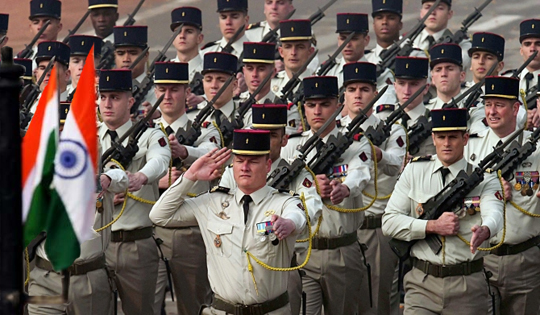
frenchregime1

The French marching contingent included 76 personnel from the 35th Infantry Regiment of the French Army (35e regiment d'infanterie). This regiment had served in India from 1781 to 1784 in its previous avatar as the 35 Aquitaine Regiment. As part of the Franco-Mysore alliance, it took part in the Second Anglo-Mysore War (1780-84), fought between the forces of the East India Company and the kingdom of Mysore under Hyder Ali and his son Tipu Sultan. The war ran parallel to the American Revolutionary War where the English were fighting their American colonies that were supported by the French.

During the war, Hyder Ali died and Tipu Sultan was forced to retreat to his capital in March 1783 when the Bombay Army invaded Mysore. The British decided to seize the opportunity to retake Cuddalore, which had been seized by Hyder from them earlier. The English advanced on Cuddalore with 1,600 European troops and 8,000 Indian troops and were joined by 1,000 cavalry of the Nawab of Arcot. Facing them were nearly 12,000 French and Indian troops, including 2,000 cavalry left behind by Tipu, under the command of Marquis de Bussy.

On June 25, 1783, the French tried to dislodge the British. At 3pm, the Aquitaine Regiment exchanged musket volleys with British and Indian troops and then conducted a bayonet charge. Facing this charge were Indian troops of the 24th Bengal Native Infantry and Madras Army. The charge was repulsed and the French withdrew with 450 men killed or wounded and 150 taken prisoners. Among those captured was Chevalier de Damas, who led the charge, and a young wounded soldier, Jean Baptiste de Bernadotte who later became a marshal in Napoleonic France and eventually became the king of Sweden. Interestingly, the House of Bernadotte still rules Sweden.

Meanwhile, the gallant action of the Indians was acknowledged and praised in England. "It was held as equally singular and extraordinary that the 24th battalion of the Bengal Sepoys, with another belonging to Madras, fought some of the oldest and best troops of France with the bayonet, and foiled them at that favourite European weapon, which is supposed to be the most trying test of the firmness and excellence of soldiers. It will probably then afford no small satisfaction to many who read this narrative, to be informed, that the general, in his address of thanks to the army, gave an assurance to those brave sepoys, that he would recommend their distinguished services to the governments of Bengal and Madras, that they, and their families, should be ever supported and rewarded according to their merit," reported the Annual Register of 1783 edited by none other than Edmund Burke.

The 24th Bengal Native Infantry later mutinied in 1857 and was disbanded, only to be re-raised in 1861. Today, it continues as the 6 Punjab Regiment of Pakistan Army.

The Aquitaine Regiment was withdrawn in 1784, while Mysore itself fell in 1799. Tipu's cavalry, which aided the French, later became the Mysore Lancers. After Independence, the Mysore, Gwalior and Jodhpur lancers were amalgamated into 61 Cavalry. On Tuesday, they marched immediately behind the French troops, as if it were a tribute to their former allies. Further back marched the brass band of the Madras Regimental Centre, the former nemesis of the French.

Comments

abumohammed
 - 
Wednesday, 27 Jan 2016

At least India Govt. look french army have latest weapons. In Our India army is still using oldest weapons, guns.. But in the filed of corruption India govt. is very new model

Add new comment

  • Coastaldigest.com reserves the right to delete or block any comments.
  • Coastaldigset.com is not responsible for its readers’ comments.
  • Comments that are abusive, incendiary or irrelevant are strictly prohibited.
  • Please use a genuine email ID and provide your name to avoid reject.
Ram Puniyani
March 8,2020

They say ‘history repeats itself first as a tragedy and then as a farce’. In case of India, communal violence not only keeps repeating itself, the pattern of the tragedy keeps changing every next time. Some features of the violence are constant, but they are under the wraps mostly. The same can be said about the Delhi violence (February 2020). The interpretations, the causative factors are very discernible, but those who are generally the perpetrators have a knack of shifting the blame on the victim community or those who stand for the victims.

As the carnage began presumably in the aftermath of statement of Kapil Mishra of BJP, which was given in front of a top police official, in which he threatened to get the roads emptied. The roots of violence were sown earlier. The interpretations given by the Hindu Nationalist camp is that the riot is due to the changing demographic profile of the area with Muslims increasing in number in those areas, and coming up of Shaheen Bagh which was presented was like ‘Mini Pakistan’. As per them the policies of BJP in matters of triple talaq, Article 370 and CAA, NPR, NRC has unnerved the ‘radical’ elements and so this violence.

As such before coming to the observations of the activists and scholars of communal violence in India, we can in brief say that violence, in which nearly 46 people have died, include one from police and another from intelligence. Majority victims are Muslims. The violence started right under the nose of the police and the ruling party. From the videos and other eye accounts, police not only looked the other way around, at places it assisted those attacking the innocent victims and burning and looting selective shops. Home minister, Amit Shah, was nowhere on the scene. For first three days the rioters had free run. After the paramilitary force was brought in; the violence simmered and slowly reduced in intensity. The state AAP Government, which in a way is the byproduct of RSS supported Anna Hazare movement, was busy reading Hanuman Chalisa and praying at Rajghat with eyes closed to the mayhem going in parts of Delhi.

Communal violence is the sore point of Indian society. It did begin during colonial period due to British policy of ‘Divide and Rule’. At root cause was the communal view of looking at history and pro active British acts to sow the seeds of Hindu-Muslim divide. At other level the administrative and police the British were fairly neutral. On one hand was the national movement, uniting the people and creating and strengthening the fraternal feeling among all Indians. On the other were Muslim Communalists (Muslim League) and Hindu Communalists (Hindu Mahasabha, RSS) who assisted the British goal of ‘divide and rule’ promoting hatred between the communities. After partition the first major change was the change in attitude of police and administration which started tilting against Muslims. Major studies by Dr. Asghar Ali Engineer, Paul Brass and Omar Khalidi demonstrated that anti Muslim bias is discernible in during and after the riots.

Now the partisan role of police has been visible all through. Sri Krishna Commission report brought forth this fact; as did the research of the Ex DIG of UP police Dr. V.N.Rai. Dr. Rai’s studies also concluded that no communal violence can go on beyond 24 hours unless state administration is complicit in the carnage. In one of the violence, investigation of which was done by concerned Citizen’s team (Dhule, 2013) this author observed that police itself went on to undertake the rampage against Muslims and Muslim properties.

General observation about riots is that violence sounds to be spontaneous, as the Home Minister is pointing out, but as such it is well planned act. Again the violence is orchestrated in such a way that it seems Muslims have begun the riots. Who casts the First stone? To this scholars point out that the carnage is so organized that the encircled community is forced to throw the first stone. At places the pretext is made that ‘they’ (minorities) have thrown the first stone.

The pretexts against minorities are propagated, in Gujarat violence Godhra train burning, in Kandhamal the murder of Swami Laxamannand and now Shaheen bagh! The Hindu Muslim violence began as riots. But it is no more a riot, two sides are not involved. It is plain and simple anti Minority violence, in which some from the majority are also the victims.

This violence is possible as the ‘Hate against this minority’ is now more or less structural. The deeper Hate against Muslims and partly against Christians; has been cultivated since long and Hindu nationalist politics, right from its Shakhas to the social media have been put to use for spreading Hatred. The prevalent deeper hate has been supplanted this time by multiple utterances from BJP leaders, Modi (Can be recognized by clothes), Shah (press EVM machine button so hard that current is felt in Shaheen Bagh), Anurag Thakur (Goli (bullet) Maro) Yogi Aditya Nath (If Boli (Words)Do not work Goli will) and Parvesh Varma (They will be out to rape).

The incidental observation of the whole tragedy is the coming to surface of true colors of AAP, which not only kept mum as the carnage was peaking but also went on to praise the role of police in the whole episode. With Delhi carnage “Goli Maro” seems to be becoming the central slogan of Hindu nationalists. Delhi’s this violence has been the first one in which those getting killed are more due to bullets than by swords or knifes! Leader’s slogans do not go in vain! Courts the protectors of our Constitution seem to be of little help as if one of them like Murlidhar Rao gives the verdict to file against hate mongers, he is immediately transferred.

And lastly let’s recall the academic study of Yale University. It concludes; BJP gains in electoral strength after every riot’. In India the grip of communalism is increasing frighteningly. Efforts are needed to combat Hate and Hate mongers.

Comments

Add new comment

  • Coastaldigest.com reserves the right to delete or block any comments.
  • Coastaldigset.com is not responsible for its readers’ comments.
  • Comments that are abusive, incendiary or irrelevant are strictly prohibited.
  • Please use a genuine email ID and provide your name to avoid reject.
News Network
April 7,2020

Wayanad, April 7: The Kerala government has allowed people from border villages of Karnataka and Tamil Nadu to use medical facilities at Wayanad.

"We have opened our borders to people from neighbouring states who require medical facilities in Kerala. Twenty-nine people from Bairakuppa in Karnataka have used medical facilities in Wayanad and 44 from Tamil Nadu," Kerala Chief Minister Pinarayi Vijayan said on Monday.

Bairakuppa, a small village in Karnataka, is separated by the river Kabini from Wayanad district and the residents there depend on the healthcare facilities available in Wayanad.

Speaking to news agency, Adeela Abdulla, District Collector of Wayanad, said that instructions have been issued to allow people from neighbouring states of Karnataka and Tamil Nadu, who need medical facilities, to cross the border.

"Right from the start of the lockdown, we have not restricted individuals from Bairakuppa region in Mysore district to use the medical facilities in Wayanad as people in that region depend on medical facilities in Wayanad," she said.

Comments

Add new comment

  • Coastaldigest.com reserves the right to delete or block any comments.
  • Coastaldigset.com is not responsible for its readers’ comments.
  • Comments that are abusive, incendiary or irrelevant are strictly prohibited.
  • Please use a genuine email ID and provide your name to avoid reject.
News Network
June 1,2020

Manglauru, Jun 1: The southwest monsoon has made an onset over Kerala, marking the commencement of the four-month long rainfall season, the India Meteorological Department said on Monday.

"The southwest monsoon has made an onset over Kerala," IMD director general Mrutyunjay Mohapatra said.

The four-month monsoon season from June to September accounts for 75 per cent of rainfall in the country.

Private forecaster Skymet Weather on May 30 had declared arrival of monsoon, but the IMD had differed, saying conditions were not ripe then for such an announcement.

Orange alert

Meanwhile, coastal Karnataka’s Dakshina Kannada district, which is receiving sporadic rains for past couple of days, is on orange alert.

Deputy Commissioner Sindhu B Rupesh declared the orange alert following IMD’s prediction of heavy rainfall in the region.

Comments

Add new comment

  • Coastaldigest.com reserves the right to delete or block any comments.
  • Coastaldigset.com is not responsible for its readers’ comments.
  • Comments that are abusive, incendiary or irrelevant are strictly prohibited.
  • Please use a genuine email ID and provide your name to avoid reject.