


French regiment in India brings back memories of Hyder-Tipu era

January 27, 2016

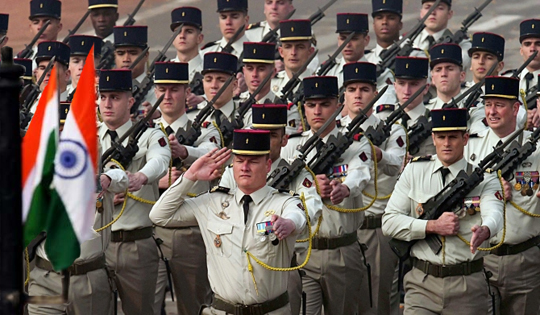
New Delhi, Jan 27: As the 124-member French military contingent marched down Rajpath amid loud cheers, they became the first foreign soldiers to take part in the Republic Day parade. But here's a fascinating fact — the moment brought the French Army, Indian Army, Pakistan Army, Tipu Sultan and the Swedish monarchy on the same side of history for the first time.
frenchregime1

The French marching contingent included 76 personnel from the 35th Infantry Regiment of the French Army (35e regiment d'infanterie). This regiment had served in India from 1781 to 1784 in its previous avatar as the 35 Aquitaine Regiment. As part of the Franco-Mysore alliance, it took part in the Second Anglo-Mysore War (1780-84), fought between the forces of the East India Company and the kingdom of Mysore under Hyder Ali and his son Tipu Sultan. The war ran parallel to the American Revolutionary War where the English were fighting their American colonies that were supported by the French.

During the war, Hyder Ali died and Tipu Sultan was forced to retreat to his capital in March 1783 when the Bombay Army invaded Mysore. The British decided to seize the opportunity to retake Cuddalore, which had been seized by Hyder from them earlier. The English advanced on Cuddalore with 1,600 European troops and 8,000 Indian troops and were joined by 1,000 cavalry of the Nawab of Arcot. Facing them were nearly 12,000 French and Indian troops, including 2,000 cavalry left behind by Tipu, under the command of Marquis de Bussy.

On June 25, 1783, the French tried to dislodge the British. At 3pm, the Aquitaine Regiment exchanged musket volleys with British and Indian troops and then conducted a bayonet charge. Facing this charge were Indian troops of the 24th Bengal Native Infantry and Madras Army. The charge was repulsed and the French withdrew with 450 men killed or wounded and 150 taken prisoners. Among those captured was Chevalier de Damas, who led the charge, and a young wounded soldier, Jean Baptiste de Bernadotte who later became a marshal in Napoleonic France and eventually became the king of Sweden. Interestingly, the House of Bernadotte still rules Sweden.

Meanwhile, the gallant action of the Indians was acknowledged and praised in England. "It was held as equally singular and extraordinary that the 24th battalion of the Bengal Sepoys, with another belonging to Madras, fought some of the oldest and best troops of France with the bayonet, and foiled them at that favourite European weapon, which is supposed to be the most trying test of the firmness and excellence of soldiers. It will probably then afford no small satisfaction to many who read this narrative, to be informed, that the general, in his address of thanks to the army, gave an assurance to those brave sepoys, that he would recommend their distinguished services to the governments of Bengal and Madras, that they, and their families, should be ever supported and rewarded according to their merit," reported the Annual Register of 1783 edited by none other than Edmund Burke.

The 24th Bengal Native Infantry later mutinied in 1857 and was disbanded, only to be re-raised in 1861. Today, it continues as the 6 Punjab Regiment of Pakistan Army.

The Aquitaine Regiment was withdrawn in 1784, while Mysore itself fell in 1799. Tipu's cavalry, which aided the French, later became the Mysore Lancers. After Independence, the Mysore, Gwalior and Jodhpur lancers were amalgamated into 61 Cavalry. On Tuesday, they marched immediately behind the French troops, as if it were a tribute to their former allies. Further back marched the brass band of the Madras Regimental Centre, the former nemesis of the French.

Comments

abumohammed
 - 
Wednesday, 27 Jan 2016

At least India Govt. look french army have latest weapons. In Our India army is still using oldest weapons, guns.. But in the filed of corruption India govt. is very new model

Add new comment

  • Coastaldigest.com reserves the right to delete or block any comments.
  • Coastaldigset.com is not responsible for its readers’ comments.
  • Comments that are abusive, incendiary or irrelevant are strictly prohibited.
  • Please use a genuine email ID and provide your name to avoid reject.
coastaldigest.com news network
June 23,2020

Mangaluru, June 23: G Jagadeesha, deputy commissioner of Udupi, who is heading the magisterial inquiry into the December 19 police firing case in Mangaluru, has sought more time from the government to submit the report.

Two innocent passersby - Nauseen Kudroli (49) and Abdul Jaleel Bengre (23) - were killed when policemen opened fire randomly after caning the alleged anti-CAA protesters in Mangaluru. 

The chief minister B S Yediyurappa led Karnataka state government had commissioned two inquires, one magisterial and the other CID, into the incident. 

“Due to the covid-19 pandemic the probe couldn’t be complete on time. I have asked the government for more time. Two more hearings are to be conducted,” said Mr Jagadeesha, who was expected to submit the report before the government on Tuesday.

Comments

Add new comment

  • Coastaldigest.com reserves the right to delete or block any comments.
  • Coastaldigset.com is not responsible for its readers’ comments.
  • Comments that are abusive, incendiary or irrelevant are strictly prohibited.
  • Please use a genuine email ID and provide your name to avoid reject.
Media Release
February 14,2020

Veteran journalist P. Sainath has said that the nation is in a crisis. And this crisis is not limited to just the rural area. It has become a national crisis at various areas such as agriculture, education, economy, job creation etc.

He was delivering the endowment lecture on the topic ‘Indian democracy at the post-liberalization and post-truth era’ at Media Manthan 2020 organized by the PG department of journalism and mass communication at St Aloysius College (Autonomous). 

Mr Sainath said that the many policies adopted in the 90s led to India becoming unusually unequal. Referring to the speech Ambedkar had made at the Constituent Assembly while handing over the draft of the Constitution, Mr Sainath said, “Ambedkar had warned about the weakness of Indian democracy that liberty without equality allows the supremacy of a few over the multitude. Liberty, equality and fraternity must be kept together as we cannot have one without the other.” 

Mr Sainath stated that the agrarian crisis was no longer about the loss of productivity, employment or about farmer suicide; it was a societal, civilizational crisis. Commenting on the lopsided policies such as cow-slaughter ban, he explained how cow slaughter ban had adversely affected many industries due to their interdependency. While Muslims who slaughtered cows were rendered helpless, the cattle traders who were mostly OBCs lost their earnings as the cattle prices crashed. An important industry like Kolhapur sandals industry in Maharashtra went bankrupt as a result of the cow slaughter ban in Maharashtra. He said the policymakers had no idea how the rural industries were interconnected. Demonetisation too devastated the rural economy as 98 percent of rural transactions happen through cash. 

Mr Sainath also spoke about the crisis of inequality which affects the Dalits and the Adivasis far more than anyone else as 90 percent of the rural households take home less than Rs 10,000/- per month. “Women are yet another group whose labour is never counted in the gross domestic product. Women and girls globally do unpaid work which amounts to about 12.5 billion working hours per year. Monetarily speaking, this is worth 10.8 trillion dollars,” Mr Sainath added. 

Speaking about the crisis of jobs Mr Sainath said that major companies were laying off employees just to create more profits for the investors and the adoption of artificial intelligence in the industry would further destroy millions of jobs.

Rector of St Aloysius College Institutions Fr Dionysius Vaz SJ, Principal Dr (Fr) Praveen Martis SJ, HOD of Journalism and Mass Communication department Dr (Fr) Melwyn Pinto SJ were present.

‘Veerappan and Vijay Mallya’s business models are interesting!’

Addressing the gathering during his endowment lecture on Friday, Mr Sainath made an interesting comment on the so called ‘revenue model’. “Whenever I visit IIMs and IITs for lectures on my PARI project, the students there ask me what my revenue model for my project is. I tell them that I do not have a revenue model. In fact, journalism does not begin with a revenue model. Gandhiji, Ambedkar, Bhagat Singh were all great journalists. But they did not have a revenue model,” Mr Sainath said.

On a lighter note, he said that the best revenue model that he liked was that of forest brigand Veerappan and liquor baron Vijay Mallya. “Veerappan ruled the forest for forty years and from the top ministers to the villagers he could dictate terms and liver royally. Similarly, Mallya’s revenue model was to steal the banks and run away abroad and live like a king,” Mr Sainath added.

Journalism is not and can never be a business. It is a calling, he opined. While newspaper can be a business, television can be a business, journalism per se cannot be reduced to a business. “Unfortunately today, journalists are recruited on a contract basis and they have no bargaining power; and there are no unions to fight for their cause. Hence, they are at the mercy of the corporate media houses for their survival and are made to write stories that cannot be called journalism,” Mr Sainath said.

Answering a question as to the pressures he faced as a journalist, he said that external pressures from the government or others could be very well handled. It is the internal pressures from once own media house that journalists find it difficult to manage.


Comments

Add new comment

  • Coastaldigest.com reserves the right to delete or block any comments.
  • Coastaldigset.com is not responsible for its readers’ comments.
  • Comments that are abusive, incendiary or irrelevant are strictly prohibited.
  • Please use a genuine email ID and provide your name to avoid reject.
News Network
June 8,2020

Bengaluru, Jun 8: Amid the relaxations in the coronavirus-induced lockdown, wedding planners are adapting to changing times and advancing themselves to provide best possible services to their clients.

Wedding planners come up with new trends. While women are matching their masks to their outfits, men who use turban for a wedding are wearing matching masks with the turbans. People are getting creative at the same time maintaining safety protocols. The live streaming of weddings for those who could not attend the wedding is also becoming a new normal.

Manisha Porwal Chouraria, a wedding planner at Color Palette Productions speaking to news agency said that Post COVID-19, weddings are performed as per the old cultures.

"Wedding Industry has impacted due to lockdown in the wake of COVID-19. Now, the concept of micro-wedding is trending in which you have guests who are close to you. Now, the old culture is back again as people who use to hold a wedding at lavish destinations are getting married in their lawns, farmhouses, terraces. Earlier, people used to get married in their 'Aangan' (Courtyard), people seem to be doing the same now. It is more personalised and expenses have come down, now. People are spending small amounts on decoration," said Chouraria.

"Following government guidelines, we are allowing 50 people at the wedding and not more than that. We are doing live streaming telecast and people can watch the wedding. We are also shipping gift boxes with a letter to 500 people who could not become part of the wedding. In the letter, we are writing that because of norms, you may not be invited but we want something to gift you on our wedding. People are planning to get married now and decide to throw a grand reception after 6 months in the hope that things will get better," she added.

Commenting upon how wedding planners are ensuring social distancing and how the fashion style changed due to pandemic, Chouraria said: "People are using matching masks. If women are wearing silk sarees, they are also wearing silk masks. Men are wearing matching masks with saafa (turban). The entire staff is asked to wear PPE kits. We are giving the guests a healthy kit comprising up of masks, sanitisers, gloves and tissues. We are doing thermal screening of the guests. We are also gifting cuddle curtains, a plastic transparent shield by using which you can touch feet of elders without physically touching them."

Mansi Porwal, Creative Head at Color Palette Productions said that it is becoming a challenging task for creative heads to plan wedding but still they are providing their best to the clients.

"Earlier people used to do theme wedding, big Indian Fat weddings. Now people are wedding with a small gathering. Now, family members are getting time to suggest the wedding planners about themes and the thing they want in their weddings. We are providing the best," she said.

"We have come up with a new theme, 'Har Din Subh hai' which means every day is auspicious. Post COVID-19 people are looking for available dates for the wedding. Now, every day becomes auspicious. This is going to be the new trend," she added.

Another wedding planner, Abhilash of Taarini Weddings said that their company is providing customised masks to guests.

"Earlier we have lots of weddings to cover across the globe. But now, we have less numbers of weddings. Budgets are reduced now. We are happy to start again. We are creating e-invites in which we are sending the guidelines to the guests. We also have a help desk to assist the clients and guests. We are providing the matching masks to the groom and we are also giving customized masks to guests too," he said.

Earlier, Karnataka's Department of Health and Family Welfare Services had issued an advisory for marriages, stating that not more than 50 guests shall be allowed and the consumption of liquor on the occasion will be prohibited.

As per the advisory, anyone found having fever, cold, cough, difficulty in breathing shall not be permitted to attend the event and immediately referred to seek medical advice.

"All persons shall wear face mask compulsorily. All persons shall maintain a physical distance of more than one metre. Hand wash with soap and water shall be provided in washrooms," adds the advisory.

Comments

Add new comment

  • Coastaldigest.com reserves the right to delete or block any comments.
  • Coastaldigset.com is not responsible for its readers’ comments.
  • Comments that are abusive, incendiary or irrelevant are strictly prohibited.
  • Please use a genuine email ID and provide your name to avoid reject.