


French regiment in India brings back memories of Hyder-Tipu era

January 27, 2016

New Delhi, Jan 27: As the 124-member French military contingent marched down Rajpath amid loud cheers, they became the first foreign soldiers to take part in the Republic Day parade. But here's a fascinating fact — the moment brought the French Army, Indian Army, Pakistan Army, Tipu Sultan and the Swedish monarchy on the same side of history for the first time.
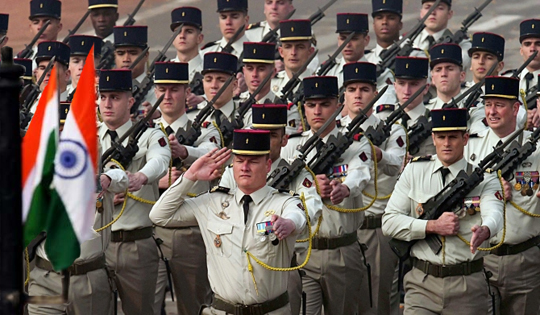
frenchregime1

The French marching contingent included 76 personnel from the 35th Infantry Regiment of the French Army (35e regiment d'infanterie). This regiment had served in India from 1781 to 1784 in its previous avatar as the 35 Aquitaine Regiment. As part of the Franco-Mysore alliance, it took part in the Second Anglo-Mysore War (1780-84), fought between the forces of the East India Company and the kingdom of Mysore under Hyder Ali and his son Tipu Sultan. The war ran parallel to the American Revolutionary War where the English were fighting their American colonies that were supported by the French.

During the war, Hyder Ali died and Tipu Sultan was forced to retreat to his capital in March 1783 when the Bombay Army invaded Mysore. The British decided to seize the opportunity to retake Cuddalore, which had been seized by Hyder from them earlier. The English advanced on Cuddalore with 1,600 European troops and 8,000 Indian troops and were joined by 1,000 cavalry of the Nawab of Arcot. Facing them were nearly 12,000 French and Indian troops, including 2,000 cavalry left behind by Tipu, under the command of Marquis de Bussy.

On June 25, 1783, the French tried to dislodge the British. At 3pm, the Aquitaine Regiment exchanged musket volleys with British and Indian troops and then conducted a bayonet charge. Facing this charge were Indian troops of the 24th Bengal Native Infantry and Madras Army. The charge was repulsed and the French withdrew with 450 men killed or wounded and 150 taken prisoners. Among those captured was Chevalier de Damas, who led the charge, and a young wounded soldier, Jean Baptiste de Bernadotte who later became a marshal in Napoleonic France and eventually became the king of Sweden. Interestingly, the House of Bernadotte still rules Sweden.

Meanwhile, the gallant action of the Indians was acknowledged and praised in England. "It was held as equally singular and extraordinary that the 24th battalion of the Bengal Sepoys, with another belonging to Madras, fought some of the oldest and best troops of France with the bayonet, and foiled them at that favourite European weapon, which is supposed to be the most trying test of the firmness and excellence of soldiers. It will probably then afford no small satisfaction to many who read this narrative, to be informed, that the general, in his address of thanks to the army, gave an assurance to those brave sepoys, that he would recommend their distinguished services to the governments of Bengal and Madras, that they, and their families, should be ever supported and rewarded according to their merit," reported the Annual Register of 1783 edited by none other than Edmund Burke.

The 24th Bengal Native Infantry later mutinied in 1857 and was disbanded, only to be re-raised in 1861. Today, it continues as the 6 Punjab Regiment of Pakistan Army.

The Aquitaine Regiment was withdrawn in 1784, while Mysore itself fell in 1799. Tipu's cavalry, which aided the French, later became the Mysore Lancers. After Independence, the Mysore, Gwalior and Jodhpur lancers were amalgamated into 61 Cavalry. On Tuesday, they marched immediately behind the French troops, as if it were a tribute to their former allies. Further back marched the brass band of the Madras Regimental Centre, the former nemesis of the French.

Comments

abumohammed
 - 
Wednesday, 27 Jan 2016

At least India Govt. look french army have latest weapons. In Our India army is still using oldest weapons, guns.. But in the filed of corruption India govt. is very new model

Add new comment

  • Coastaldigest.com reserves the right to delete or block any comments.
  • Coastaldigset.com is not responsible for its readers’ comments.
  • Comments that are abusive, incendiary or irrelevant are strictly prohibited.
  • Please use a genuine email ID and provide your name to avoid reject.
News Network
May 26,2020

Bengaluru, May 26: Ministers of the central government or state governments or officers on their official duty, who are travelling across states, will be exempted from requirements of quarantine, the Karnataka government said on Monday.

The state government issued an addendum to Standard Operating Procedure (SOP) for inter-state passengers.

"Any person who gets a negative COVID test certificate (from ICMR approved lab) which is not more than two days old from the date of journey will be exempted from the requirement of institutional quarantine," read the addendum.

The state government has laid down new norms for those coming from other states (including those coming by domestic air flights).

Passengers coming from 'high prevalence states' (Maharashtra, Gujarat, Tamil Nadu, Delhi, Rajasthan, Madhya Pradesh) would be required to undergo a seven-day "institutional quarantine", which will be followed by home quarantine.

The new norms also said that home quarantine of 14 days would be necessary for the passengers coming from other states.

Comments

Add new comment

  • Coastaldigest.com reserves the right to delete or block any comments.
  • Coastaldigset.com is not responsible for its readers’ comments.
  • Comments that are abusive, incendiary or irrelevant are strictly prohibited.
  • Please use a genuine email ID and provide your name to avoid reject.
News Network
June 4,2020

Bengaluru, Jun 4: Leader of Opposition in Karnataka Siddaramaiah on Thursday said it was not appropriate to reopen schools for two more months, given the current rate at which coronavirus infection is spreading.

He also advised Chief Minister B S Yediyurappa and Primary and Secondary Education Minister Suresh Kumar not to take any hasty decisions in this regard.

"As corona infection is spreading in the state beyond limits, it is not appropriate to open schools for at least two more months. Chief Minister and Suresh Kumar should not make any hasty decisions," Siddaramaiah tweeted.

Stating that Suresh Kumar has placed a proposal to reopen schools in July, he said the chief minister has to take note of worried parents opposing this proposal.

"There are reports about students getting infected by coronavirus after reopening of schools in countries like Britain, France and Italy. It is appropriate to think about reopening schools on analysing the situation after two months," he said in another tweet.

The state government has sought an opinion from parents and stakeholders regarding reopening of schools in the state, with the easing of the COVID-19 lockdown norms.

Amidst worries and concerns expressed by parents across the state, the Education Minister on Wednesday had assured that the government would not take any hasty decisions regarding reopening of schools.

The Union government, in its recent guidelines, had asked state governments to hold consultation at school, college, training and coaching institutions-level with parents and other stakeholders, and based on the feedback, a decision on reopening them would be taken.

Comments

Add new comment

  • Coastaldigest.com reserves the right to delete or block any comments.
  • Coastaldigset.com is not responsible for its readers’ comments.
  • Comments that are abusive, incendiary or irrelevant are strictly prohibited.
  • Please use a genuine email ID and provide your name to avoid reject.
Agencies
February 6,2020

Even more than three years after demonetisation and all-out efforts to make most transactions through electronic, cash is still king, as it thrives in a digital India, said fintech start-up Paytm founder Vijay Sekhar Sharma.

"While cashless economy is not possible in India, less cash economy will be in the future. Less cash is the only solution, not the elimination of cash," Sharma told IANS in an interview after unveiling an all-in-one payment gateway on Tuesday.

Asserting that it would take 5-10 years for India to make the transition to digital payments from the traditional mode of cash, Sharma, 41, said the e-payment industry benefitted more from the November 8, 2016 note ban and withdrawal of old Rs 1,000 and Rs 500 denominations.

"I think it (demonetisation) helped the industry despite lack of specific help. But the world has changed since then. It is about the scale of distribution of merchants that is what is propelling digital payments," said Sharma.

Most of the cash not only came back into circulation, but also remains as the mode of payment for the majority due to its convenience for the people used to such transactions.

Expounding Paytm's zero service charge, Sharma said the strategy is sustainable as it leads to acquiring more customers and merchants, enabling newer business opportunities.

Paytm also does not levy a service charge to small merchants for its payments services, unlike organised players like Uber.

"Though there is a monetisation model, the merchants who are small shopkeepers, become our financial services customers as they open a bank account, which is profitable."

Paytm secured a Payments Bank license from the Reserve Bank of India to offer a savings bank account, Rupay debit card and money transfer services.

"We are banking on payment services acquiring customers and merchants who avail banking, lending, insurance, wealth and software services like billing software and business ledger software services eventually," Sharma noted.

The mobile first bank services include zero balance and zero digital transaction charge accounts.

"Basically, payments, cloud, commerce and financial services are a cohort we follow. So, payments is our customer as well as merchant acquisition. If it breaks even, we are happy because other line items make more money, he affirmed.

Noting that in a market like India, one cannot price services at a premium unlike in a developed country like the US, the billionaire businessman said a consumer in a developing country would not be able to afford such a hefty charge.

Forbes ranked Sharma as India's youngest billionaire in 2017, with a net worth of $2.1 billion.

While several countries operate on the model of higher service charges, Sharma said newer business models have to be discovered in India, as customer lifecycle value is accounted for more stages than in other nations.

Asked about an upscale retailer like Zara not giving a wallet payment option during its recent end of season sale in Bengaluru, Sharma said Paytm was addressing such hiccups with its all-in-one payment solutions.

"It's an opportunity, because if the retailer has our all-in-one point of sale machine, where in they enter the amount, it shows both the Quick Response code (QR) and card payment options," he observed.

Sharma compared older swiping payment machine to feature phones and modern ones to feature-rich smartphones.

"If you notice, they look like feature phones and the modern day card machine is more a smartphone like. You can add the smatphone components, which can add the features," reiterated Sharma.

Though Paytm's all-in-one QR point of sale machine integrates the billing system, its chief executive said it was not ideal to have an independent QR feature.

Paytm has 16 million strong merchant user base, which Sharma aims to raise to 26 million base in the next one year.

Sharma has launched in this tech city an all-in-one payment gateway and Paytm Business Payments solution, which enable digital payments through multiple methods for small and medium enterprises (SMEs) and an Android point of sale machine.

With the new gateway solution, collecting digital payments through multiple methods can be achieved seamlessly while Paytm Business Payments solution enables automated vendor payments, including employee salaries and customer refunds among others.

The One97 Communications-owned Paytm aims to help SMEs streamline and digitise their business activities using its new solutions, which enhance the overall efficiency of both accepting and making payments.

Paytm has a data bank of over 200 million saved cards and bank accounts, a feature which enables partner apps to shorten transaction times and propel faster conversions while using the all-in-one payment gateway.

Complementing the two solutions, Sharma also launched an all-in-one Android point of sale machine, which can accept payments through all forms such as cards, wallets, UPI apps and even cash.

The device has a QR code that supports all contact and contactless payments, coming with integrated billing software customized solutions for different sectors such as catering, ticketing, parking and others.

The handheld Android device is equipped with an in-built printer, scanner and can also generate bills.

Valued at $16 billion, Paytm is not alone in the fiercely competitive Indian fintech space where a dozen players like PhonePe, MobiKwik, Kotak 811 and deep pocketed international giants Google Pay and Amazon Pay are in the fray.

Comments

Add new comment

  • Coastaldigest.com reserves the right to delete or block any comments.
  • Coastaldigset.com is not responsible for its readers’ comments.
  • Comments that are abusive, incendiary or irrelevant are strictly prohibited.
  • Please use a genuine email ID and provide your name to avoid reject.