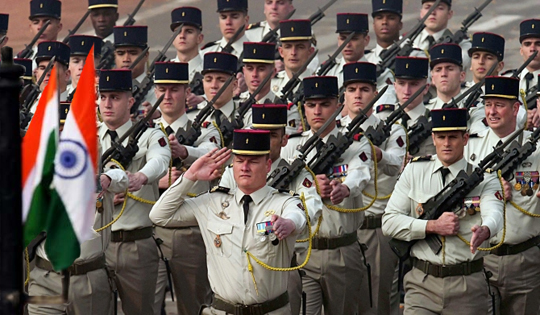
French regiment in India brings back memories of Hyder-Tipu era

January 27, 2016

New Delhi, Jan 27: As the 124-member French military contingent marched down Rajpath amid loud cheers, they became the first foreign soldiers to take part in the Republic Day parade. But here's a fascinating fact — the moment brought the French Army, Indian Army, Pakistan Army, Tipu Sultan and the Swedish monarchy on the same side of history for the first time.
frenchregime1

The French marching contingent included 76 personnel from the 35th Infantry Regiment of the French Army (35e regiment d'infanterie). This regiment had served in India from 1781 to 1784 in its previous avatar as the 35 Aquitaine Regiment. As part of the Franco-Mysore alliance, it took part in the Second Anglo-Mysore War (1780-84), fought between the forces of the East India Company and the kingdom of Mysore under Hyder Ali and his son Tipu Sultan. The war ran parallel to the American Revolutionary War where the English were fighting their American colonies that were supported by the French.

During the war, Hyder Ali died and Tipu Sultan was forced to retreat to his capital in March 1783 when the Bombay Army invaded Mysore. The British decided to seize the opportunity to retake Cuddalore, which had been seized by Hyder from them earlier. The English advanced on Cuddalore with 1,600 European troops and 8,000 Indian troops and were joined by 1,000 cavalry of the Nawab of Arcot. Facing them were nearly 12,000 French and Indian troops, including 2,000 cavalry left behind by Tipu, under the command of Marquis de Bussy.

On June 25, 1783, the French tried to dislodge the British. At 3pm, the Aquitaine Regiment exchanged musket volleys with British and Indian troops and then conducted a bayonet charge. Facing this charge were Indian troops of the 24th Bengal Native Infantry and Madras Army. The charge was repulsed and the French withdrew with 450 men killed or wounded and 150 taken prisoners. Among those captured was Chevalier de Damas, who led the charge, and a young wounded soldier, Jean Baptiste de Bernadotte who later became a marshal in Napoleonic France and eventually became the king of Sweden. Interestingly, the House of Bernadotte still rules Sweden.

Meanwhile, the gallant action of the Indians was acknowledged and praised in England. "It was held as equally singular and extraordinary that the 24th battalion of the Bengal Sepoys, with another belonging to Madras, fought some of the oldest and best troops of France with the bayonet, and foiled them at that favourite European weapon, which is supposed to be the most trying test of the firmness and excellence of soldiers. It will probably then afford no small satisfaction to many who read this narrative, to be informed, that the general, in his address of thanks to the army, gave an assurance to those brave sepoys, that he would recommend their distinguished services to the governments of Bengal and Madras, that they, and their families, should be ever supported and rewarded according to their merit," reported the Annual Register of 1783 edited by none other than Edmund Burke.

The 24th Bengal Native Infantry later mutinied in 1857 and was disbanded, only to be re-raised in 1861. Today, it continues as the 6 Punjab Regiment of Pakistan Army.

The Aquitaine Regiment was withdrawn in 1784, while Mysore itself fell in 1799. Tipu's cavalry, which aided the French, later became the Mysore Lancers. After Independence, the Mysore, Gwalior and Jodhpur lancers were amalgamated into 61 Cavalry. On Tuesday, they marched immediately behind the French troops, as if it were a tribute to their former allies. Further back marched the brass band of the Madras Regimental Centre, the former nemesis of the French.

Comments

abumohammed
 - 
Wednesday, 27 Jan 2016

At least India Govt. look french army have latest weapons. In Our India army is still using oldest weapons, guns.. But in the filed of corruption India govt. is very new model

Add new comment

  • Coastaldigest.com reserves the right to delete or block any comments.
  • Coastaldigset.com is not responsible for its readers’ comments.
  • Comments that are abusive, incendiary or irrelevant are strictly prohibited.
  • Please use a genuine email ID and provide your name to avoid reject.
coastaldigest.com news network
May 22,2020

It has been 33 years since the night of 22 May, 1987 when nearly 50 Muslim men from Hashimpura, a settlement in Meerut were rounded up and packed into the rear of a truck of the Provincial Armed Constabulary (PAC), an armed police of Uttar Pradesh. It was the blessed month of Ramadan and all the Muslims were fasting.

That night 42 of those on board the truck were killed in two massacres in neighbouring Ghaziabad district. One along the Upper Ganga canal near Muradnagar, the other along the Hindon canal in Makanpur, on the border with Delhi.

The cops had returned home after dumping the dead bodies into the canal. A few days later, the dead bodies were found floating in the canal and a case of murder was registered. 

Vir Bahadur Singh was the chief minister of Uttar Pradesh and Rajiv Gandhi was the prime minister of India when this incident took place. 

Not much has changed for the survivors and the relatives of the victims even today. The wounds are still fresh. Hashimpura remains devoid of basic municipal amenities, the erring silence on the narrow lanes of the locality amid the activities of a daily life speaks of the horror of the fateful day in 1987.

The massacre was the result of one among the many outcomes of the decision taken by the Rajiv Gandhi government to open the locks of Babri Masjid. After a month of rioting, the situation was tense in various parts of Meerut, and a lot spilled over in the nearby areas.

Timeline

May 22, 1987

Nearly 50 Muslims picked up by the PAC personnel from Hashimpura village in Meerut, Uttar Pradesh.
Victims later shot and bodies thrown into a canal. 42 persons declared dead.

1988

UP government orders CB-CID probe in the case.

February 1994

CB-CID submits inquiry report indicting over 60 PAC and police personnel of all ranks.

May 20, 1996

Charge sheet filed against 19 accused before Chief Judicial Magistrate, Ghaziabad by CB-CID of Uttar Pradesh police. 161 people listed as witnesses.

September 2002

Case transferred to Delhi by the Supreme Court on a petition by the families of victims and survivors.

July 2006

Delhi court frames charges of murder, attempt to murder, tampering with evidence and conspiracy under the IPC against 17 accused.

March 8, 2013

Trial court dismisses Subramanian Swamy's plea seeking probe into the alleged role of P Chidambaram, then Minister of State for Home, in the matter.

January 22, 2015

Trial court reserves judgement.

March 21, 2015

Court acquits 16 surviving accused giving them benefit of doubt regarding their identity.

May 18, 2015

Trial court decision challenged in the Delhi HC by the victims' families and eyewitnesses who survived the incident.

May 29, 2015

HC issues notice to the 16 PAC personnel on Uttar Pradesh government's appeal against the trial court verdict.

December 2015

National Human Rights Commission is impleaded in the matter. NHRC also seeks further probe into the massacre.

February 17, 2016

HC tags Swamy's appeal with the other petitions in the matter.

September 6, 2018

Delhi HC reserves verdict in the case.

October 31, 2018

Delhi HC convicts 16 former PAC personnel for life after finding them guilty of the murder of 42 people.

Comments

Add new comment

  • Coastaldigest.com reserves the right to delete or block any comments.
  • Coastaldigset.com is not responsible for its readers’ comments.
  • Comments that are abusive, incendiary or irrelevant are strictly prohibited.
  • Please use a genuine email ID and provide your name to avoid reject.
Agencies
April 15,2020

San Diego, Apr 15: Several people lost their sense of smell or taste weeks ago globally and are still waiting for it to come back and now, researchers have identified an association between sensory loss and novel coronavirus 2019 (COVID-19) infection, indicating that loss of smell and taste may be considered as early symptoms of the deadly disease.

Interestingly, the study also found that persons who reported experiencing a sore throat more often tested negative for COVID-19.

The team from University of California-San Diego found high prevalence and unique presentation of certain sensory impairments in patients positive with COVID-19.

Of those who reported a loss of smell and taste, the loss was typically profound, not mild.

"Based on our study, if you have smell and taste loss, you are more than 10 times more likely to have COVID-19 infection than other causes of infection. The most common first sign of a COVID-19 infection remains fever, but fatigue and loss of smell and taste follow as other very common initial symptoms," explained study researcher Carol Yan from UC San Diego.

"We know COVID-19 is an extremely contagious virus. This study supports the need to be aware of smell and taste loss as early signs of COVID-19," Yan added.

For the findings, published in the journal International Forum of Allergy and Rhinology, the research team surveyed 1,480 patients with flu-like symptoms and concerns regarding potential COVID-19 infection who underwent testing at UC San Diego Health from March 3 through March 29, 2020.

Within that total, 102 patients tested positive for the virus and 1,378 tested negatives. The study included responses from 59 COVID-19-positive patients and 203 COVID-19-negative patients.

Encouragingly, the rate of recovery of smell and taste was high and occurred usually within two to four weeks of infection.

"Our study not only showed that the high incidence of smell and taste is specific to COVID-19 infection but we fortunately also found that for the majority of people sensory recovery was generally rapid," said Yan.

"Among the COVID-19 patients with smell loss, more than 70 per cent had reported improvement of smell at the time of the survey and of those who hadn't reported improvement, many had only been diagnosed recently," she added.

Sensory return typically matched the timing of disease recovery.

In an effort to decrease the risk of virus transmission, UC San Diego Health now includes loss of smell and taste as a screening requirement for visitors and staff, as well as a marker for testing patients who may be positive for the virus.

"It is our hope that with these findings other institutions will follow suit and not only list smell and taste loss as a symptom of COVID-19, but use it as a screening measure for the virus across the world," Yan said.

Comments

Add new comment

  • Coastaldigest.com reserves the right to delete or block any comments.
  • Coastaldigset.com is not responsible for its readers’ comments.
  • Comments that are abusive, incendiary or irrelevant are strictly prohibited.
  • Please use a genuine email ID and provide your name to avoid reject.
coastaldigest.com news network
August 1,2020

Bengaluru, Aug 1:: Karnataka Minister BC Patil on Friday said that he has tested positive for Coronavirus.

"The report has confirmed me to be corona positive. I am in home quarantine at my residence in Bangalore," he said in a tweet.

"During a recent visit to Koppal district, five of the staff members who accompanied me were reported to be coronavirus positive," he tweeted.

Meanwhile, a total of 5,483 new COVID-19 cases and 84 deaths were reported in Karnataka, the state's health department informed on Friday.

Karnataka now has a total of 1,24,115 coronavirus cases, including 72,005 active cases and 49,788 discharges.

So far, 2,134 deaths have been reported from the state.

Comments

Add new comment

  • Coastaldigest.com reserves the right to delete or block any comments.
  • Coastaldigset.com is not responsible for its readers’ comments.
  • Comments that are abusive, incendiary or irrelevant are strictly prohibited.
  • Please use a genuine email ID and provide your name to avoid reject.