Furniture industry goes up in flames; children evacuated from 3 schools

[email protected] (CD Network | Chakravarthi)
February 1, 2016

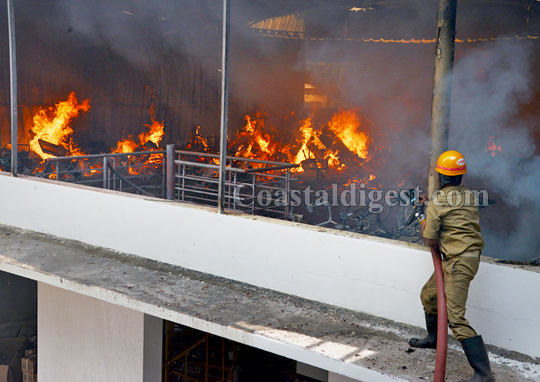
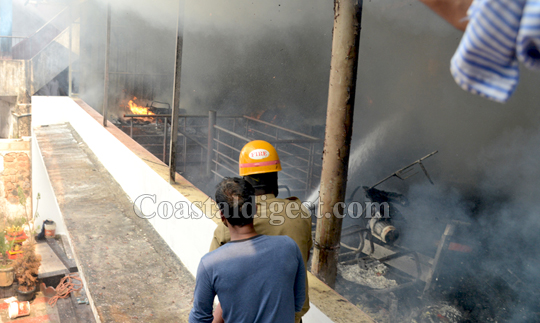
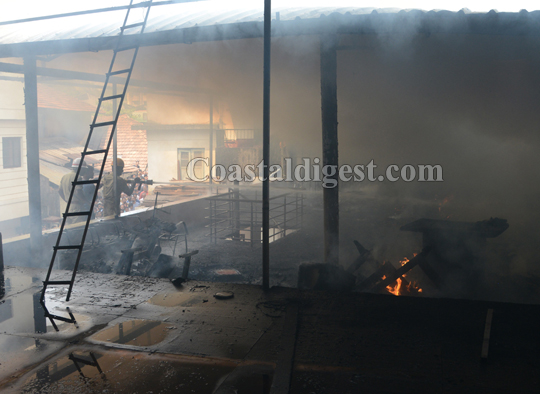
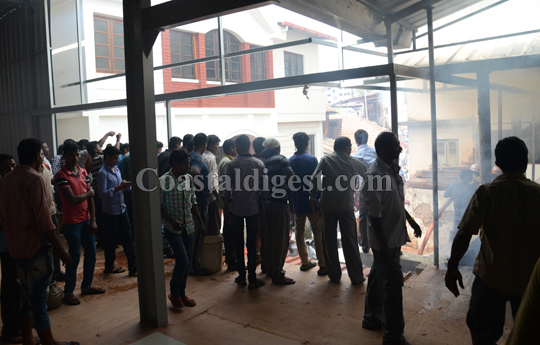
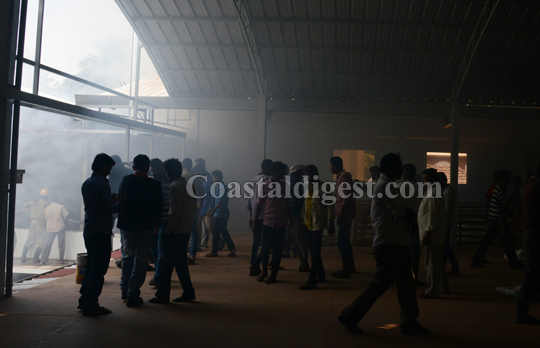
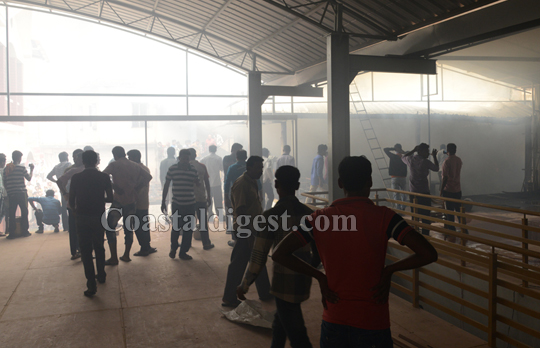
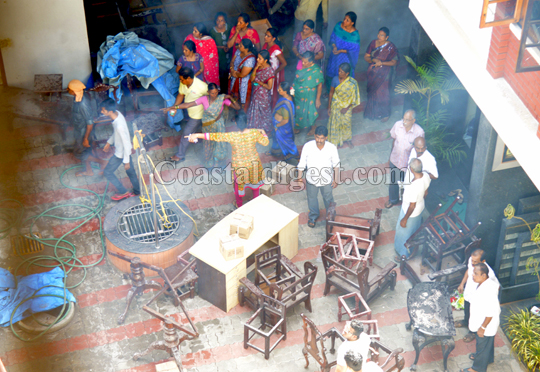
Mangaluru, Feb 1: A furniture factory located in sensitive area at Konchady in Mangaluru was gutted in a fire accident on Monday.

fire 1

Three education institutions, wherein hundreds of students study, are located close to the ill-fated Bhagya Jyothi Industries and Emerald Decor Pvt Ltd, a company of furniture and interior designing.

As soon as the fire began to engulf the factory, the managements of Vidya Nursery School, Vidya Higher Primary School and Indira Gandhi Memorial School evacuated the children as part of precautionary measures.

Fire tenders were alerted and they rushed to the spot, but by then the fire had spread. Several fire tenders and rescue personnel battled the blaze for a few hours to douse the flames.

Police said the estimated loss was around Rs 15 lakh.

fire 2

fire 3

fire 4

fire 5

fire 6

fire 7

fire 8

fire 9

fire 10

fire 11

fire 12

Comments

Asif
 - 
Tuesday, 2 Feb 2016

Al Hamdulillah!! Children are safe smiling & happy for the break

Add new comment

  • Coastaldigest.com reserves the right to delete or block any comments.
  • Coastaldigset.com is not responsible for its readers’ comments.
  • Comments that are abusive, incendiary or irrelevant are strictly prohibited.
  • Please use a genuine email ID and provide your name to avoid reject.
News Network
June 8,2020

Mangaluru, Jun 8: Forum Fiza Mall in Mangaluru on Monday reopened for public after Ministry of Home Affairs allowed the reopening of shopping malls from June 8 with certain precautionary measures amid COVID-19 pandemic.

People visited the mall wearing masks and maintaining social distancing.

Earlier, the Union Ministry of Home Affairs (MHA) had said that religious places and places of worship for public, hotels, restaurants and other hospitality services along with shopping malls will be permitted to open from June 8.

However, these facilities will not be able to resume operations inside containment zones designated by authorities in states, said a government notification.

Comments

Add new comment

  • Coastaldigest.com reserves the right to delete or block any comments.
  • Coastaldigset.com is not responsible for its readers’ comments.
  • Comments that are abusive, incendiary or irrelevant are strictly prohibited.
  • Please use a genuine email ID and provide your name to avoid reject.
coastaldigest.com web desk
May 22,2020

Newsroom, May 22: Countless netizens including Indians have hailed the action taken by Jazan University of Kingdom of Saudi Arabia against a high-ranking Indian expatriate who had posted called Indian Muslims as radicals.  

Social media platforms such as Twitter and Facebook flooded with appreciation after the University announced on Twitter that the professor, who had posted objectionable messsages, had been fired. The university, however, did not disclose the name of the professor. 

On its Twitter account, Jazan University wrote, “Based on what was monitored by the university about the publication of a contracted faculty member for offensive posts and tweets, his registration has already been folded. #JazanUniversity affirms that it resolutely addresses any perverted or extremist ideas that affect the constants or violate the directions of good leadership.”

After the university’s announcement, many on Twitter posted screenshots of the communal tweets claiming that the professor is Neeraj Bedi and made it clear that the dismissed professor is an Indian.

Bedi has been working as full time Professor in Faculty of Public Health and Tropical Medicine in Jazan University for years.

In his Twitter account, which does not currently exist, he was praising PM Modi and spewing poison against Islam and holding Muslims responsible for the spread of Coronavirus. It is believed that the account was deleted after the protests became severe.

Comments

Add new comment

  • Coastaldigest.com reserves the right to delete or block any comments.
  • Coastaldigset.com is not responsible for its readers’ comments.
  • Comments that are abusive, incendiary or irrelevant are strictly prohibited.
  • Please use a genuine email ID and provide your name to avoid reject.
News Network
April 2,2020

The current physical distancing guidelines provided by the World Health Organisation (WHO) and by the US Centers for Disease Control and Prevention (CDC) may not be adequate to curb the coronavirus spread, according to a research which says the gas cloud from a cough or sneeze may help virus particles travel up to 8 metres. The research, published in the Journal of the American Medical Association, noted that the the current guidelines issued by the WHO and CDC are based on outdated models from the 1930s of how gas clouds from a cough, sneeze, or exhalation spread.

Study author, MIT associate professor Lydia Bourouiba, warned that droplets of all sizes can travel 23 to 27 feet, or 7-8 metres, carrying the pathogen.

According to Bourouiba, the current guidelines are based on "arbitrary" assumptions of droplet size, "overly simplified", and "may limit the effectiveness of the proposed interventions" against the deadly pandemic.

 She explained that the old guidelines assume droplets to be one of two categories, small or large, taking short-range semi-ballistic trajectories when a person exhales, coughs, or sneezes.

However based on more recent discoveries, the MIT scientist said, sneezes and coughs are made of a puff cloud that carries ambient air, transporting within it clusters of droplets of a wide range of sizes.

Bourouiba warned that this puff cloud, with ambient air entrapped in it, can offer the droplets moisture and warmth that can prevent it from evaporation in the outer environment.

"The locally moist and warm atmosphere within the turbulent gas cloud allows the contained droplets to evade evaporation for much longer than occurs with isolated droplets," she said.

"Under these conditions, the lifetime of a droplet could be considerably extended by a factor of up to 1000, from a fraction of a second to minutes," the researcher explained in the study.

The MIT scientist, who has researched the dynamics of coughs and sneezes for years, added that these droplets settle along the trajectory of a cough or sneeze contaminating surfaces, with their residues staying suspended in the air for hours.

"Even when maximum containment policies were enforced, the rapid international spread of COVID-19 suggests that using arbitrary droplet size cutoffs may not accurately reflect what actually occurs with respiratory emissions, possibly contributing to the ineffectiveness of some procedures used to limit the spread of respiratory disease," Bourouiba wrote in the study


Comments

Add new comment

  • Coastaldigest.com reserves the right to delete or block any comments.
  • Coastaldigset.com is not responsible for its readers’ comments.
  • Comments that are abusive, incendiary or irrelevant are strictly prohibited.
  • Please use a genuine email ID and provide your name to avoid reject.