


Gandhi ashram's Muslim head dead; prefers cremation over burial

October 9, 2016

Ahmedabad, Oct 9: "My life is my message", said Mahatma Gandhi. And one of Bapu's original disciples, Abdul Hamid Kureshi, 89 -the chair man of the Sabarmati Ashram - has enclosed a message in his death. Kureshi, who was also an eminent lawyer, chose to be cremated and not buried.gandhi
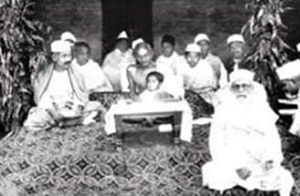
Kureshi breathed his last at the breakfast table in his residence in Swastik Society, Navrangpura, on Saturday morning. Sabarmati Ashram was the cradle of Bapu's revolutionary ideas to win freedom from the British.

It was a rare sight at the Mukti Dham crematorium in Paldi where Kureshi's illustrious family gathered for his final rites. Senior members of the higher judiciary and distinguished lawyers stood alongside the grieving family . Kureshi was the grandson of Imam Saheb Abdul Kadir Bawazir, a close associate of Bapu in South Africa.Bapu referred to Imam Bawazir as his "sahodar", brother born from the same mother.

"Kureshi saheb wished to be cremated because he did not want to waste land with his burial," said Bharat Naik, the sonin-law of Kureshi's brother, Wahid Kureshi. "In fact, he made me a witness to the decision in the presence of other family members." Over the past four years, Kureshi had been reminding his son, Justice Akil Kureshi, and Naik that they should ensure he is cremated. He asserted that if anyone objected, the person should be told of his last wish.Kureshi was cremated after 7 pm.

Kureshi was born in the Sabarmati Ashram in Ahmedabad where Imam Bawazir had settled with Bapu in 1915. Born in 1927, Kureshi grew up on Bapu's lap till Bapu embarked on the Dandi March in 1930. Kureshi was one of the few kids who ate tomato slices from Bapu's lunch. Bapu wrote letters to a young Kureshi, which were later donated to the National Archives of India.

"Kureshi's father, Ghulam Rasool, was part of `Arun Tukdi' that walked ahead of the Dandi March procession," said Sabarmati Ashram director Tridip Suhrud. "The team had to ensure that arrangements for meetings and halts were in place."

After Ghulam Rasool and his wife were arrested during the Dandi March, Abdul Hamid, his brother Wahid, and sister Sultana were brought up for a few years by Anasuya Sarabhai, said the secretary of the ashram, Amrut Modi. "Sarabhai was a Gandhian and pioneer of women's labour movement in India," he said. Rizwan Kadri, an Ahmedabad-based historian, said that in September1942 Kureshi was arrested in Detroj during the Quit India movement.

Kureshi became the chairman of the Sabarmati Ashram trust three years ago. A peace activist at heart, Kureshi worked to build bridges between Hindus and Muslims and penned a book titled " Agnipariksha" after the 1969 communal riots in Gujarat.

Comments

shaji
 - 
Monday, 10 Oct 2016

None can stop if any one wants to follow Sataan and enter Hell. I think this idiot deserves it. He did not agree to waste land but agree to pollute atmosphere thereby creating pollution. I am sure he was a follower of Satan and he will meet his Guru in the Hell.

Onte Moothra, …
 - 
Monday, 10 Oct 2016

Good muslim, doesn't want to meet 72 houris.

Add new comment

  • Coastaldigest.com reserves the right to delete or block any comments.
  • Coastaldigset.com is not responsible for its readers’ comments.
  • Comments that are abusive, incendiary or irrelevant are strictly prohibited.
  • Please use a genuine email ID and provide your name to avoid reject.
coastaldigest.com news network
June 9,2020

Bengaluru, Jun 9: The total number of positive COVID-19 cases in Karnataka rose to 5,921 on Tuesday after the state reported two deaths and 161 new cases of the virus.

"Two deaths and 161 new COVID-19 positive cases reported from yesterday 5 pm till today at 5 pm, taking the total number of positive cases to 5,921," said Karnataka Health Department.

The toll in the state is presently at 66.

While 164 patients have been discharged today, the number of discharged patients so far is 2,605. The active cases in the state stands at 3,248.

Among the new cases, Yadgir contributed highest (61), followed by Bengaluru Urban (29) and Dakshina Kannada (23). Udupi did not report any new case. More details to follow.

Comments

Add new comment

  • Coastaldigest.com reserves the right to delete or block any comments.
  • Coastaldigset.com is not responsible for its readers’ comments.
  • Comments that are abusive, incendiary or irrelevant are strictly prohibited.
  • Please use a genuine email ID and provide your name to avoid reject.
Ram Puniyani
March 14,2020

In the wake of Citizenship Amendment Act (CAA) UN High Commissioner, Michele Bachelet, has filed an intervention in the Supreme Court petition challenging the constitutionality of the Citizenship Amendment Act, as she is critical of CAA. Responding to her, India’s Foreign Minister S. Jai Shanker strongly rebutted her criticism, saying that the body (UNHCR) has been wrong and is blind to the problem of cross border terrorism. The issue on hand is the possibility of scores of people, mainly Muslims, being declared as stateless. The problem at hand is the massive exercise of going through the responses/documents from over 120 crore of Indian population and screening documents, which as seen in Assam, yield result which are far from truthful or necessary.

The issue of CAA has been extensively debated and despite heavy critique of the same by large number of groups and despite the biggest mass opposition ever to any move in Independent India, the Government is determined on going ahead with an exercise which is reminiscent of the dreaded regimes which are sectarian and heartless to its citizens, which have indulged in extinction of large mass of people on grounds of citizenship, race etc. The Foreign minister’s assertion is that it is a matter internal to India, where India’s sovereignty is all that matters! As far as sovereignty is concerned we should be clear that in current times any sovereign power has to consider the need to uphold the citizenship as per the principle of non-discrimination which is stipulated in Art.26 of the International Covenant on Civil and Political (ICCPR) rights.

Can such policies, which affect large number of people and are likely to affect their citizenship be purely regarded as ‘internal’? With the World turning into a global village, some global norms have been formulated during last few decades. The norms relate to Human rights and migrations have been codified. India is also signatory to many such covenants in including ICCPR, which deals with the norms for dealing with refugees from other countries. One is not talking of Chicago speech of Swami Vivekanand, which said that India’s greatness has been in giving shelter to people from different parts of the World; one is also not talking of the Tattariaya Upanishad’s ‘Atithi Devovhav’ or ‘Vasudhaiva Kutumbkam’ from Mahaupanishad today.

What are being talked about are the values and opinions of organizations which want to ensure to preserve of Human rights of all people Worldwide. In this matter India is calling United Nations body as ‘foreign party’; having no locus standi in the case as it pertains to India’s sovereignty. The truth is that since various countries are signatories to UN covenants, UN bodies have been monitoring the moves of different states and intervening at legal level as Amicus (Friend of the Court) to the courts in different countries and different global bodies. Just to mention some of these, UN and High Commissioner for Human Rights has often submitted amicus briefs in different judicial platforms. Some examples are their intervention in US Supreme Court, European Court of Human Rights, International Criminal Court, and the Inter-American Court of Human Rights. These are meant to help the Courts in areas where UN bodies have expertise.

 Expertise on this has been jointly formulated by various nations. These interventions also remind the nations as to what global norms have been evolved and what are the obligations of individual states to the values which have evolved over a period of time. Arvind Narrain draws our attention to the fact that, “commission has intervened in the European Court of Human Rights in cases involving Spain and Italy to underscore the principle of non-refoulement, which bars compulsory expulsion of illegal migrants… Similarly, the UN has intervened in the International Criminal Court in a case against the Central African Republic to explicate on the international jurisprudence on rape as a war crime.”

From time to time organizations like Amnesty International and Human Rights Watch have been monitoring the status of Human rights of different countries. This puts those countries in uncomfortable situation and is not welcome by those establishments. How should this contradiction between ‘internal matter’, ‘sovereignty’ and the norms for Human rights be resolved? This is a tough question at the time when the freedom indices and democratic ethos are sliding downwards all over the world. In India too has slid down on the scale of these norms.

In India we can look at the intervention of UN body from the angle of equality and non discrimination. Democratic spirit should encourage us to have a rethink on the matters which have been decided by the state. In the face of the greatest mass movement of Shaheen bagh, the state does need to look inwards and give a thought to international morality, the spirit of global family to state the least.

The popular perception is that when Christians were being persecuted in Kandhmal the global Christian community’s voice was not strong enough. Currently in the face of Delhi carnage many a Muslim majority countries have spoken. While Mr. Modi claims that his good relations with Muslim countries are a matter of heartburn to the parties like Congress, he needs to relook at his self gloating. Currently Iran, Malaysia, Indonesia and many Muslim majority countries have spoken against what Modi regime is unleashing in India. Bangladesh, our neighbor, has also seen various protests against the plight of Muslims in India. More than the ‘internal matter’ etc. what needs to be thought out is the moral aspect of the whole issue. We pride ourselves in treading the path of morality. What does that say in present context when while large section of local media is servile to the state, section of global media has strongly brought forward what is happening to minorities in India.   

The hope is that Indian Government wakes up to its International obligations, to the worsening of India’s image in the World due to CAA and the horrific violence witnessed in Delhi.

Comments

Add new comment

  • Coastaldigest.com reserves the right to delete or block any comments.
  • Coastaldigset.com is not responsible for its readers’ comments.
  • Comments that are abusive, incendiary or irrelevant are strictly prohibited.
  • Please use a genuine email ID and provide your name to avoid reject.
News Network
February 17,2020

Varanasi, Feb 17: For the first time, the Indian Railways has reserved a seat for a deity on a train. The national transporter, which launched its third IRCTC operated train named Kashi Mahakal Express from Varanasi to Indore, has reserved a seat for Lord Mahakal (Lord Shiva) on board.

Speaking to media, Northern Railway spokesperson Deepak Kumar said: "It is for the first time that a seat has been left reserved for a deity."

"One seat in Kashi Mahakal Express (seat number 64 in B5 coach) has been left reserved for Lord Shiva," he said.

"Even a temple has been drawn on the seat to make people aware that the seat is reserved for Lord Mahakal," he said.

IRCTC's Director, Tourism, Rajni Hasija said that the practice would continue beyond the inaugural run.

Prime Minister Narendra Modi flagged off the Kashi Mahakal Express via video conferencing from Varanasi, where he is all launched several projects worth Rs 1,250 crore during the day's visit to his parliamentary constituency.

The third IRCTC train, after the two Tejas Express trains on New Delhi-Lucknow and Mumbai-Ahmedabad routes, the Kashi Mahakal Express will connect three places -- Jyotirlinga-Omkareshwar (near Indore), Mahakaleshwar (Ujjain) and Kashi Vishwanath (at Varanasi).

Also connecting the industrial and educational hub of Indore, with Bhopal, the train will begin its commercial run from February 20.

"The Kashi Mahakal Express will operate three days in a week and it will be a bi-weekly service through the Sultanpur-Lucknow route and a weekly service via the Prayagraj route," Kumar said.

Elaborating on the two routes from which the train will pass every week, Hasija said: "Once the new train starts its regular run from this week, it will depart from Varanasi at 2.45 p.m. every Tuesday and Thursday to reach Indore at 9.40 a.m. on Wednesday and Friday.

Similarly, the train will start from Indore at 10.55 a.m. every Wednesday and Friday and will reach Varanasi at 6.00 a.m. the next day. This train will have stoppages at Ujjain, Sant Hirdaram Nagar, Bina, Jhansi, Kanpur and Sultanpur stations in both directions.

Meanwhile, in the weekly service via Prayagraj route, the Kashi Mahakal Express will depart from Varanasi at 3.15 p.m. every Sunday to reach Indore at 9.40 a.m. the next day. On the other way, it will depart from Indore at 10.55 a.m. every Monday and reach Varanasi at 5 a.m. the next day.

"This train will halt at Ujjain, Sant Hirdaram Nagar, Bina, Jhansi, Kanpur and Allahabad stations in both directions," Kumar said.

Explaining the fares of the Kashi Mahakal Express, Hasija said, "Kashi Mahakal Express will follow a dynamic fare structure like the other two Tejas Express trains."

One-way journey from Varnasi to Indore will cost Rs 1,951, inclusive of four meals.

According to the IRCTC officials, the Indore-Varanasi Kashi Mahakal Express will be the first private train that will run overnight and for a comfortable long distance journey, will feature a host of facilities. The IRCTC will serve vegetarian food, and provide housekeeping services, on-board security services and bedrolls.

The IRCTC officials said that passengers will also get complementary insurance of Rs 10 lakh.

The train will have an advance reservation period of 120 days and will only have the general and foreign tourist quotas. The current booking will be available to the passengers on the platform itself after preparation of first chart, four hours to five minutes before the scheduled departure of the train.

To facilitate travel for pilgrims, the IRCTC is also introducing special tour packages for passengers who want to see the pilgrim centres enroute. The tour options are; Mahakal Darshan (Ujjain - Omkareshwar), Bhopal-Sanchi-Bhimbetka, Malwa Jyotrilinga Darshan (Ujjain-Omkareshwar- Maheshwar- Indore) and Bhopal-Sanchi-Bhimbetka-Ujjain. Other tour options include Kashi, Ayodhya and Prayag; Kashi Darshan; Kashi, Prayag, Ayodhya; Kashi and Prayag and only Kashi.

The train has silent features like CCTV cameras, which will be monitored online around the clock from the IRCTC centres, whereas for the first time the IRCTC has brought the marshals in the train for passengers safety and also to make people aware to not smoke inside the train as it has smoke and heat sensors installed in the coaches as well as in the bathroom. For the blind passengers, the train coaches have the seat numbers written in Braille, and the catering staff will be dressed in yellow kurta-pyjamas with a rudraksh malas on their necks to promote the train's theme.

Comments

ASIF
 - 
Tuesday, 18 Feb 2020

waw.. good header with superb news..

good going !!

Althaf
 - 
Tuesday, 18 Feb 2020

If you are truthful then go to china and stay with patients of carona virus. The carona virus should not affect you as you are a vegeterian. Prove this first. 

Add new comment

  • Coastaldigest.com reserves the right to delete or block any comments.
  • Coastaldigset.com is not responsible for its readers’ comments.
  • Comments that are abusive, incendiary or irrelevant are strictly prohibited.
  • Please use a genuine email ID and provide your name to avoid reject.