'Gau rakshaks' are victims not tyrants, says VHP

Agencies
July 5, 2017

New Delhi, Jul 5: It has only been a few days since prime minister Narendra Modi lashed out at violence in the name of cow protection, but the Viswa Hindu Parishad (VHP) seems to be not in a mood to embrace the PM's view.surendrajain
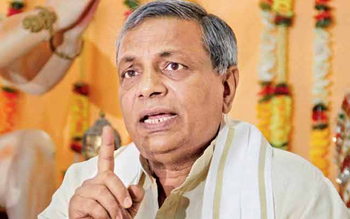
In a gesture of wholehearted support to the cow vigilante groups, the Hindutva outfit on Tuesday said cow protectors or 'gau-rakshaks' were 'victims not tyrants".

VHP international joint secretary, Surendra Jain, said the strong meat lobby was trying to malign the holy vow of cow protection.

"In last 10 years, more than 50 policemen and gau-rakshaks were killed by the cow butchers. These killers or jehadis have brutally murdered the innocent people committed for the cause of cow protection," he said.

Stating that there is no place for violence in the holy resolve to protect the cow, Jain added but everyone including a cow protector has right to self-defense.

"Cow protectors are victims not tyrants as some people are trying to establish".

VHP's remarks in support of cow protectors, comes days after Modi had said that killing people in the name of cow protection is not acceptable.

Taking on the organizers of the 'Not in My Name' protests, taken out against lynching of people, especially Muslims in the name of cow protection, Jain said "the placard-carrying groups with selfish interests were trying to malign the holy resolve of cow-protection".

"These people will question our brave soldiers fighting in Kashmir but support Yakub Memon by opposing his death sentence," he added.

At present, VHP runs more than 450 'gaushalas' (shelters for cows) in different parts of the country and more than 1,500 similar shelters are run by its volunteers.

Violence unleashed by gau rakshaks have been on the rise in the country in recent years and the lynching of a Muslim teen, Juanid, by a mob on board a train for allegedly carrying beef sparked a wide range of debate on the issue of late.

Comments

Sitara
 - 
Saturday, 8 Jul 2017

RSS terrorists would not listen to the word of CM they need special treatment from CM & Army. Shut down RSS members business and revoke their govt employment contract. Do not allow them to work in educational institutions & banks. Watch out how they are doing GST.

Mani
 - 
Saturday, 8 Jul 2017

Har hara ...sharath .......

VIREN ...his blood will not go waste ...you are right .....as these blood meant for killing innocents ..so few innocent lives spared from Sharath ..you started it so you people should stop it

you know that ...MUSLIMS will never ever surrender to Fascists or any dictators ...what ever might be the consequence ......Jai INDIA JAI MUSLIM

MBS
 - 
Saturday, 8 Jul 2017

Abhee tho apne bhai duniya ka sabse bade terrorists se milke aaya, jahan jaake chay peeke aaya tha thub pata nahi tha kyaaaa.... Bhai modi thoo bhi sahi pahuncha huwa cheez hai re baba... tera koi jawab naheeeeeeeee

Add new comment

  • Coastaldigest.com reserves the right to delete or block any comments.
  • Coastaldigset.com is not responsible for its readers’ comments.
  • Comments that are abusive, incendiary or irrelevant are strictly prohibited.
  • Please use a genuine email ID and provide your name to avoid reject.
News Network
May 9,2020

Bengaluru, May 9: Dubai NRI Kannadigaru president and entrepreneur Naveed Magundi in a video message thanked government of India for helping stranded Indians in Arab countries to return home. 

The video was shared by Karnataka Deputy Chief Minister C N Ashwath Narayan on Friday on Twitter. 

"Kannadigas, who are in trouble in the Arab countries and wanting to return home, have got the central government's rapid response. Prime Minister Narendra Modi gratitude video on behalf of Dubai President Kannadigas," Narayan said in the tweet.

The Ministry of External Affairs (MEA) has prepared a chart for the first phase evacuation of over 14,000 Indian nationals stranded in 13 foreign countries by 64 flights in week one of the operation.

Comments

Add new comment

  • Coastaldigest.com reserves the right to delete or block any comments.
  • Coastaldigset.com is not responsible for its readers’ comments.
  • Comments that are abusive, incendiary or irrelevant are strictly prohibited.
  • Please use a genuine email ID and provide your name to avoid reject.
Ram Puniyani
June 29,2020

In Minneapolis, US an African American, George Floyd lost his life as the white policeman, Derek Chauvin, caught hold of him and put his knee on his neck. This is a technique developed by Israel police. For nine long minutes the knee of the while policeman was on the neck of George, who kept shouting, I can’t breathe.

Following this gruesome murder America erupted with protests, ‘Black lives matter’. The protestors were not just African Americans but also a large section of whites. Within US one police Chief apologized for the act of this. In a touching gesture of apology the police force came on its knees. This had reverberations in different parts of the World.

The act was the outcome of the remnants of the racial hatred against blacks by the whites. It is the hatred and the perceptions which are the roots of such acts of violence. What was also touching that the state of democracy in US is so deep that even the police apologized, the nation, whites and blacks, stood up as a sensitive collective against this violence.

US is not the only country where the brutal acts of violence torment the marginalized sections of society. In India there is a list of dalits, minorities and adivasis who are regularly subjected to such acts. But the reaction is very different. We have witnessed the case of Tabrez Ansari, who was tied to the pole by the mob and beaten ruthlessly. When he was taken to police station, police took enough time to take him to hospital and Tabrez died.

Mohsin Sheikh, a Pune techie was murdered by Hindu Rashtra Sena mob, the day Modi came to power in 2014. Afrazul was killed by Shambhulal Regar, videotaped the act released on social media. Regar believed that Muslims are indulging in love Jihad, so deserve such a fate. Mohammad Akhlaq is one among many names who were mob lynched on the issue of beef cow. The list can fill pages after pages.

Recently a young dalit boy was shot dead for the crime of entering a temple. In Una four dalits were stripped above waste and beaten mercilessly. Commenting on this act the Union Minister Ramvilas Paswan commented that it is a minor incident. Again the list of atrocities against dalits is long enough. The question is what Paswan is saying is the typical response to such gruesome murders and tortures. In US loss of one black life, created the democratic and humane response. In India there is a general silence in response to these atrocities. Some times after a good lapse of time, the Prime Minister will utter, ‘Mother Bharati has lost a son’. Most of the time victim is blamed. Some social groups raise their voice in some fora but by and large the deafening silence from the country is the norm.

India is regarded as the largest democracy. Democracy is the rule of law, and the ground on which the injustices are opposed. In America though the present President is insensitive person, but its institutions and processes of democratic articulations are strong. The institutions have deepened their roots and though prejudices may be guiding the actions of some of the officers like the killer of George, there are also police officers who can tell their President to shut up if he has nothing meaningful to say on the issue. The prejudices against Blacks may be prevalent and deep in character, still there are large average sections of society, who on the principles of ‘Black lives matter’. There are large sections of vocal population who can protest the violation of basic norms of democracy and humanism.

In India by contrast there are multiple reasons as to why the lives of Tabrez Ansari, Mohammad Akhlaq, Una dalit victims and their likes don’t matter. Though we claim that we are a democracy, insensitivity to injustices is on the rise. The strong propaganda against the people from margins has become so vicious during last few decades that any violence against them has become sort of a new normal. The large populace, though disturbed by such brutalities, is also fed the strong dose of biases against the victims. The communal forces have a great command over effective section of media and large section of social media, which generates Hate against these disadvantaged groups, thereby the response is muted, if at all.

As such also the process of deepening of our democracy has been weak. Democracy is a dynamic process; it’s not a fixed entity. Decades ago workers and dalits could protest for their rights. Now even if peasants make strong protests, dominant media presents it as blocking of traffic! How the roots of democracy are eroded and are visible in the form where the criticism of the ruling dispensation is labelled as anti National..

Our institutions have been eroded over a period of time, and these institutions coming to the rescue of the marginalized sections have been now become unthinkable. The outreach of communal, divisive ideology, the ideology which looks down on minorities, dalits and Adivasis has risen by leaps and bounds.

The democracy in India is gradually being turned in to a hollow shell, the rule of law being converted in to rule of an ideology, which does not have faith in Indian Constitution, which looks down upon pluralism and diversity of this country, which is more concerned for the privileges of the upper caste, rich and affluent. The crux of the matter is the weak nature of democracy, which was on way to become strong, but from decades of 1980s, as emotive issues took over, the strength of democracy started dwindling, and that’s when the murders of the types of George Floyd, become passé. One does complement the deeper roots of American democracy and its ability to protect the democratic institutions, which is not the case in India, where protests of the type, which were witnessed after George Floyd’s murder may be unthinkable, at least in the present times. 

Comments

Add new comment

  • Coastaldigest.com reserves the right to delete or block any comments.
  • Coastaldigset.com is not responsible for its readers’ comments.
  • Comments that are abusive, incendiary or irrelevant are strictly prohibited.
  • Please use a genuine email ID and provide your name to avoid reject.
Agencies
January 12,2020

New Delhi, Jan 12: In a shocking revelation, one unemployed person committed suicide every hour during 2018 when a total of 1,34,516 suicides, including 92,114 male and 42,391 female, were reported in the country, NCRB's "Suicide in India 2018" says.

The latest data, issued by the National Crime Records Bureau (NCRB), which comes under Ministry of Home Affairs, last week reveals that a total of 12,936 unemployed persons committed suicide in 2018, which accounted for 9.6 per cent of the total suicides, and were of aged below 18 years to above 60 years.

Those below 18 years include 31 males and nine females while those between 18 and 30 years comprise 1,240 male and 180 female. A total of 868 male and 95 female were aged between 30 and 45 years. A number of 237 males and 21 females were aged between 45 and 60 years while 2,431 males and 310 females were above 60 years.

Of the total suicides by unemployed persons, males are 10,687 while the females are 2,249.

The highest number of suicides - 12.3 per cent - committed by unemployed persons were in Kerala (1,585 out of 12,936 suicides), 12.2 per cent in Tamil Nadu (1,579), 9.7 per cent in Maharashtra (1,260 suicides), 8.5 per cent in Karnataka (1,094 suicides) and 7 per cent in Uttar Pradesh (902 suicides).

"Each suicide is a personal tragedy that prematurely takes the life of an individual and has a continuing ripple effect, dramatically affecting the lives of families, friends and communities. Every year, more than 1 lakh people commit suicide in our country. There are various causes of suicides like professional/career problems, sense of isolation, abuse, violence, family problems, mental disorders, addiction to alcohol, financial loss, chronic pain etc," says the NCRB adding it collects data on suicides from police recorded suicide cases.

As per the NCRB, rate of suicides has been calculated using projected population for the non-census years whereas for 2011, the population of the Population Census 2011 was used.

The NCRB data says that a total of 1,34,516 suicides were reported in the country during 2018 showing an increase of 3.6 per cent in comparison to 2017 and the rate of suicides has increased by 0.3 during 2018 over 2017.

Government servants accounted for 1.3 per cent (1,707 out of 1,34,516) of the total suicide victims as compared to 6.1 per cent (8,246 out of 1,34,516) of total victims from Private Sector Enterprises.

Employees from Public Sector Undertakings formed 1.5 per cent (2,022 out of 1,34,516) of the total suicide victims, whereas students and unemployed victims accounted for 7.6 per (10,159 victims) of total suicides. Self-employed category accounted for 9.8 per cent of total suicide victims (13,149 out of 1,34,516).

A total of 10,349 persons involved in farming sector (consisting of 5,763 farmers and cultivators and 4,586 agricultural labourers) have committed suicide during 2018, accounting for 7.7 per cent of total suicides victims (1,34,516) in the country.

A total of 11 transgenders have committed suicide in which three were daily wage earners, one each were 'professionals and salaried persons' and 'unemployed persons' while six falls under 'Other Persons'.

Comments

Add new comment

  • Coastaldigest.com reserves the right to delete or block any comments.
  • Coastaldigset.com is not responsible for its readers’ comments.
  • Comments that are abusive, incendiary or irrelevant are strictly prohibited.
  • Please use a genuine email ID and provide your name to avoid reject.