


Gau rakshaks, Muslims unite to protest KFC's jhatka' chicken

[email protected] (Hindustan Times)
September 4, 2016

Bhopal, Sep 4: A section of Muslims and Hindus in Bhopal have come together to protest against global fast food chain KFC accusing it of hurting their religious sentiments.kfc
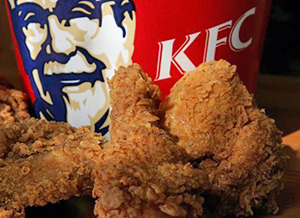
While Muslims accused the multinational giant of serving Jhatka' chicken or meat in the name of halal chicken', Hindus have joined the protests to save cows, considered sacred animal by the community.
However, no scientific tests of the KFC food items were done by any of the groups.

KFC spokesperson denied the charges vehemently, saying, “KFC holds the highest respect for the law of the land and complies with all government rules and regulations. These accusations are baseless and seem to be driven with malicious intent to harm our brand.”

“We serve chicken sourced from reputed Indian suppliers like Venky's and Godrej. We are always willing to provide consumers any clarifications they may require on the food served in our restaurants. We will be approaching the authorities to investigate this false propaganda and take appropriate action against those spreading misinformation,” the spokesperson said.

In Islam, meat obtained by severing the head of an animal instantly i.e. jhatka is considered diseased and not fit for eating. They have halal chicken or meat which is obtained by making a deep cut on the neck of a bird or animal from which blood is drained out completely.

On Friday, a joint group of protesters assembled at Iqbal Maidan and launched a signature campaign demanding a KFC-free India', with Shahar Qazi Syed Mushtaq Ali Nadvi and superintendent, Masajid Committee, Yasir Arafat appealing to people to take part in the campaign.

Anam Ibrahim who is leading the campaign claimed they had signatures of 50,112 persons and warned that if action was not taken against KFC, they would protest at the shopping mall in MP Nagar which has a KFC outlet next Friday.

Ibrahim and others had lodged a complaint at MP Nagar police station against the KFC outlet on August 6. However, KFC employees lodged a counter complaint against Ibrahim and others for their creating ruckus at the outlet.

In his complaint, Ibrahim said during Ramzan, when he sought a halal certificate from the KFC outlet, the staff showed him a certificate issued by a mufti in Mumbai Anwar Khan to a company named Venky's, for only 1,000 halal chicken whereas, KFC outlets in the country sold 2,000 to 2,500 chickens per day on an average. It did not have any mention of KFC on it.

Hence, the company did not have any certificate for halal chicken and was cheating customers who might be eating the meat of any animal in the name of chicken, which the company bought from slaughter houses in various states, he said.

Talking to HT, Arun Chawariya of Balmiki Samaj, who joined the signature campaign, said his protest was to save cows.
“We will continue our campaign till KFC closes its chain in the country,” he said.

Nadvi told HT that KFC must declare if it was selling halal or jhatka meat, where it procured the meat, what meat it was, and also if it had any certificate in this regard.

“If they are transparent, we don't have any problem. Then the option will lie with the consumers if they wish to have the kind of meat offered by KFC with a declaration,” he said.

SP Anshuman Singh said police were looking into the complaints from both sides.

He said as far as Ibrahim's complaint is concerned he had also written to the Bhopal collector to see if it was a case of adulteration and violated provisions of Food Safety and Standard Act.

Comments

AHMED
 - 
Monday, 5 Sep 2016

Please watch in yt

Why do Muslims eat Halal unbelievable (Watch until the end)

AHMED
 - 
Monday, 5 Sep 2016

www you tube com/watch?v=eVk8xF179sY

Please watch it to believe it... Dont beat the drums blindly...

vijay
 - 
Sunday, 4 Sep 2016

Icd is flooded with zakir naiks...only preachings...lol

shanu
 - 
Sunday, 4 Sep 2016

Dear Chedddis,
I have a few examples of halal, muslims have loats of reason for halal, circumcision & etc. etc.
Suresh,Rahul,Yogesh...first thing is, Why rituals in hindu marriage, mangalasutra, saptapadi, kanyadana. even without rituals also can be done, if you guys are bachelors just remember straight away go to register office and do the required procedures that is more than enough instead of rituals.... animal&bird slaughter in Islam to drain the bloods from veins (coz drinking blood is not permissible in islam ) animals and birds who died in wild cannot be eaten...

Fami
 - 
Sunday, 4 Sep 2016

What a reply by true indian. U made my day

TRUE INDIAN
 - 
Sunday, 4 Sep 2016

Suresh santhosh and yogesh. Here is the answer for ur question bro

I - Halal Method

1. The first three seconds from the time of Islamic slaughter as recorded on the EEG did not show any change from the graph before slaughter, thus indicating that the animal did not feel any pain during or immediately after the incision.

2. For the following 3 seconds, the EEG recorded a condition of deep sleep - unconsciousness. This is due to a large quantity of blood gushing out from the body.

3. After the above mentioned 6 seconds, the EEG recorded zero level, showing no feeling of pain at all.

4. As the brain message (EEG) dropped to zero level, the heart was still pounding and the body convulsing vigorously (a reflex action of the spinal cord) driving maximum blood from the body: resulting in hygienic meat for the consumer.

TRUE INDIAN
 - 
Sunday, 4 Sep 2016

Many of the five star hotels in india. They cut with halal method only. But looking at the blood. They can find out is the chicken is sick or no.

TRUE INDIAN
 - 
Sunday, 4 Sep 2016

Mr yogesh and suresh

Ur talking as if u haven't killed a single mosquito. Why god has given both sharp and flat teeth. If he wanted to eat only veg. He would have given flat teeth only. Even plant feel pain.

Coming to halaal. U will be shocked to hear that in proper halal method. Animals will feel zero pain.
When u accidently cut ur finger with blade or knife. U will feel pain after few seconds.
When u slaughter any animal during the halal method. While cutting. the brain connection gets disconnected. Only the body shakes and vibrates. They dont feel pain at all. And science have already proven it.
ALLAH is master he knows everything.

Santhosh
 - 
Sunday, 4 Sep 2016

Suresh, don't speak rubbish. Before you say something try to know the scientific reason behind it. Even now science says to follow islamic way of cutting the chicken. In this case am completely against you.

Rikaz
 - 
Sunday, 4 Sep 2016

Suresh, you wont understand, when you convert to Islam you will know why is it required to cut chicken or other eatable animals in accordance with Islamic teaching....if you need you can always ask nearest Muslim brothers.....come out of superstition beliefs.....

TRUE INDIAN
 - 
Sunday, 4 Sep 2016

KFC IS SLOW POISON. MORE DANGEROUS THAN SMOKING CIGARETTES.

MOST OF INDIANS GET PILES. DUE TO EATING KFC.

IN SWITZERLAND FRANCE AND MANY OF THE EUROPEAN COUNTRIES BANNED KFC. BECAUSE THEY USE CHEAP CHICKEN.

Add new comment

  • Coastaldigest.com reserves the right to delete or block any comments.
  • Coastaldigset.com is not responsible for its readers’ comments.
  • Comments that are abusive, incendiary or irrelevant are strictly prohibited.
  • Please use a genuine email ID and provide your name to avoid reject.
Wafa Sultana
April 4,2020

Over the last couple of days when the world was occupied with unifying efforts to fight the deadly Covid19 pandemic, sections of Indian media provided viewers a familiar scapegoat – the Indian Muslims – who are often stereotyped as a community being constantly at loggerheads with the citizenry and the State. Biased media channels were quick to resort to blaming the entire Muslim community for the spread of the disease in the country, thanks to an ill-timed Tablighi Jamaat gathering at its international headquarters in Delhi’s Nizamuddin. Unsurprisingly, the opprobrium was also marked by a sudden spike in WhatsApp forwards of videos with people wearing skullcaps licking spoons and performing Sufi breathing rituals, suggesting some sort of wild conspiracy on the part of the community to spread the virus.  Some media channels were quick to formulate, hypothesize and provide loose definitions of a newly discovered form of Jihad i.e. ‘Corona Jihad ’ thereby vilifying the Islamic faith and its followers.

While the investigation on the culpability of the organizers of the Nizamuddin event is still ongoing, there is enough information to suggest that the meeting was held before any lockdown was in force, and the problem began when there was no way of getting people out once the curfew was announced. Be that as it may, there is little doubt that organizing a meet of such a scale when there is a global pandemic smacks of gross misjudgment, and definitely the organizers should be held accountable if laws or public orders were defied. Attendees who attempt to defy quarantine measures must be dealt with strictly. However, what is alarming is that the focus and narrative have now shifted from the unfortunate event at Nizamuddin to the Tablighi Jamaat itself.

For those not familiar with the Tablighi Jamaat, the organization was founded in 1926 in Mewat by scholar Maulana Mohammad Ilyas. The Jamaat’s main objective was to get Muslim youth to learn and practice pristine Islam shorn of external influences. This is achieved through individuals dedicating time for moral and spiritual upliftment secluded from the rest of the world for a brief period of time. There is no formal membership process. More senior and experienced participants typically travel from one mosque to other delivering talks on religious topics, inviting local youth to attend and then volunteer for a spiritual retreat for a fixed number of days to a mosque in a nearby town or village to present the message to their co-religionists. Contrary to ongoing Islamophobic rhetoric, the movement does not actively proselytize. The focus is rather on getting Muslims to learn the teachings and practices of Islam.  This grassroots India-based movement has now grown to almost all countries with substantial Muslim populations. Its annual meets, or ‘ijtemas’ are among the largest Islamic congregations in the world after the annual Haj. One of the reasons for its popularity and wide network in the subcontinent and wordwide is the fact that it has eschewed the need for scholarly intervention, focusing on peer learning of fundamental beliefs and practice rather than high-falutin ideological debates. The Tablighi Jamaat also distinguishes itself from other Islamic movements through its strictly apolitical nature, with a focus on individual self-improvement rather than political mobilization. Hardships and difficulty in the world are expected to be face through ‘sabr’ (patience) and ‘dua’ (supplication),  than through quest for political power or influence. In terms of ideology, it is very much based on mainstream Sunni Islamic principles derived from the Deobandi school.

So, why is all this background important in the current context? While biased media entities have expectedly brought out their Islamophobic paraphernalia out for full display, more neutral commentators have tried to paint the Tablighi Jamaat as a fringe group and have tried to distance it from 'mainstream Muslims'. While the intent is no doubt innocent, this is a trap we must not fall into. This narrative, unfortunately, is also gaining ground due to apathy some Muslims have for the group, accusing it of being “disconnected from the realities of the world”. Unlike other Muslim organizations and movements, the Tablighi Jamat, by virtue of its political indifference, does not boast of high-profile advocates and savvy spokespersons who can defend it in mainstream or social media.  The use of adjectives such as 'outdated' and 'orthodox' by liberal columnists to describe the Jamaat feeds into the malignant attempt to change the narrative from the control of the spread of the pandemic due to the Nizamuddin gathering to 'raison d'etre' of the organization itself.

A large mainstream religious group like the Tablighi Jamaat with nearly a hundred-year history, normally considered to be peaceful, apolitical and minding its own business is now suddenly being villainized owing to unfortunate circumstances. Biased media reactions filled with disgust and hate seem to feed the Indian public conscience with a danngerous misconception - to be a nominal Muslim is okay but being a practicing one is not.  For those committed to the truth and fighting the spread of Islamophobia, the temptation to throw the entire Tablighi Jamaat under the bus must be resisted.

The writer is a lawyer and research scholar at Qatar University. Her research interests include Islamic law and politics.

Comments

zahoorahmed
 - 
Saturday, 4 Apr 2020

great article! provides a great perspective on tableeg jamat

Add new comment

  • Coastaldigest.com reserves the right to delete or block any comments.
  • Coastaldigset.com is not responsible for its readers’ comments.
  • Comments that are abusive, incendiary or irrelevant are strictly prohibited.
  • Please use a genuine email ID and provide your name to avoid reject.
News Network
April 29,2020

Mangaluru, Apr 29: District in-charge Minister Kota Srinivas Poojary on Wednesday inaugurated a mobile fever clinic to cure COVID-19 patients.

Karnataka State Road Transport Corporation (KSRTC) has converted one of its buses into a clinic in Mangaluru to treat COVID-19 patients.

The mobile fever clinic has a bed for the patient and a cabin for the doctor. There is also a seating facility, medicine box, wash-basin, sanitizer, soap oil, a separate water facility, and fans.

Comments

Add new comment

  • Coastaldigest.com reserves the right to delete or block any comments.
  • Coastaldigset.com is not responsible for its readers’ comments.
  • Comments that are abusive, incendiary or irrelevant are strictly prohibited.
  • Please use a genuine email ID and provide your name to avoid reject.
Agencies
June 17,2020

Riyadh, Jun 17: Saudi Arabia is expected to scale back or call off this year's hajj pilgrimage for the first time in its modern history, observers say, a perilous decision as coronavirus cases spike.

Muslim nations are pressing Riyadh to give its much-delayed decision on whether the annual ritual will go ahead as scheduled in late July.

But as the kingdom negotiates a call fraught with political and economic risks in a tinderbox region, time is running out to organise logistics for one of the world's largest mass gatherings.

A full-scale hajj, which last year drew about 2.5 million pilgrims, appears increasingly unlikely after authorities advised Muslims in late March to defer preparations due to the fast-spreading disease.

"It's a toss-up between holding a nominal hajj and scrapping it entirely," a South Asian official in contact with Saudi hajj authorities said.

A Saudi official said: "The decision will soon be made and announced."

Indonesia, the world's most populous Muslim nation, withdrew from the pilgrimage this month after pressing Riyadh for clarity, with a minister calling it a "very bitter and difficult decision".

Malaysia, Senegal and Singapore followed suit with similar announcements.

Many other countries with Muslim populations -- from Egypt and Morocco to Turkey, Lebanon and Bulgaria -- have said they are still awaiting Riyadh's decision.

In countries like France, faith leaders have urged Muslims to "postpone" their pilgrimage plans until next year due to the prevailing risks.

The hajj, a must for able-bodied Muslims at least once in their lifetime, represents a major potential source of contagion as it packs millions of pilgrims into congested religious sites.

But any decision to limit or cancel the event risks annoying Muslim hardliners for whom religion trumps health concerns.

It could also trigger renewed scrutiny of the Saudi custodianship of Islam's holiest sites -- the kingdom's most powerful source of political legitimacy.

A series of deadly disasters over the years, including a 2015 stampede that killed up to 2,300 worshippers, has prompted criticism of the kingdom's management of the hajj.

"Saudi Arabia is caught between the devil and the deep blue sea," Umar Karim, a visiting fellow at the Royal United Services Institute in London, told AFP.

"The delay in announcing its decision shows it understands the political consequences of cancelling the hajj or reducing its scale."

"Buying time"

The kingdom is "buying time" as it treads cautiously, the South Asian official said.

"At the last minute if Saudi says 'we are ready to do a full hajj', (logistically) many countries will not be in a position" to participate, he said.

Amid an ongoing suspension of international flights, a reduced hajj with only local residents is a likely scenario, the official added.

A decision to cancel the hajj would be a first since the kingdom was founded in 1932.

Saudi Arabia managed to hold the pilgrimage during previous outbreaks of Ebola and MERS.

But it is struggling to contain the virus amid a serious spike in daily cases and deaths since authorities began easing a nationwide lockdown in late May.

In Saudi hospitals, sources say intensive care beds are fast filling up and a growing number of health workers are contracting the virus as the total number of cases has topped 130,000. Deaths surpassed 1,000 on Monday.

To counter the spike, authorities this month tightened lockdown restrictions in the city of Jeddah, gateway to the pilgrimage city of Mecca.

"Heartbroken"

"The hajj is the most important spiritual journey in the life of any Muslim, but if Saudi Arabia proceeds in this scenario it will not only exert pressure on its own health system," said Yasmine Farouk from the Carnegie Endowment for International Peace.

"It could also be widely held responsible for fanning the pandemic."

A cancelled or watered-down hajj would represent a major loss of revenue for the kingdom, which is already reeling from the twin shocks of the virus-induced slowdown and a plunge in oil prices.

The smaller year-round umrah pilgrimage was already suspended in March.

Together, they add $12 billion to the Saudi economy every year, according to government figures.

A negative decision would likely disappoint millions of Muslim pilgrims around the world who often invest their life savings and endure long waiting lists to make the trip.

"I can't help but be heartbroken -- I've been waiting for years," Indonesian civil servant Ria Taurisnawati, 37, told AFP as she sobbed.

"All my preparations were done, the clothes were ready and I got the necessary vaccination. But God has another plan."

Comments

Add new comment

  • Coastaldigest.com reserves the right to delete or block any comments.
  • Coastaldigset.com is not responsible for its readers’ comments.
  • Comments that are abusive, incendiary or irrelevant are strictly prohibited.
  • Please use a genuine email ID and provide your name to avoid reject.