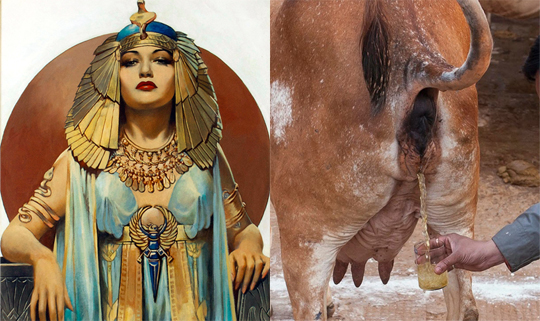
Get Cleopatra's beauty with cow urine: Gujarat Gauseva board

October 11, 2016

Ahmedabad, Oct 11: Citing the example of Cleopatra's legendary beauty, Gujarat Gauseva and Gauchar Vikas Board has issued its own pearls of wisdom for cow protection.

Untitled-1

In an advisory to women meant to preserve their eternal beauty, the board has stated that cow milk, ghee, urine and dung are the ingredients for a facial treatment that can leave the skin glowing.

The board says, "The queen of Egypt, Cleopatra, considered the most beautiful woman in the world, also used milk for bathing."

Interestingly, the 'Aarogya Geeta', an advisory on the board's website enumerating home remedies for various diseases which use cow urine, dung and milk cites studies by researchers from Italy, Russia and America to prove how these by-products are useful in treating various diseases.

The facial treament in the chapter titled 'Gaumutra, Essential treatment for women's eternal beauty' in the 'Aarogya Geeta' prescribes that women first massage their face with cow milk for 15 minutes.

This has to be followed by 15 minutes massage with cow ghee and turmeric. The third step is to massage it with cow urine for 15 minutes. The last step is application of a face pack of cow dung, to be washed off with neem water after 15 minutes.

"Natural beauty treatments can give you glow and shine that cannot be achieved through many layers of artificial makeup. Panchgavya (cow urine) treatment can help women get elegant, pleasant, attractive and beautiful personality and achieve love and affection from others," reads a paragraph in the chapter.

When the chairman of the board, Vallabh Kathiria, was asked if Cleopatra really bathed in cow milk, he said, "Yes. She may have bathed in cow milk." It needs to be mentioned that historical records say Cleopatra would bathe in donkey milk.

Comments

Advisor
 - 
Tuesday, 11 Oct 2016

They are FOOLING YOU guys... A urine is a waste of body and will not work on a beauty... Please dont believe these stupid ideas... Devils agenda to work on your life.. please be aware of such deception.

Satyameva jayate
 - 
Tuesday, 11 Oct 2016

That is why India is full of world's beauty queens....need to ask aishwarya and submit a sen if this is their secret....ha ha haa....better live in a go shaala.......you cow lards ......

Kiazer
 - 
Tuesday, 11 Oct 2016

hahahahahahahahahahahahahahahaha

Rikaz
 - 
Tuesday, 11 Oct 2016

Former PM Morarji was drinking his own urine....but is dead....

Add new comment

  • Coastaldigest.com reserves the right to delete or block any comments.
  • Coastaldigset.com is not responsible for its readers’ comments.
  • Comments that are abusive, incendiary or irrelevant are strictly prohibited.
  • Please use a genuine email ID and provide your name to avoid reject.
News Network
February 6,2020

Kalaburagi, Feb 6: The State government will take steps to ensure that Kannada as a language is taught in all private schools, Chief Minister B.S. Yediyurappa announced today at the 85th Akhila Bharata Kannada Sahitya Sammelana in Kalaburagi.

This comes in the wake of the demand by some Kannada activists for making Kannada medium compulsory in all schools in the State. Sammelana president H.S. Venkatesh Murthy, who spoke after the Chief Minister, also made this demand.

The Chief Minister said “We are committed to putting in place a series of steps to see that Kannada is taught in all schools, aided and private, as a language. Kannada should be taught as the first or second language. We will also take steps to strengthen government schools. However, the government alone cannot do much. The community and parents should offer support to make sure that government schools provide quality education to all.”

To inculcate the spirit of scientific inquiry, the State government is setting up mobile planetariums. This will increase the interest of children in space technology and India’s efforts in space exploration.

The government is committed to protecting the interests of the State in Mahadayi and other river water disputes. It will take the border row issue, based on the Mahajan Commission report pending in the Supreme Court, to its logical end.

The government will also address backwardness and related issues. It will make sure that adequate funds are allocated to the development of Kalyana Karnataka. Among other things, it will establish a hostel for students from Kalaburagi region in Bengaluru. Land has been allotted in Nagarabavi for the hostel that can accommodate around 200 students. The government has decided to celebrate Kalyana Karnataka Utsav once every two years. This will showcase the culture of the region.

“We are working towards forging sentimental and emotional unity of the State other than unity based on language or administration. Our dream is to see that Karnataka remains a homogeneous unit with equality and equal opportunity for all,’’ the Chief Minister added.

Kambar bats for technology

Chandrashekar Kambar, Sahitya Akademi president and former president of the Akhila Bharata Kannada Sahitya Sammelana, favoured effective implementation of technology in administration and for universal use of Kannada in computing and e-governance.

Speaking at the Sammelana inauguration, he said “Several years ago, at the insistence of writer Poornachandra Tejaswi, I appealed to the State government to give a push to Kannada computing. We were convinced that no language can survive without the use of modern technology and use of the language in computers. The Department of Kannada and Culture, headed by then director Manu Baligar, released ₹2 crore for the project. The work began in earnest and teams of technologists came up with software and fonts. Some departments started using Kannada software. But this work has stopped or slowed down at some level. I appeal to Chief Minister B.S. Yediyurappa to continue the work and ensure that computerised Kannada is used at all levels of government and in e-governance.’’

Supports dubbing

Mr. Kambar batted for content dubbing of informative TV channels in Kannada. Channels such as Discovery and History produce good quality content that can be educative and informative. They are very useful for children. These channels are now available in Tamil, Telugu and Hindi and some other Indian languages. But they are not available in Kannada. That is because some people in the film industry are opposing dubbing. Such opposition is not good. Informative channels are our window to the world and allowing dubbing will enhance our knowledge base. There is no merit in not allowing dubbing. I appeal to C.T. Ravi, Minister for Kannada and Culture, to allow dubbing in Kannada, he said.

Mr. Kambar favoured primary education in the mother tongue of the child and urged the State government to introduce universal and compulsory education in Kannada medium in all schools. “This will help preserve our culture. Nothing else can,’’ he said.

He blamed the East India Company administration for inculcating a craze for English education among the people. “The introduction of English education by the British was strongly welcomed by the masses in India as they had been denied the opportunity for education for millenia. The deprived classes and Dalits who had not been exposed to education till then, were excited about the opportunity. However, along with English education, the British were successful in introducing inferiority in our minds. We are yet to escape from this inferiority complex.”

Quoting from Greek mythology, Mr. Kambar said that Hercules had killed his children and relatives in a fit of alcohol-induced rage. “We should not behave like that. We may be very strong, but we should not kill our mother tongue, in our power-induced rage,’’ he said.


Comments

Add new comment

  • Coastaldigest.com reserves the right to delete or block any comments.
  • Coastaldigset.com is not responsible for its readers’ comments.
  • Comments that are abusive, incendiary or irrelevant are strictly prohibited.
  • Please use a genuine email ID and provide your name to avoid reject.
News Network
May 5,2020

Bengaluru, May 5: A 62-year-old woman from Vijayapura succumbed to coronavirus infection on Tuesday, taking the COVID-19 death toll in Karnataka to 28, a health official said.

The state has registered eight more COVID-19 cases in the past 19 hours, increasing the count of such cases to 659, the official added.

"Positive case 640, 62-year-old female resident of Vijayapura died on Tuesday due to cardiac arrest," the health official said.

Admitted to a designated hospital''s ICU on Sunday, the woman was also suffering from Chronic Obstructive Pulmonary Disease (COPD), Bronchial Asthma (BA) and complained of breathlessness.

Among the eight fresh cases that emerged in the state, four were contacts of earlier cases, two with Influenza Like Illness (ILI) and one with travel history to Uttarakhand.

The health department is also tracing the contact history of a 30-year-old woman from Bengaluru Urban.

Incidentally, no new cases emerged from Davangere as 22 cases rocked the district on Monday.

Among the new cases, Bengaluru Urban contributed 3, followed by Bagalkote, 2, Ballari, Dakshina Kannada and Bhatkal in Uttara Kannada, 1 each.

Of the new cases, six are men and two women.

Comments

Add new comment

  • Coastaldigest.com reserves the right to delete or block any comments.
  • Coastaldigset.com is not responsible for its readers’ comments.
  • Comments that are abusive, incendiary or irrelevant are strictly prohibited.
  • Please use a genuine email ID and provide your name to avoid reject.
coastaldigest.com news network
February 23,2020

Mangalore University has been participating in the campus bird count a sub-event of ‘Great backyard bird count’ (GBBC) organized by Bird Count India for the past 5 years. This year, CBC was held from 14th to 17th February of 2020 across various campuses in India.

This year the four days event was successfully ended up with the sightings of 103 species of birds from various locations across the campus spread on 300 acres. In this Black Drongo, Black Kite, Brahminy Kite, Common Iora, Green Wabler, Purple-rumed Sunbird, Red-whiskered Bulbul, White-cheeked Barbet, Jungle Babbler and Plum headed parakeets were the common birds, and also observed House Crow with nest and nestlings, Indian Robin nest with eggs, Bronzed Drongo constructing the nest and Shikra mating and carrying nesting materials.  Whereas Yellow-billed Babbler is rare in the campus, Ashy Drongo, Barn Swallow, Booted Eagle, Grey Wagtail, Indian Pitta etc. were migratory birds, Grey-headed Bulbul (Near Threatened bird), Rufous Babbler and Grey-headed Bulbul were Western Ghats Endemics  and Brown Wood Owl, Barn Owl, Spotted Owlet, Nightjars (Savanna, Indian and Jerdon’s) and Sri Lanka Frogmouth were nocturnal birds. Blue-eared Kingfisher Grey-bellied Cuckoo which was very rare and new additions to avian list of the campus.

In the first year (2016) of Mangalore University’s CBC recorded 77 species, in 2017 recorded 95 species, in 2018 recorded 110 species and in 2019 recorded 107 species of birds. However some of the common species like Rose ringed parakeets, Blue tailed bee-eater, Nilgiri Flowerpecker and Indian roller etc., sighted last year were not seen this year. But with 2 new additions from this CBC, the checklist of Mangalore University Campus has been updated with a total of 141 species.

This event was coordinated by Vivek Hasyagar from the Department of Applied Zoology and Maxim Rodrigues from the Department of Marine Geology. Survey trails were led by more than 60 students and research scholars from various Departments of Mangalore University includes Applied Zoology, Biosciences, Microbiology, Botany, Physics, Chemistry and Material Science.  In addition, some enthusiastic participants from St. Aloysius College had involved in identifying the birds around the campus.

Quote:

Wild/planned fire affects negatively on the existing ecologically sensitive areas in and around the campus especially in lateritic grasslands. Because many insectivorous birds are dependent on these lateritic grassland habitats for their food and breeding grounds for many ground dwelling birds like Yellow wattled lapwing, Red wattled lapwing, Indian Robin and Barred buttonquails. Conserving these habitats will be helpful in protecting these birds.

Quotes from the participants: “The Campus Bird Count 2020 at Mangalore University was an experience of its own kind. Observing birds in their natural habitat gave me new perspective of viewing them not only as another living being, but as equals, or even of higher intelligence. The Campus Bird Count is an important step towards documenting bird life year after year, and creating awareness amongst youngsters, so that proper conservation steps can be taken to protect them from human interference”.

-Jyotsna Dessai ( 1 M.Sc Zoology)

Comments

Add new comment

  • Coastaldigest.com reserves the right to delete or block any comments.
  • Coastaldigset.com is not responsible for its readers’ comments.
  • Comments that are abusive, incendiary or irrelevant are strictly prohibited.
  • Please use a genuine email ID and provide your name to avoid reject.