Mangalore University has been participating in the campus bird count a sub-event of ‘Great backyard bird count’ (GBBC) organized by Bird Count India for the past 5 years. This year, CBC was held from 14th to 17th February of 2020 across various campuses in India.
This year the four days event was successfully ended up with the sightings of 103 species of birds from various locations across the campus spread on 300 acres. In this Black Drongo, Black Kite, Brahminy Kite, Common Iora, Green Wabler, Purple-rumed Sunbird, Red-whiskered Bulbul, White-cheeked Barbet, Jungle Babbler and Plum headed parakeets were the common birds, and also observed House Crow with nest and nestlings, Indian Robin nest with eggs, Bronzed Drongo constructing the nest and Shikra mating and carrying nesting materials. Whereas Yellow-billed Babbler is rare in the campus, Ashy Drongo, Barn Swallow, Booted Eagle, Grey Wagtail, Indian Pitta etc. were migratory birds, Grey-headed Bulbul (Near Threatened bird), Rufous Babbler and Grey-headed Bulbul were Western Ghats Endemics and Brown Wood Owl, Barn Owl, Spotted Owlet, Nightjars (Savanna, Indian and Jerdon’s) and Sri Lanka Frogmouth were nocturnal birds. Blue-eared Kingfisher Grey-bellied Cuckoo which was very rare and new additions to avian list of the campus.
In the first year (2016) of Mangalore University’s CBC recorded 77 species, in 2017 recorded 95 species, in 2018 recorded 110 species and in 2019 recorded 107 species of birds. However some of the common species like Rose ringed parakeets, Blue tailed bee-eater, Nilgiri Flowerpecker and Indian roller etc., sighted last year were not seen this year. But with 2 new additions from this CBC, the checklist of Mangalore University Campus has been updated with a total of 141 species.
This event was coordinated by Vivek Hasyagar from the Department of Applied Zoology and Maxim Rodrigues from the Department of Marine Geology. Survey trails were led by more than 60 students and research scholars from various Departments of Mangalore University includes Applied Zoology, Biosciences, Microbiology, Botany, Physics, Chemistry and Material Science. In addition, some enthusiastic participants from St. Aloysius College had involved in identifying the birds around the campus.
Quote:
Wild/planned fire affects negatively on the existing ecologically sensitive areas in and around the campus especially in lateritic grasslands. Because many insectivorous birds are dependent on these lateritic grassland habitats for their food and breeding grounds for many ground dwelling birds like Yellow wattled lapwing, Red wattled lapwing, Indian Robin and Barred buttonquails. Conserving these habitats will be helpful in protecting these birds.
Quotes from the participants: “The Campus Bird Count 2020 at Mangalore University was an experience of its own kind. Observing birds in their natural habitat gave me new perspective of viewing them not only as another living being, but as equals, or even of higher intelligence. The Campus Bird Count is an important step towards documenting bird life year after year, and creating awareness amongst youngsters, so that proper conservation steps can be taken to protect them from human interference”.
-Jyotsna Dessai ( 1 M.Sc Zoology)






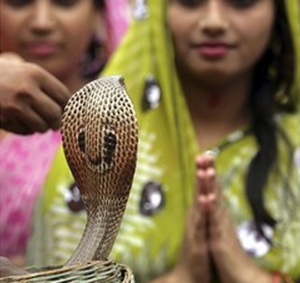 Yadgir, Aug 8: In a shocking incident, a teenage girl died after a snake bit her in Yadgir district on Sunday.
Comments
RIP ...plis some one filled the on naga devata ... I think he retrun to naga loka ....
Yaar please call the creator as god....not creation....koi bhi jaati ho...don't take the characters of valmiki tales and call all the characters in it as GOD....keep it device...not every Pathar kutta billli saamp GO ect
Hinduism is commonly perceived as a polytheistic religion, Indeed most hindus would attest to this, by professing belief in multiple gods. while some hindus believe in the existence of 3 gods. some believe in thousands of gods and some other in thirty three crore i.e 330 million gods how ever learned hindus who is well versed in scriptures insist that a hindu should believe in one god.
The major difference between hindu and muslim is perception of god is common. Hindu belief in philosophy of pantheism. pantheism considers everything living and non living. to be divine and sacred.the common hindu therefore consider everything as god.he consider sun moon snake monkey etc and even human being as manifestations of god!
Islam on the contrary, exhorts man to consider himself and his surroundings as example divine creation rather then as divinity itself. Muslim therefore believe that everything is God's i.e the word god with an apostrophe 's'. In other words muslim believe that everything belong to god. The tree snake monkey etcin the universe belong to god.
Thus the major difference between the Hindu and Muslim Beliefs is the difference of apostrophe 's'. The Hindu says everything is god. The Muslim says everything is God's. Therefore 'WORSHIP THE CREATOR NOT HIS CREATIONS.
How can a god bite and kill his creations?
Yeh Wrong No. hai, Read your authentic scriptures and ponder on it.
RIP!
Superstition belief....snake does not spare anyone....but it should have...cant play with it....
we cannot blame the snake here because
girls know that is god as per hindhu culture but
snake dont know that it is god
Cow, buffalo, Rat, Elephant, Crow, Monkey, Donkey, Snake.. What next? Mooka praani galella dewara? worship the creator not creations! and specially not animals..
Indians are foolish, this happens only in India they do not know what to worship linga, snake, monkey, donkey, pig etc.....
Yes to cover their cunning and so called deva bhakti, some will start to blame that lady. Punishment from Naag devtha and they will continue these bling practice.
karana rao, Where is naga loka?
Whatever may be the reason, we lost a precious life. Pray for God's mercy on the poor family.
Snake is not God or it will not take you to God. Worship the creator and not his creation.
this is called mooda nambike and she deserve for it.
she will directly go to nagaloka, lucky girl.
Add new comment