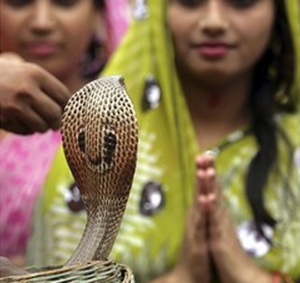
Girl dies after snake-bite while preparing to worship serpent god'

[email protected] (CD Network)
August 8, 2016

nagarapanchamiYadgir, Aug 8: In a shocking incident, a teenage girl died after a snake bit her in Yadgir district on Sunday.

The victim has been identified as Renuka Gurikar (18), a resident of Gurikardoddi near Kakkera village in Surpur taluk in Yadgir.

The incident occurred when the girl was preparing to offer puja during the Nagara Panchami festival. A case has been registered in the Kodekal police station.

Nagara Panchami or Nag Panchami festival is celebrated by Hindus across India on Sunday and it usually falls on the fifth day of the bright fortnight of the lunar day in the month of Sravana during the monsoon season.

It is a traditional worship of snakes or serpents observed by Hindus throughout India, Nepal and other countries where Hindu adherents live.

Comments

Fadds
 - 
Monday, 8 Aug 2016

RIP ...plis some one filled the on naga devata ... I think he retrun to naga loka ....

Satyameva jayate
 - 
Monday, 8 Aug 2016

Yaar please call the creator as god....not creation....koi bhi jaati ho...don't take the characters of valmiki tales and call all the characters in it as GOD....keep it device...not every Pathar kutta billli saamp GO ect

Shameem
 - 
Monday, 8 Aug 2016

Hinduism is commonly perceived as a polytheistic religion, Indeed most hindus would attest to this, by professing belief in multiple gods. while some hindus believe in the existence of 3 gods. some believe in thousands of gods and some other in thirty three crore i.e 330 million gods how ever learned hindus who is well versed in scriptures insist that a hindu should believe in one god.

The major difference between hindu and muslim is perception of god is common. Hindu belief in philosophy of pantheism. pantheism considers everything living and non living. to be divine and sacred.the common hindu therefore consider everything as god.he consider sun moon snake monkey etc and even human being as manifestations of god!

Islam on the contrary, exhorts man to consider himself and his surroundings as example divine creation rather then as divinity itself. Muslim therefore believe that everything is God's i.e the word god with an apostrophe 's'. In other words muslim believe that everything belong to god. The tree snake monkey etcin the universe belong to god.

Thus the major difference between the Hindu and Muslim Beliefs is the difference of apostrophe 's'. The Hindu says everything is god. The Muslim says everything is God's. Therefore 'WORSHIP THE CREATOR NOT HIS CREATIONS.

Irfan
 - 
Monday, 8 Aug 2016

How can a god bite and kill his creations?
Yeh Wrong No. hai, Read your authentic scriptures and ponder on it.

Rikaz
 - 
Monday, 8 Aug 2016

RIP!
Superstition belief....snake does not spare anyone....but it should have...cant play with it....

UMMAR
 - 
Monday, 8 Aug 2016

we cannot blame the snake here because

girls know that is god as per hindhu culture but

snake dont know that it is god

Sahil
 - 
Monday, 8 Aug 2016

Cow, buffalo, Rat, Elephant, Crow, Monkey, Donkey, Snake.. What next? Mooka praani galella dewara? worship the creator not creations! and specially not animals..

Mohammed SS
 - 
Monday, 8 Aug 2016

Indians are foolish, this happens only in India they do not know what to worship linga, snake, monkey, donkey, pig etc.....

Well Wisher
 - 
Monday, 8 Aug 2016

Yes to cover their cunning and so called deva bhakti, some will start to blame that lady. Punishment from Naag devtha and they will continue these bling practice.

PK
 - 
Monday, 8 Aug 2016

karana rao, Where is naga loka?

Abu Muhammad
 - 
Monday, 8 Aug 2016

Whatever may be the reason, we lost a precious life. Pray for God's mercy on the poor family.

REAL
 - 
Monday, 8 Aug 2016

Snake is not God or it will not take you to God. Worship the creator and not his creation.

Seema
 - 
Monday, 8 Aug 2016

this is called mooda nambike and she deserve for it.

Karana rao
 - 
Monday, 8 Aug 2016

she will directly go to nagaloka, lucky girl.

Add new comment

  • Coastaldigest.com reserves the right to delete or block any comments.
  • Coastaldigset.com is not responsible for its readers’ comments.
  • Comments that are abusive, incendiary or irrelevant are strictly prohibited.
  • Please use a genuine email ID and provide your name to avoid reject.
News Nerwork
July 4,2020

Bengaluru, Jul 4: Karnataka on Saturday reported its biggest single day spike of 1,839 new COVID-19 cases and 42 related fatalities, taking the total number of infections in the state to 21,549 and the death count to 335, the Health department said.

The day also saw 439 patients getting discharged after recovery; even as 226 patients in the state were undergoing treatment in ICU.

Out of 1,839 fresh cases reported on Saturday, a whopping 1,172 cases were from Bengaluru Urban alone; while 24 of the 42 deaths were from the capital city.

The previous biggest single day spike was recorded on July 3 with 1,694 cases.

As of July 4 evening, cumulatively 21,549 COVID-19 positive cases have been confirmed in the state, which includes 335 deaths and 9,244 discharges, the Health department said in its bulletin.

It said, out of 11,966 active cases, 11,740 patients are in isolation at designated hospitals and are stable, while 226 are in ICU.

Among the 42 dead are six from Bidar, four from Dakshina Kannada, three each from Kalaburagi and Dharwad and one each from Hassan and Bengaluru rural.

Of the 42, twenty-six are men, the bulletin said, adding most of them were with a history of Severe Acute Respiratory Infection (SARI), Influenza-like illness (ILI).

Out of 1,839 cases tested positive today, contacts of the majority of the cases are still under tracing.

Among the districts where the new cases were reported, Bengaluru Urban accounted for 1,172 cases, followed by Dakshina Kannada (75), Ballari (73), Bidar (51), Dharwad (45), Raichur (41), Mysuru (38), thirty seven each from Kalaburagi and Vijayapura, thirty-five each from Mandya and Uttara Kannada.

Bengaluru Urban district tops the list of positive cases, with a total of 8,345 infections, followed by Kalaburagi 1,597 and Udupi 1,276.

Among discharges, Kalaburagi tops the list with 1,189 followed by Udupi (1,103) and Bengaluru Urban (965).

A total of 6,89,526 samples were tested so far, of which 17,592 were tested on Saturday alone.

So far 6,50,876 samples have been reported as negative, and of them 15,294 were reported negative today.

Comments

Add new comment

  • Coastaldigest.com reserves the right to delete or block any comments.
  • Coastaldigset.com is not responsible for its readers’ comments.
  • Comments that are abusive, incendiary or irrelevant are strictly prohibited.
  • Please use a genuine email ID and provide your name to avoid reject.
News Network
July 4,2020

Bengaluru, Jul 4: Amid the rising COVID-19 cases in the state, the Karnataka COVID-19 Task Force has decided to set up booth-level committees across the state including 8,800 here for effective monitoring and surveillance.

The task force also released detailed guidelines for home isolation for asymptomatic cases including 17 days ''home isolation'' for patients below 50 years of age. It also warned of legal action against those health workers for disrespect to the bodies.

Briefing reporters after the meeting on Friday, Medical Education Minister Dr K Sudhakar said the local management will be strengthened for effective monitoring and surveillance of COVID-19 cases. "There will be booth-level task force committees throughout the state right from the village to Bengaluru.

These task force committees will act at the ultra local level. The task force will act as a structural and functional unit of COVID-19 dealing with monitoring, surveillance, checking of all the ILI cases, ambulances and hospitals," he added.

He also said the committees will comprise one member each from the Health department, police department, municipalities or Panchayat, volunteers, valveman. The committee will have five to six members.

The principal secretary in the Village Development and Panchayat Raj department L K Ateeq has been appointed as the nodal officer to manage the task force in the rural areas whereas in the urban areas, the Urban Development secretary, the municipal administration directors and the municipal commissioner will form the local task force.

"In Bengaluru alone 8,800 teams will be formed, which will be coterminous with the 8,800 booths in the city. They will provide the real-time data. They will be imparted training," the minister added. Noting that there were about 8,800 electoral booths in Bengaluru city and each booth will have a task force committee, he said a nodal officer has been appointed to oversee this.

The state level task force also came out with a slew of conditions. As far as home isolation is concerned, it would apply for patients who are below 50 years and have no symptoms of any other disease, and their homes should have a toilet and have an attendant.

He also said home isolation duration has been increased from 14 to 17 days. "People should not get fever in the next three days after completing 14 days, else they will be quarantined for another seven days. If they don''t get fever then they will be freed to perform their personal activities," Sudhakar said.

Those who are above 50 years and have comorbidities, will be treated at the COVID care centres only and they will be under medical supervision and be subjected to regular tests. The state is also making arrangements for telecommunication for those who are asymptomatic but wish to speak to a doctor.

It was also decided to have at least two ambulances in each of the 198 wards of Bengaluru. The minister said the additional commissioner of police (traffic) will be the nodal officer to coordinate the movement of ambulances. The task force has also appointed a nodal officer to manage the hospitals based on the availability of beds and ventilators. The officer will provide real time information about beds.

"We want to make sure that no one has to run from one hospital to another," Sudhakar said. On the cremation of the bodies, Sudhakar said guidelines have been issued on how to handle bodies at mortuaries, taking them in the ambulances, human treatment to the deceased while performing the last rites and fumigation of the bed. "Legal action will be taken against those who treat bodies in an inhuman way," Sudhakar said.

The state-level task force has also decided to arrange for test reports within 24 hours. It has also been decided to increase the testing capacity from the existing 15,000 a day to 25,000. In view of the spurt in COVID-19 cases, the task force also recommended antigen tests in crowded areas to check whether there was community spread.

To a question on closing down the border, the minister said there is no question of lockdown. "We cannot hide from this disease. It is not a solution. We have to live with it now, yet maintain a distance from it," he added. Sudhakar, who is a doctor himself, said COVID-19 is not as deadly a virus as those he had seen in the past and asked people not to be scared of it.


Comments

Add new comment

  • Coastaldigest.com reserves the right to delete or block any comments.
  • Coastaldigset.com is not responsible for its readers’ comments.
  • Comments that are abusive, incendiary or irrelevant are strictly prohibited.
  • Please use a genuine email ID and provide your name to avoid reject.
Ram Puniyani
March 14,2020

In the wake of Citizenship Amendment Act (CAA) UN High Commissioner, Michele Bachelet, has filed an intervention in the Supreme Court petition challenging the constitutionality of the Citizenship Amendment Act, as she is critical of CAA. Responding to her, India’s Foreign Minister S. Jai Shanker strongly rebutted her criticism, saying that the body (UNHCR) has been wrong and is blind to the problem of cross border terrorism. The issue on hand is the possibility of scores of people, mainly Muslims, being declared as stateless. The problem at hand is the massive exercise of going through the responses/documents from over 120 crore of Indian population and screening documents, which as seen in Assam, yield result which are far from truthful or necessary.

The issue of CAA has been extensively debated and despite heavy critique of the same by large number of groups and despite the biggest mass opposition ever to any move in Independent India, the Government is determined on going ahead with an exercise which is reminiscent of the dreaded regimes which are sectarian and heartless to its citizens, which have indulged in extinction of large mass of people on grounds of citizenship, race etc. The Foreign minister’s assertion is that it is a matter internal to India, where India’s sovereignty is all that matters! As far as sovereignty is concerned we should be clear that in current times any sovereign power has to consider the need to uphold the citizenship as per the principle of non-discrimination which is stipulated in Art.26 of the International Covenant on Civil and Political (ICCPR) rights.

Can such policies, which affect large number of people and are likely to affect their citizenship be purely regarded as ‘internal’? With the World turning into a global village, some global norms have been formulated during last few decades. The norms relate to Human rights and migrations have been codified. India is also signatory to many such covenants in including ICCPR, which deals with the norms for dealing with refugees from other countries. One is not talking of Chicago speech of Swami Vivekanand, which said that India’s greatness has been in giving shelter to people from different parts of the World; one is also not talking of the Tattariaya Upanishad’s ‘Atithi Devovhav’ or ‘Vasudhaiva Kutumbkam’ from Mahaupanishad today.

What are being talked about are the values and opinions of organizations which want to ensure to preserve of Human rights of all people Worldwide. In this matter India is calling United Nations body as ‘foreign party’; having no locus standi in the case as it pertains to India’s sovereignty. The truth is that since various countries are signatories to UN covenants, UN bodies have been monitoring the moves of different states and intervening at legal level as Amicus (Friend of the Court) to the courts in different countries and different global bodies. Just to mention some of these, UN and High Commissioner for Human Rights has often submitted amicus briefs in different judicial platforms. Some examples are their intervention in US Supreme Court, European Court of Human Rights, International Criminal Court, and the Inter-American Court of Human Rights. These are meant to help the Courts in areas where UN bodies have expertise.

 Expertise on this has been jointly formulated by various nations. These interventions also remind the nations as to what global norms have been evolved and what are the obligations of individual states to the values which have evolved over a period of time. Arvind Narrain draws our attention to the fact that, “commission has intervened in the European Court of Human Rights in cases involving Spain and Italy to underscore the principle of non-refoulement, which bars compulsory expulsion of illegal migrants… Similarly, the UN has intervened in the International Criminal Court in a case against the Central African Republic to explicate on the international jurisprudence on rape as a war crime.”

From time to time organizations like Amnesty International and Human Rights Watch have been monitoring the status of Human rights of different countries. This puts those countries in uncomfortable situation and is not welcome by those establishments. How should this contradiction between ‘internal matter’, ‘sovereignty’ and the norms for Human rights be resolved? This is a tough question at the time when the freedom indices and democratic ethos are sliding downwards all over the world. In India too has slid down on the scale of these norms.

In India we can look at the intervention of UN body from the angle of equality and non discrimination. Democratic spirit should encourage us to have a rethink on the matters which have been decided by the state. In the face of the greatest mass movement of Shaheen bagh, the state does need to look inwards and give a thought to international morality, the spirit of global family to state the least.

The popular perception is that when Christians were being persecuted in Kandhmal the global Christian community’s voice was not strong enough. Currently in the face of Delhi carnage many a Muslim majority countries have spoken. While Mr. Modi claims that his good relations with Muslim countries are a matter of heartburn to the parties like Congress, he needs to relook at his self gloating. Currently Iran, Malaysia, Indonesia and many Muslim majority countries have spoken against what Modi regime is unleashing in India. Bangladesh, our neighbor, has also seen various protests against the plight of Muslims in India. More than the ‘internal matter’ etc. what needs to be thought out is the moral aspect of the whole issue. We pride ourselves in treading the path of morality. What does that say in present context when while large section of local media is servile to the state, section of global media has strongly brought forward what is happening to minorities in India.   

The hope is that Indian Government wakes up to its International obligations, to the worsening of India’s image in the World due to CAA and the horrific violence witnessed in Delhi.

Comments

Add new comment

  • Coastaldigest.com reserves the right to delete or block any comments.
  • Coastaldigset.com is not responsible for its readers’ comments.
  • Comments that are abusive, incendiary or irrelevant are strictly prohibited.
  • Please use a genuine email ID and provide your name to avoid reject.