


Global credit card fraud worth Rs 100 cr busted in Bengaluru

DHNS
July 16, 2017

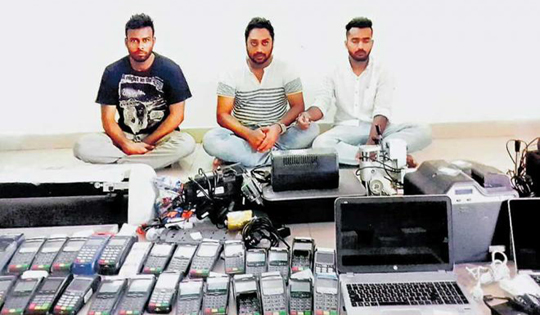
Bengaluru: Jul 16: A Sri Lankan national and two Bengalureans have been arrested for defrauding bank customers in different countries of a staggering Rs 100 crore by faking their credit cards in what is believed to be a massive online racket.
fraudstars

Divyan, a 30-year-old man from Jaffna, Sri Lanka, teamed up with Nawaz Shariff (22), a resident of Kanakanagar, and Nadeem Shariff (30), from HRBR Layout, to cheat credit card holders from Australia, Japan, Germany, Britain and other European countries. The gang targeted customers from these countries presuming that police would not come to India in search of them.

The suspects used an ingenious method to commit the fraud. First, they bought credit card data from shady websites. They then purchased magnetic swipe cards from e-commerce firms and used the secret data to clone credit cards. The next step was to contact businessmen from Haryana, Delhi, Mumbai and Puducherry who operate in Bengaluru and use point of sale (PoS) machines. They convinced these businessmen to allow them to swipe the credit cards at their PoS machines and promised them attractive commission on each transaction.

At this stage, the suspects acted cautiously. They always carried out transactions of low amounts so as to avoid scrutiny. Once the transactions were done, money would get transferred from the original card holders’ accounts in foreign banks to the businessmen’s bank accounts in India.

Foreign currency gets automatically converted into Indian rupees in case of credit card transactions. In these cases, credit cards were used and money was transferred without any sale taking place. Around 36 shopkeepers, some of the relatives of the suspects and bank officials were also part of the racket which had been going on for several years now and proved a money-spinner for all those involved.

The trio’s luck, however, ran out when they bought three LED television sets for Rs 1.1 lakh at Vishnupriya International, a home appliances store at Doddakallasandra, on June 21 and used a fake credit card to make the payment. The credit card turned out to be of a person from Bengaluru. The customer immediately blocked the card after receiving a message from the bank. The transaction was cancelled.

A team of the Central Crime Branch (CCB) happened to visit Canara Bank to investigate the increasing cases of online fraud. The bank staff informed the police about the illegal transaction at Vishnupriya International. The suspects had left a trail: they had given their phone number at the time of placing the order for the LED sets.

CCB sleuths started tracking them on the basis of the phone’s location and traced them to a three-bedroom flat at Prestige Collingwood in Jalahalli. During the raid, police found 144 fake credit cards, 16 fake driving licences, 36 card swipe machines, a card reader, a lamination machine, a card-printing machine and 270 plain cards.

Comments

ayes p
 - 
Tuesday, 18 Jul 2017

what about other right wing organisations!!

Add new comment

  • Coastaldigest.com reserves the right to delete or block any comments.
  • Coastaldigset.com is not responsible for its readers’ comments.
  • Comments that are abusive, incendiary or irrelevant are strictly prohibited.
  • Please use a genuine email ID and provide your name to avoid reject.
News Network
July 20,2020

Bengaluru, Jul 20: Janata Dal (Secular) leader HD Kumaraswamy has urged the Karnataka government to stop putting warning signboards in front of COVID-19 patients' houses alleging that they are leading to "social discrimination and untouchability" in the present times.

"A local government warning signboards in front of the homes of COVID-19 infected people is leading to neo-social discrimination and untouchability in the new age. Even after infection, the individual and family should live with dignity. The government should immediately stop the practice of placing signboards," Kumaraswamy's first tweet read.

"Instead of placing them in front of their homes and creating untouchability, send health workers to their homes to create courage and awareness. They should be told not to leave the house. There is no such degrading practice left behind. I would like to ask Chief Minister Karnataka BS Yediyurappa to pay attention to this," he added.

The former chief minister further said that threatening to cancel the licenses of medical colleges for refusing treatment to patients would not solve the problem and urged the government to take them into confidence instead of rebuking them.

"Refusing treatment is the fault of any hospital. But for the same reason, threatening to cancel government medical college licenses is not right. There is no profit in this emergency of health. MCI also has the power to revoke the licenses of medical colleges. Remember not the government," he said.

"In this case, the government should look to the Medical Colleges to get their services in order to get them to trust them instead of getting angry. Let them focus on meeting their needs. I insist on a collective fight against the coronavirus through this," he further added.

The COVID-19 count in Karnataka reached 63,772 on Sunday, including 39,370 active cases and 23,065 cured and discharged patients.

Comments

Add new comment

  • Coastaldigest.com reserves the right to delete or block any comments.
  • Coastaldigset.com is not responsible for its readers’ comments.
  • Comments that are abusive, incendiary or irrelevant are strictly prohibited.
  • Please use a genuine email ID and provide your name to avoid reject.
News Network
June 16,2020

Bengaluru, Jun 16: Karnataka Pradesh Congress Committee (KPCC) chief DK Shivakumar's daughter Aishwarya and Cafe Coffe Day founder late VG Siddhartha's son, Amarthya Hegde got engaged at SM Krishna Residence, Sadashivanagar in Bengaluru on Monday.
Only family members were present in the event. Amarthya Hegde is also the grandson of former Union Minister SM Krishna.
Last year in July, the body of Cafe Coffee Day (CCD) founder Siddhartha was unearthed on the banks of Netravati river.

Comments

Add new comment

  • Coastaldigest.com reserves the right to delete or block any comments.
  • Coastaldigset.com is not responsible for its readers’ comments.
  • Comments that are abusive, incendiary or irrelevant are strictly prohibited.
  • Please use a genuine email ID and provide your name to avoid reject.
Agencies
July 8,2020

The Central Board of Secondary Education (CBSE) has rationalised by up to 30 per cent the syllabus for classes 9 to 12 for the academic year 2020-21 to reduce course load on students amid the COVID-19 crisis, Union HRD Minister Ramesh Pokhriyal 'Nishank' announced on Tuesday.

The curriculum has been rationalised while retaining the core elements, the Human Resource Development said.

Among the chapters dropped after the rationalisation exercise are lessons on democracy and diversity, demonetisation, nationalism, secularism, India's relations with its neighbours and growth of local governments in India, among others.

"Looking at the extraordinary situation prevailing in the country and the world, CBSE was advised to revise the curriculum and reduce course load for the students of classes 9 to 12.

"To aid the decision, a few weeks back I also invited suggestions from all educationists on the reduction of syllabus for students and I am glad to share that we received more than 1.5K suggestions. Thank you, everyone, for the overwhelming response," Nishank tweeted.

"Considering the importance of learning achievement, it has been decided to rationalise syllabus up to 30 per cent by retaining the core concepts," he added.

The Union minister said the changes made in the syllabi have been finalised by the respective course committees with the approval of the curriculum committee and the Governing Body of the Board.

"The heads of schools and teachers have been advised by the board to ensure that the topics that have been reduced are also explained to the students to the extent required to connect different topics. However, the reduced syllabus will not be part of the topics for internal assessment and year-end board examination.

"Alternative academic calendar and inputs from the NCERT on transacting the curriculum using different strategies shall also be part of the teaching pedagogy in the affiliated schools," a senior official of the HRD ministry said.

For classes 1 to 8, the National Council of Education Research and Training (NCERT) has already notified an alternative calendar and learning outcomes.

According to the updated curriculum, among the chapters deleted from class 10 syllabus are-- democracy and diversity, gender, religion and caste, popular struggles and movement, challenges to democracy

For class 11, the deleted portions included chapters on federalism, citizenship, nationalism, secularism, growth of local governments in India.

Similarly, class 12 students will not be required to study chapters on India's relations with its neighbours, changing nature of India's economic development, social movements in India and demonetisation, among others.

Universities and schools across the country have been closed since March 16 when the central government announced a nationwide classroom shutdown as one of the measures to contain the COVID-19 outbreak.

A nationwide lockdown was announced on March 24, which came into effect the next day. While the government has eased several restrictions, schools and colleges continue to remain closed.

Comments

Add new comment

  • Coastaldigest.com reserves the right to delete or block any comments.
  • Coastaldigset.com is not responsible for its readers’ comments.
  • Comments that are abusive, incendiary or irrelevant are strictly prohibited.
  • Please use a genuine email ID and provide your name to avoid reject.