


Global credit card fraud worth Rs 100 cr busted in Bengaluru

DHNS
July 16, 2017

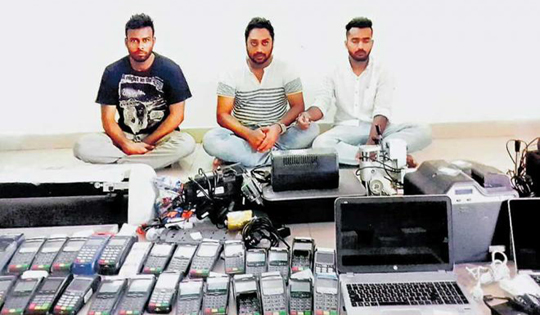
Bengaluru: Jul 16: A Sri Lankan national and two Bengalureans have been arrested for defrauding bank customers in different countries of a staggering Rs 100 crore by faking their credit cards in what is believed to be a massive online racket.
fraudstars

Divyan, a 30-year-old man from Jaffna, Sri Lanka, teamed up with Nawaz Shariff (22), a resident of Kanakanagar, and Nadeem Shariff (30), from HRBR Layout, to cheat credit card holders from Australia, Japan, Germany, Britain and other European countries. The gang targeted customers from these countries presuming that police would not come to India in search of them.

The suspects used an ingenious method to commit the fraud. First, they bought credit card data from shady websites. They then purchased magnetic swipe cards from e-commerce firms and used the secret data to clone credit cards. The next step was to contact businessmen from Haryana, Delhi, Mumbai and Puducherry who operate in Bengaluru and use point of sale (PoS) machines. They convinced these businessmen to allow them to swipe the credit cards at their PoS machines and promised them attractive commission on each transaction.

At this stage, the suspects acted cautiously. They always carried out transactions of low amounts so as to avoid scrutiny. Once the transactions were done, money would get transferred from the original card holders’ accounts in foreign banks to the businessmen’s bank accounts in India.

Foreign currency gets automatically converted into Indian rupees in case of credit card transactions. In these cases, credit cards were used and money was transferred without any sale taking place. Around 36 shopkeepers, some of the relatives of the suspects and bank officials were also part of the racket which had been going on for several years now and proved a money-spinner for all those involved.

The trio’s luck, however, ran out when they bought three LED television sets for Rs 1.1 lakh at Vishnupriya International, a home appliances store at Doddakallasandra, on June 21 and used a fake credit card to make the payment. The credit card turned out to be of a person from Bengaluru. The customer immediately blocked the card after receiving a message from the bank. The transaction was cancelled.

A team of the Central Crime Branch (CCB) happened to visit Canara Bank to investigate the increasing cases of online fraud. The bank staff informed the police about the illegal transaction at Vishnupriya International. The suspects had left a trail: they had given their phone number at the time of placing the order for the LED sets.

CCB sleuths started tracking them on the basis of the phone’s location and traced them to a three-bedroom flat at Prestige Collingwood in Jalahalli. During the raid, police found 144 fake credit cards, 16 fake driving licences, 36 card swipe machines, a card reader, a lamination machine, a card-printing machine and 270 plain cards.

Comments

ayes p
 - 
Tuesday, 18 Jul 2017

what about other right wing organisations!!

Add new comment

  • Coastaldigest.com reserves the right to delete or block any comments.
  • Coastaldigset.com is not responsible for its readers’ comments.
  • Comments that are abusive, incendiary or irrelevant are strictly prohibited.
  • Please use a genuine email ID and provide your name to avoid reject.
Agencies
June 30,2020

Washington, Jun 30: Researchers in China have discovered a new type of swine flu that is capable of triggering a pandemic, according to a study published Monday in the US science journal PNAS.

Named G4, it is genetically descended from the H1N1 strain that caused a pandemic in 2009.

It possesses "all the essential hallmarks of being highly adapted to infect humans," say the authors, scientists at Chinese universities and China's Center for Disease Control and Prevention.

The researchers then carried out various experiments including on ferrets, which are widely used in flu studies because they experience similar symptoms to humans -- principally fever, coughing and sneezing. 

G4 was observed to be highly infectious, replicating in human cells and causing more serious symptoms in ferrets than other viruses.

Tests also showed that any immunity humans gain from exposure to seasonal flu does not provide protection from G4.

According to blood tests which showed up antibodies created by exposure to the virus, 10.4 percent of swine workers had already been infected.

The tests showed that as many as 4.4 percent of the general population also appeared to have been exposed.

The virus has therefore already passed from animals to humans but there is no evidence yet that it can be passed from human to human -- the scientists' main worry.

"It is of concern that human infection of G4 virus will further human adaptation and increase the risk of a human pandemic," the researchers wrote.

The authors called for urgent measures to monitor people working with pigs.

"The work comes as a salutary reminder that we are constantly at risk of new emergence of zoonotic pathogens and that farmed animals, with which humans have greater contact than with wildlife, may act as the source for important pandemic viruses," said James Wood, head of the department of veterinary medicine at Cambridge University.

A zoonotic infection is caused by a pathogen that has jumped from a non-human animal into a human.

Comments

Add new comment

  • Coastaldigest.com reserves the right to delete or block any comments.
  • Coastaldigset.com is not responsible for its readers’ comments.
  • Comments that are abusive, incendiary or irrelevant are strictly prohibited.
  • Please use a genuine email ID and provide your name to avoid reject.
News Network
January 5,2020

Madikeri, Jan 5: Frequent attacks by Tigers on their cattle in South Kodagu region has left the dairy farmers a worried lot and causing concern for their life.

Several farmers have been rearing cows to supplement their income when low prices of pepper and coffee affect their earnings. At least 13 cows have fallen prey to Tigers in the months of November and December last year.

The Forest Department provides a compensation of Rs 10,000 if a cattle is killed by a tiger or in the attack. The compensation amount is meagre when it comes to the loss incurred by the farmers.

Though the Forest Department has submitted a proposal to increase the compensation amount to the government, no action has been initiated in this regard.

Comments

Add new comment

  • Coastaldigest.com reserves the right to delete or block any comments.
  • Coastaldigset.com is not responsible for its readers’ comments.
  • Comments that are abusive, incendiary or irrelevant are strictly prohibited.
  • Please use a genuine email ID and provide your name to avoid reject.
News Network
May 17,2020

Udupi, May 17: A total of 1,460 migrant labourers left for Uttar Pradesh from Indrali Railway Station in Udupi in Shramik Special train on Sunday.

This is the first train to ferry migrant labourers from Udupi. As many as 236 from Karkala, 323 from Kundapura, 901 labourers from Brahmavar, Kaup and Udupi left for their native villages.

More than 2,000 labourers had gathered at the railway station and only 1,460 labourers received tickets to travel.

Those who did not receive tickets were disappointed and got into heated arguments with the officials.

The labourers were promised that they will receive tickets to another train, that would depart from Udupi before May 20. One bogie of the train was reserved for pregnant women, women and children.

As many as 1,712 from Jharkhand, 770 from Odisha, 977 from West Bengal, 1,600 from Bihar, 379 from Madhya Pradesh, 280 from Chattisgarh, 110 from Uttarkhand, 379 from Rajasthan had registered on Seva Sindhu portal.

Additional Deputy Commissioner B Sadashiva Prabhu said that there are plans to make arrangements to send migrant labourers from UP, Uttaranchal, Madhya Pradesh and Jharkhand.

Comments

Add new comment

  • Coastaldigest.com reserves the right to delete or block any comments.
  • Coastaldigset.com is not responsible for its readers’ comments.
  • Comments that are abusive, incendiary or irrelevant are strictly prohibited.
  • Please use a genuine email ID and provide your name to avoid reject.