


Global credit card fraud worth Rs 100 cr busted in Bengaluru

DHNS
July 16, 2017

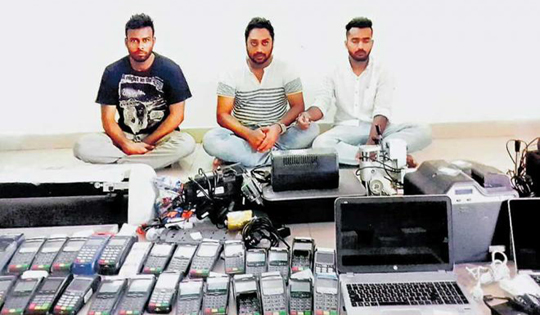
Bengaluru: Jul 16: A Sri Lankan national and two Bengalureans have been arrested for defrauding bank customers in different countries of a staggering Rs 100 crore by faking their credit cards in what is believed to be a massive online racket.
fraudstars

Divyan, a 30-year-old man from Jaffna, Sri Lanka, teamed up with Nawaz Shariff (22), a resident of Kanakanagar, and Nadeem Shariff (30), from HRBR Layout, to cheat credit card holders from Australia, Japan, Germany, Britain and other European countries. The gang targeted customers from these countries presuming that police would not come to India in search of them.

The suspects used an ingenious method to commit the fraud. First, they bought credit card data from shady websites. They then purchased magnetic swipe cards from e-commerce firms and used the secret data to clone credit cards. The next step was to contact businessmen from Haryana, Delhi, Mumbai and Puducherry who operate in Bengaluru and use point of sale (PoS) machines. They convinced these businessmen to allow them to swipe the credit cards at their PoS machines and promised them attractive commission on each transaction.

At this stage, the suspects acted cautiously. They always carried out transactions of low amounts so as to avoid scrutiny. Once the transactions were done, money would get transferred from the original card holders’ accounts in foreign banks to the businessmen’s bank accounts in India.

Foreign currency gets automatically converted into Indian rupees in case of credit card transactions. In these cases, credit cards were used and money was transferred without any sale taking place. Around 36 shopkeepers, some of the relatives of the suspects and bank officials were also part of the racket which had been going on for several years now and proved a money-spinner for all those involved.

The trio’s luck, however, ran out when they bought three LED television sets for Rs 1.1 lakh at Vishnupriya International, a home appliances store at Doddakallasandra, on June 21 and used a fake credit card to make the payment. The credit card turned out to be of a person from Bengaluru. The customer immediately blocked the card after receiving a message from the bank. The transaction was cancelled.

A team of the Central Crime Branch (CCB) happened to visit Canara Bank to investigate the increasing cases of online fraud. The bank staff informed the police about the illegal transaction at Vishnupriya International. The suspects had left a trail: they had given their phone number at the time of placing the order for the LED sets.

CCB sleuths started tracking them on the basis of the phone’s location and traced them to a three-bedroom flat at Prestige Collingwood in Jalahalli. During the raid, police found 144 fake credit cards, 16 fake driving licences, 36 card swipe machines, a card reader, a lamination machine, a card-printing machine and 270 plain cards.

Comments

ayes p
 - 
Tuesday, 18 Jul 2017

what about other right wing organisations!!

Add new comment

  • Coastaldigest.com reserves the right to delete or block any comments.
  • Coastaldigset.com is not responsible for its readers’ comments.
  • Comments that are abusive, incendiary or irrelevant are strictly prohibited.
  • Please use a genuine email ID and provide your name to avoid reject.
News Network
June 22,2020

Bengaluru, June 22: Even as the covid-19 positive cases are steadily increasing in Karnataka, an expert has claimed that community transmission has begun in Bengaluru and cases could keep rising over the next two months.

“If you look at the natural course of this virus across countries around the world, it is about six months. Now we’re in the fourth month. This will go on for another two months. It also sounds like this is the beginning of the peak. There is also a possibility of the number of cases going up from now on. Even across India, cases are increasing,” says Dr CN Manjunath, director of Sri Jayadeva Institute of Cardiovascular Sciences and Research and State Task Force member.

Besides the increase in number of cases, the virus is advancing silently, stealthily. A lot of people who are testing positive are asymptomatic. In areas like Padarayanapura, Nanjangud and many places in north Karnataka, there have been positive cases who have not had any contact with infected individuals. Some cases recorded in Bengaluru over the last two to three days have not had any contact with Covid-positive people.

Dr Manjunath adds: “We are in community transmission. This will happen because nature is ahead of everything. We have to take all possible precautionary measures at our command. This has to happen. Only then some kind of herd immunity will be developed.”

“We are expanding the guidelines of testing to include a large number of people to be tested. Now, according to the Indian Council for Medical Research (ICMR) guidelines, only symptomatic Influenza like Illness (ILI) or Severe Acute Respiratory Infection (SARI), or a person coming in contact with an infected person are being tested.

But since we have crossed 100 days in Karnataka from the first reported case and we’re getting cases with no travel history or contact with a Covid-positive person, we have to start random testing across the sub-group population. Only then will we understand the burden of the disease and what precautions need to be taken,” he says.

Comments

Add new comment

  • Coastaldigest.com reserves the right to delete or block any comments.
  • Coastaldigset.com is not responsible for its readers’ comments.
  • Comments that are abusive, incendiary or irrelevant are strictly prohibited.
  • Please use a genuine email ID and provide your name to avoid reject.
News Network
May 11,2020

Mangaluru, May 11: Hundreds of migrant labourers today gathered at a service bus stand in Mangaluru to return to Uttar Pradesh and Jharkhand.

They were working in different parts of Dakshina Kannada and remained stranded without a job after the announcement of lockdown.

Labourers said that they have not registered with Seva Sindhu portal to avail pass for travelling outside the state.

Though all the people who gathered wore a mask, the physical distancing norm was not followed.

Already three Shramik trains from Mangaluru had left for Jharkhand, Uttar Pradesh and Bihar with nearly 3,500 stranded labourers in the last two days.

The gathered labourers are anticipating that they would be allowed to travel to their destinations in the Shramik trains that will leave in the evening from Mangaluru.

The doctors and paramedical staff who have arrived the spot are checking the health of the labourers before allowing them to travel to the railway station.

The cost of a ticket to Uttar Pradesh is Rs 1,040 per person (which includes bus fare from service bus stand to railway station, food and water bottle).

Comments

Add new comment

  • Coastaldigest.com reserves the right to delete or block any comments.
  • Coastaldigset.com is not responsible for its readers’ comments.
  • Comments that are abusive, incendiary or irrelevant are strictly prohibited.
  • Please use a genuine email ID and provide your name to avoid reject.
Agencies
May 8,2020

Washington D.C., May 8: The prime time for brain development in a child's life is the first year, where the infant spends most of the time asleep. It is the time when neural connections form and sensory memories are encoded.

However, when sleep is disrupted, as occurs more often among children with autism, brain development may be affected, too.

New research led by the University of Washington finds that sleep problems in a baby's first 12 months may not only precede an autism diagnosis but also may be associated with altered growth trajectory in a key part of the brain, the hippocampus.

The study, which was published in the American Journal of Psychiatry, researchers report that in a sample of more than 400 taken of 6- to 12-month-old infants, those who were later diagnosed with autism were more likely to have had difficulty falling asleep.

It also states that this sleep difficulty was associated with altered growth trajectories in the hippocampus.

"The hippocampus is critical for learning and memory, and changes in the size of the hippocampus have been associated with poor sleep in adults and older children.

As many as 80 per cent of the children with autism spectrum disorder have sleep problems," said Annette Estes, director of the UW Autism Center and senior author of the study.

"In our clinical experience, parents have a lot of concerns about their children's sleep, and in our work on early autism intervention, we observed that sleep problems were holding children and families back," added Estes, who is also a UW professor of speech and hearing sciences.

"It could be that altered sleep is part-and-parcel of autism for some children. One clue is that behavioural interventions to improve sleep don't work for all children with autism, even when their parents are doing everything just right. This suggests that there may be a biological component to sleep problems for some children with autism," said Estes.

To consider links among sleep, brain development, and autism, researchers at the IBIS Network looked at MRI scans of 432 infants, surveyed parents about sleep patterns, and measured cognitive functioning using a standardized assessment.

At the outset of the study, infants were classified according to their risk for developing autism: Those who were at higher risk of developing autism -- about two-thirds of the study sample -- had an older sibling who had already been diagnosed.

Infant siblings of children with autism have a 20 per cent chance of developing autism spectrum disorder -- a much higher risk than children in the general population.

In the current study, 127 of the 432 infants were identified as "low risk" at the time the MRI scans were taken because they had no family history of autism.

They later evaluated all the participants at 24 months of age to determine whether they had developed autism. Of the roughly 300 children originally considered "high familial risk," 71 were diagnosed with autism spectrum disorder at that age.

Problems with sleep were more common among the infants later diagnosed with an autism spectrum disorder, as were larger hippocampi. No other subcortical brain structures were affected, including the amygdala, which is responsible for certain emotions and aspects of memory, or the thalamus, a signal transmitter from the spinal cord to the cerebral cortex.

The authors note that while parents reported more sleep difficulties among infants who developed autism compared to those who did not, the differences were very subtle and only observed when looking at group averages across hundreds of infants.

Sleep patterns in the first years of life change rapidly as infants transition from sleeping around the clock to a more adult-like sleep/wake cycle. Until further research is completed, Estes said, it is not possible to interpret challenges with sleep as an early sign of increased risk for autism.

Comments

Add new comment

  • Coastaldigest.com reserves the right to delete or block any comments.
  • Coastaldigset.com is not responsible for its readers’ comments.
  • Comments that are abusive, incendiary or irrelevant are strictly prohibited.
  • Please use a genuine email ID and provide your name to avoid reject.