



Goat taken into custody for criminal trespass, then its owner arrested

February 9, 2016

Raipur, Feb 9: Incredible as it may sound, a goat was taken into custody by police in Chattisgarh on a trespass complaint.goat
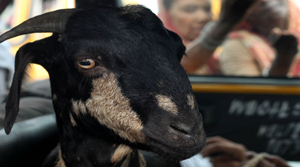
The goat, which was accused of being a 'repeat offender', was released later but its owner was not lucky.

Abdul Hasan (40) was arrested after his goat allegedly ventured into the garden of a judge’s bungalow in Korea district, police said today, as the incident gave fodder to the opposition Congress to slam the state police.

Hasan was booked under IPC’s section 447 (criminal trespass) and 427 (mischief causing damage) based on the complaint of Judicial Magistrate (first class) H Ratre yesterday, SHO Janakpur police station RS Paikra told PTI.

The goat had many times raided into the garden of the Ratre’s bungalow, located in Janakpur town, about 350 km from here, and ate flowers and plants there, he said.

"My goat scaled the boundary wall again and ate flowers and vegetables from the garden. It was taken to the police station and then the police also brought me in," Hasan said.

Several warnings were given to the owner of the ruminant animal by the judge as well as police but the incident continued to happen, the SHO said.

The magistrate had yesterday called up senior police officers to complain about the goat's antics following which the animal and Hasan were brought to the police station, he said. However, the goat was released later, he added.

Hasan was today produced before the court of a Tehsildar which sent him to two days remand, the SHO said, as he refused bail.

"The 'arrest' of a goat is ridiculous. Chhattisgarh police has made fun of themselves by doing so," Congress leader Shailesh Nitin Trivedi said, adding, "Those accused in rape cases are moving freely".

"The most painful and disappointing aspect is the entry made by an ASI of Chhatisgarh police in diary that the goat used to graze despite several warnings. Chhattisgarh police is communicating with even goats, this is one aspect of the incident," he added.

It may be recalled that a parrot in Chandrapur in Maharashtra was detained by police last year after an old woman filed a complaint against it for swearing at her and making obscene remarks.

The parrot, named as Hariyal, was reportedly trained for two years by its owner, Suresh Sakharkar, to abuse his stepmother, Janabai.

The bird apparently insulted Janabai every time she walked past Sakharkar's home in Rajura, Maharashtra. The family were living separately apparently because of a property dispute.

The police did not press charges against the parrot, but handed it over to the state's forestry department.

Last year too, cops locked up a pigeon in Manwal village in Punjab over suspicions of it being a Pakistani spy! It was listed as a 'suspected spy’ because of a note in Urdu found taped to its foot.

Comments

Kaizer
 - 
Wednesday, 10 Feb 2016

What if it was a cow instead of Goat ?

aharkul
 - 
Wednesday, 10 Feb 2016

Exactly Mr. Asif, Dubai. There is no value for poor people in India.

Acche Din Kab Ayega?????? Ya Modi.....

ASIF
 - 
Wednesday, 10 Feb 2016

Incredible India...
Poor people is arrested for silly reasons... crime of rich people is treated as social work.....

Add new comment

  • Coastaldigest.com reserves the right to delete or block any comments.
  • Coastaldigset.com is not responsible for its readers’ comments.
  • Comments that are abusive, incendiary or irrelevant are strictly prohibited.
  • Please use a genuine email ID and provide your name to avoid reject.
Agencies
August 5,2020

Prime Minister Narendra Modi is in Ayodhya to lay the foundation of the Ram temple. He participated in the bhoomi poojan rituals at the temple site and offered prayers. He will shortly lay the foundation of the temple with a sliver brick.

From Varanasi to Tamil Nadu, many devotees have sent gifts for the ceremony, like silver bricks and coins.

Special prayers were started on Monday and will culminate with the PM laying the foundation stone for the temple. The city has been decorated with paintings depicting scenes from the Ramayana. The Uttar Pradesh government has also made elaborate security arrangement for the event.

Apart from the state police, the NSG commandos have also been kept on stand-by. The invitations for the ceremony have been kept limited due to the coronavirus pandemic. Veteran BJP leaders LK Advani and Murli Manohar Joshi will witness the event from New Delhi via video-conferencing.

Comments

Add new comment

  • Coastaldigest.com reserves the right to delete or block any comments.
  • Coastaldigset.com is not responsible for its readers’ comments.
  • Comments that are abusive, incendiary or irrelevant are strictly prohibited.
  • Please use a genuine email ID and provide your name to avoid reject.
Agencies
February 25,2020

Agra, Feb 25: The architectural grandeur of 17th century Taj Mahal and the story of its construction by Mughal Emperor Shah Jahan left US President Donald Trump "impressed" during his visit to the famed mausoleum, according to the guide who accompanied him.

Nitin Kumar, an Agra-based guide, said the first word the president said after laying his eyes on the marble marvel was "incredible".

He and First Lady Melania Trump visited on Monday the iconic Taj Mahal in Agra, the second stop on his little less than 36-hour-long trip of India, and marvelled at the Mughal-era mausoleum built as a monument of love.

After Dwight David Eisenhower (1959) and Bill Clinton (2000), he became the third US president to visit the architectural icon.

"I told them the story of the Taj Mahal, the construction, and the story behind it. President Trump got very emotional after knowing the story of Shah Jahan and his wife Mumtaz Mahal. How he was kept under house arrest by his own son Aurangzeb, and buried here at Taj, next to Mumtaz's grave, after his death," Kumar told reporters.

The couple was left speechless on the first sight of the monument, and showed interest when they were told about the history and architecture of the dome, and the design details, Kumar said.

"Melania Trump asked about the mud-pack treatment and was amazed when she got to know the details of the process," he said.

One of the most photographed sites in the world, it is always high on the itinerary of head of states visiting India.

The monument was built over a period of nearly 20 years by Shah Jahan in memory of his wife after her death in 1631.

"The Taj Mahal inspires awe, a timeless testament to the rich and diverse beauty of Indian Culture!' Thank You, India," the US President and First Lady jointly wrote in the visitors' book before signing it.

According to Mohammed Zafar, who lives close to Taj Mahal complex, Nitin has been conducting guided tours for many years. "He was selected for this VVIP visit," he said.

"Many people were taking selfies with him, after the end of the visit. So, many media persons interacted with him. He has got some instant fame of sorts," Zafar said.

Authorities at Archaeological Survey of India had "advanced the dates" for mud-pack treatment for the graves of Shah Jahan and Mumtaz Mahal at Taj Mahal in view of the US President Trump's visit to Taj, a senior official had earlier said.

Comments

Add new comment

  • Coastaldigest.com reserves the right to delete or block any comments.
  • Coastaldigset.com is not responsible for its readers’ comments.
  • Comments that are abusive, incendiary or irrelevant are strictly prohibited.
  • Please use a genuine email ID and provide your name to avoid reject.
News Network
June 9,2020

Jun 9: Prime Minister Narendra Modi wants all 1.3 billion Indians to be “vocal for local” — meaning, to not just use domestically made products but also to promote them. As an overseas citizen living in Hong Kong, I’m doing my bit by very vocally demanding Indian mangoes on every trip to the grocery. But half the summer is gone, and not a single slice so far.

My loss is due to India’s COVID-19 lockdown, which has severely pinched logistics, a perennial challenge in the huge, infrastructure-starved country. But more worrying than the disruption is the fruity political response to it. Rather than being a wake-up call for fixing supply chains, the pandemic seems to be putting India on an isolationist course. Why?

Granted that the liberal view that trade is good and autarky bad isn’t exactly fashionable anywhere right now. What makes India’s lurch troublesome is that the pace and direction of economic nationalism may be set by domestic business interests. The Indian liberals, many of whom are Western-trained academics, authors and — at least until a few years ago — policy makers, want a more competitive economy. They will be powerless to prevent the slide.

Modi’s call for a self-reliant India has been echoed by Home Minister Amit Shah, the cabinet’s unofficial No. 2, in a television interview. If Indians don’t buy foreign-made goods, the economy will see a jump, he said. The strategy — although it’s too nebulous yet to call it that — has a geopolitical element. A military standoff with China is under way, apparently triggered by India’s completion of a road and bridge near the common border in the tense Himalayan region of Ladakh. It’s very expensive to fight even a limited war there. With India’s economy flattened by COVID, New Delhi may be looking for ways to restore the status quo and send Beijing a signal.

Economic boycotts, such as Chinese consumers’ rejection of Japanese goods over territorial disputes in the East China Sea, are well understood as statecraft. In these times, it’s not even necessary to name an enemy. An undercurrent of popular anger against China, the source of both the virus and India’s biggest bilateral trade deficit, is supposed to do the job. But is it ever that easy?

A hastily introduced policy to stock only local goods in police and paramilitary canteens became a farcical exercise after the list of banned items ended up including products by the local units of Colgate-Palmolive Co., Nestle SA, and Unilever NV, which have had significant Indian operations for between 60 and 90 years, as well as Dabur India Ltd., a New Delhi-based maker of Ayurveda brands. The since-withdrawn list demonstrates the practical difficulty of bureaucrats trying to find things in a globalized world that are 100% indigenous.

Free-trade champions fret that the prime minister, whom they saw as being on their side six years ago, is acting against their advice to dismantle statist controls on land, labor and capital to help make the country more competitive. Engage with the world more, not less, they caution. But Modi also has to satisfy the Rashtriya Swayamsevak Sangh, the umbrella Hindu organisation that gets him votes. Its backbone of small traders, builders and businessmen — the RSS admits only men — was losing patience with the anemic economy even before the pandemic. Now, they’re in deep trouble, because India’s broken financial system won’t deliver even state-guaranteed loans to them.

The U.S.-China tensions — over trade, intellectual property, COVID responsibility and Hong Kong’s autonomy — offer a perfect backdrop. A dire domestic economy and trouble at the border provide the foreground. Big business will dial economic nationalism up and down to hit a trifecta of goals: Block competition from the People's Republic; make Western rivals fall in line and do joint ventures; and tap deep overseas capital markets. The first goal is being achieved with newly placed restrictions on investment from any country that shares a land border with India. The second aim is to be realized by corporate lobbying to influence India's whimsical economic policies. As for the third objective, with the regulatory environment becoming tougher for U.S.-listed Chinese companies like Alibaba Group Holding Ltd., an opportunity may open up for Indian firms.

All this may bring India Shenzhen-style enclaves of manufacturing and trade, but it will concentrate economic power in fewer hands, something that worries liberals. They’re moved by the suffering of India’s low-wage workers, who have borne the brunt of the COVID shutdown. But when their vision of a more just society and fairer income distribution prompts them to make common cause with the ideological Left, they’re quickly repelled by the Marxist voodoo that all cash, property, bonds and real estate held by citizens or within the nation “must be treated as national resources available during this crisis.” Who will invest in a country that does that instead of just printing money?

At the same time, when liberals look to the business class, they see a sudden swelling of support for ideas like a universal basic income. They wonder if this isn’t a ploy by industry to outsource part of the cost of labor to the taxpayer. Slogans like Modi’s vocal-for-local stir the pot and thicken the confusion. The value-conscious Indian consumer couldn’t give two hoots for calls to buy Indian, but large firms will know how to exploit economic nationalism. One day soon, I’ll get my mangoes — from them.

Comments

Add new comment

  • Coastaldigest.com reserves the right to delete or block any comments.
  • Coastaldigset.com is not responsible for its readers’ comments.
  • Comments that are abusive, incendiary or irrelevant are strictly prohibited.
  • Please use a genuine email ID and provide your name to avoid reject.