Gorakhpur tragedy: Dr Kafeel Khan slams Yogi Adityanath for telling ‘blatant lies’

Agencies
August 27, 2018

Newsroom, Aug 27: Dr Kafeel Khan, who was made a scapegoat in the death of several children reportedly due to lack of oxygen at Gorakhpur Medical College, on Monday hit out at Uttar Pradesh Chief Minister Yogi Adityanath of ''lying'' on the issue for “political gains”.

"It is a blatant lie. The state government has admitted in the court that the shortage of oxygen had led to the death of children. The government has also admitted that shortage of oxygen had been caused owing to delay in payment of bills to the company that supplied the gas," Kafeel, who was in-charge of the neo-natal ward, where the maximum number of deaths took place, said.

He also contested Adityanath's claim that there had been a decline in the death of children from encephalitis. ''The chief minister is lying for political gains'' Kafeel, who is out on bail, said.

Adityanath at a function here had said that the Gorakhpur incident had been blown out of proportion owing to the ''internal politics'' of the doctors.

He had also claimed that there was no shortage of oxygen in the hospital. Around 60 children, including many newborn, died within a period of four days at the medical college-hospital last year in Gorakhpur, Adityanath's hometown.

Comments

AA
 - 
Tuesday, 28 Aug 2018

Dr.Kafeel    no need to worry Allah Almighty with you,

Truth will prevail  and evil will perish soon, 


justice will be done soon

MR
 - 
Tuesday, 28 Aug 2018

We all know that Yogi is a liar

Add new comment

  • Coastaldigest.com reserves the right to delete or block any comments.
  • Coastaldigset.com is not responsible for its readers’ comments.
  • Comments that are abusive, incendiary or irrelevant are strictly prohibited.
  • Please use a genuine email ID and provide your name to avoid reject.
Agencies
August 8,2020

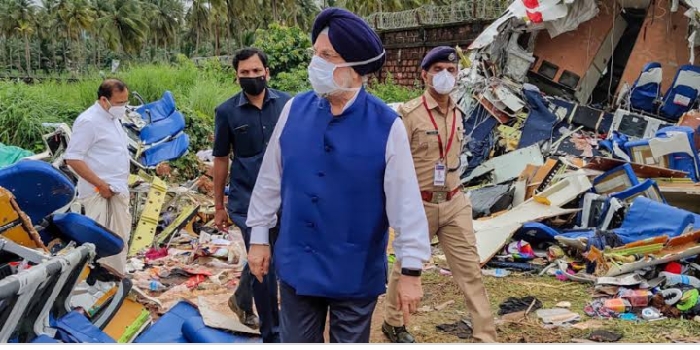
The Civil Aviation Ministry announced an initial assistance of Rs 10 lakh to the dependents of the deceased in the Kozhikode AIE plane crash, while the Kerala government also announced a compensation of Rs 10 lakh each.

Minister of Civil Aviation, Hardeep Singh Puri, who visited the mishap spot on Saturday, said that a detailed probe is already on and the pilot and co-pilot were highly experienced.

He also announced a compensation of Rs 2 lakh each to the injured and Rs. 50,000 each to those who suffered minor injuries. The other normal compensations would be decided in due course.

Puri said that Captain Deepak Vasant Sathe, aged 59, who commandeered the AIE flight, had a flying experience of 10,848 hours, while co-pilot Akhilesh Kumar, aged 32, had a flying experience of 1,723 hours.

"Deepak was one of the most distinguished and experienced pilots. He had a commanding experience of 6,662 hours and was commander of B-737 aircraft for 4,244 hours. He had also operated to Kozhikode international airport 27 times. He joined AIE in 2013 and prior to that he served with the IAF and HAL. He was a figher pilot and a recipient of prestigious sword of honour and a gold medalist," said Puri.

Puri said that even as the flight slipped down to around 35 feet, a major disaster was averted due to timely rescue operations. Local people played an exemplary role and the fire brigade's timely action of cutting the plane body and rescuing the passengers minimised the casualties, he said.

Chief Minister Pinarayi Vijayan also said that the local people and all rescue and relief agencies did a well co-ordinated job. The state government would also meet the entire treatment expenses of the injured.

Till Saturday afternoon, the total number of deaths was 18. While 149 were still in hospitals, 23 were discharged.

Comments

Add new comment

  • Coastaldigest.com reserves the right to delete or block any comments.
  • Coastaldigset.com is not responsible for its readers’ comments.
  • Comments that are abusive, incendiary or irrelevant are strictly prohibited.
  • Please use a genuine email ID and provide your name to avoid reject.
Agencies
May 4,2020

Mumbai, May 4: Days after Facebook, private equity firm Silver Lake said it will invest 56.56 billion rupees ($746.74 million) in Reliance Industries's digital arm, giving it a valuation of 4.90 trillion rupees. Silver Lake on Monday agreed to pay Rs 5,655.75 crore to buy 1.15 per cent stake in the firm that houses billionaire Mukesh Ambani's telecom arm Jio.

The investment in Jio Platforms comes within days of Facebook investing USD 5.7 billion to buy a 9.99 per cent stake in Jio Platforms. The investment is at a premium of 12.5 per cent to the Facebook deal.

"This investment values Jio Platforms at an equity value of Rs 4.90 lakh crore and an enterprise value of Rs 5.15 lakh crore and represents a 12.5 per cent premium to the equity valuation of the Facebook investment announced on April 22, 2020," Reliance said in a statement.

Comments

Add new comment

  • Coastaldigest.com reserves the right to delete or block any comments.
  • Coastaldigset.com is not responsible for its readers’ comments.
  • Comments that are abusive, incendiary or irrelevant are strictly prohibited.
  • Please use a genuine email ID and provide your name to avoid reject.
News Network
January 13,2020

Jan 13: For the first time in years, the government of India’s Prime Minister Narendra Modi is playing defense. Protests have sprung up across the country against an amendment to India’s laws — which came into effect on Friday — that makes it easier for members of some religions to become citizens of India. The government claims this is simply an attempt to protect religious minorities in the Muslim-majority countries that border India; but protesters see it as the first step toward a formal repudiation of India’s constitutionally guaranteed secularism — and one that must be resisted.

Modi was re-elected prime minister last year with an enhanced majority; his hold over the country’s politics is absolute. The formal opposition is weak, discredited and disorganized. Yet, somehow, the anti-Citizenship Act protests have taken hold. No political party is behind them; they are generally arranged by student unions, neighborhood associations and the like.

Yet this aspect of their character is precisely what will worry Modi and his right-hand man, Home Minister Amit Shah. They know how to mock and delegitimize opposition parties with ruthless efficiency. Yet creating a narrative that paints large, flag-waving crowds as traitors is not quite that easy.

For that is how these protests look: large groups of young people, many carrying witty signs and the national flag. They meet and read the preamble to India’s Constitution, into which the promise of secularism was written in the 1970’s.

They carry photographs of the Constitution’s drafter, the Columbia University-trained economist and lawyer B. R. Ambedkar. These are not the mobs the government wanted. They hoped for angry Muslims rampaging through the streets of India’s cities, whom they could point to and say: “See? We must protect you from them.” But, in spite of sometimes brutal repression, the protests have largely been nonviolent.

One, in Shaheen Bagh in a Muslim-dominated sector of New Delhi, began simply as a set of local women in a square, armed with hot tea and blankets against the chill Delhi winter. It has now become the focal point of a very different sort of resistance than what the government expected. Nothing could cure the delusions of India’s Hindu middle class, trained to see India’s Muslims as dangerous threats, as effectively as a group of otherwise clearly apolitical women sipping sweet tea and sharing their fears and food with anyone who will listen.

Modi was re-elected less than a year ago; what could have changed in India since then? Not much, I suspect, in most places that voted for him and his party — particularly the vast rural hinterland of northern India. But urban India was also possibly never quite as content as electoral results suggested. India’s growth dipped below 5% in recent quarters; demand has crashed, and uncertainty about the future is widespread. Worse, the government’s response to the protests was clearly ill-judged. University campuses were attacked, in one case by the police and later by masked men almost certainly connected to the ruling party.

Protesters were harassed and detained with little cause. The courts seemed uninterested. And, slowly, anger began to grow on social media — not just on Twitter, but also on Instagram, previously the preserve of pretty bowls of salad. Instagram is the one social medium over which Modi’s party does not have a stranglehold; and it is where these protests, with their photogenic signs and flags, have found a natural home. As a result, people across urban India who would never previously have gone to a demonstration or a political rally have been slowly politicized.

India is, in fact, becoming more like a normal democracy. “Normal,” that is, for the 2020’s. Liberal democracies across the world are politically divided, often between more liberal urban centers and coasts, and angrier, “left-behind” hinterlands. Modi’s political secret was that he was that rare populist who could unite both the hopeful cities and the resentful countryside. Yet this once magic formula seems to have become ineffective. Five of India’s six largest cities are not ruled by Modi’s Bharatiya Janata Party in any case — the financial hub of Mumbai changed hands recently. The BJP has set its sights on winning state elections in Delhi in a few weeks. Which way the capital’s voters will go is uncertain. But that itself is revealing — last year, Modi swept all seven parliamentary seats in Delhi.

In the end, the Citizenship Amendment Act is now law, the BJP might manage to win Delhi, and the protests might die down as the days get unmanageably hot and state repression increases. But urban India has put Modi on notice. His days of being India’s unifier are over: From now on, like all the other populists, he will have to keep one eye on the streets of his country’s cities.


Comments

Add new comment

  • Coastaldigest.com reserves the right to delete or block any comments.
  • Coastaldigset.com is not responsible for its readers’ comments.
  • Comments that are abusive, incendiary or irrelevant are strictly prohibited.
  • Please use a genuine email ID and provide your name to avoid reject.