



Governance reform is number one priority: Modi to CEOs

September 25, 2015

New York, Sep 25: Prime Minister Narendra Modi has said governance reform is his number one priority, during a meeting with a group of top American CEOs with a collective net worth of USD 4.5 trillion.
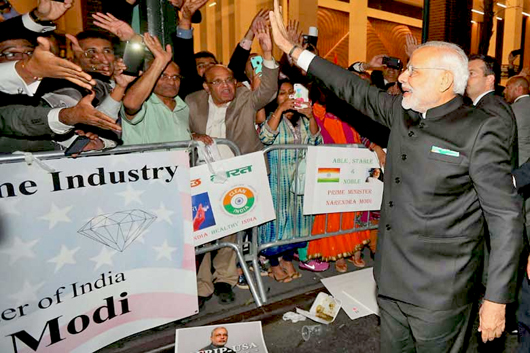
Modi copy

"Reform in governance is my No 1 priority. We are for simplified procedures, speedy decision making, transparency and accountability," Modi told over 40 CEOs of Fortune 500 companies over a dinner as he presented a page-long fact sheet of the steps taken by his government in the last one year.

Among the CEOs of Fortune 500 companies attending event were Lockheed Martin Chairman and CEO Marillyn Hewson, Ford President and CEO Mark Fields, IBM Chairman Ginni Rometty, Pepsi Co Chief Indra Nooyi, and Dow Chemical Chairman Andrew Liveris.

Some of the CEOs attending the dinner described it as "report card," adding that this reflected the great transparency of the Modi Government.

"Please continue to do more what you are doing. May be slightly faster," External Affairs Minister spokesperson Vikas Swarup said. Briefing reporters after the day long meetings, Indian Ambassador to the US Arun K Singh said the comments made by some of the CEOs was that a lot of progress has been made in the last one year, but it has been inaccurately assessed and reported.

During the meeting, the Prime Minister said the foreign direct investment (FDI) all over the world has fallen but in India it has increased by 40 per cent. "This reflects confidence in the Indian economy," Modi said.

During the meeting, Swarup said the Prime Minister listened from each one of the CEOs present in the room on what their plans are for India and what are the problems they are facing and how that can be resolved.

"By and large the mood was very upbeat. There is general consensus that the Prime Minister is effecting change in India. The only thing all the CEOs said is that please make that change faster," the Indian diplomat said.

Modi told the CEOs that fundamentally he believes in deregulation, the government should allow the private sector to develop and that he is for predictable, transparent and accountable governance.

Giving a sense of day long interactions that the Prime Minister had with the corporate world, Singh said that it came through clearly that most people felt that this was a very good moment for India in the global context.

"If you look at the global trends, this was the unique opportunity to move ahead, attract capital and finds moments in terms of market access and ability to produce both for domestic and for exports," he said.

"There was also a sense that the unique position of digital technology today and in the coming period provided a special opportunity for India with its strength in this sector," Singh said.

The Indian talent, which is contributing in a major to the development of this technology in a global context, could provide a very special opportunity for India to leapfrog technology and to move ahead in terms of economic strategies, he said.

"There was support and appreciation expressed for the make in India program, the skills India program and the work related to smart cities, the focus on renewable energy. Some emphasis on the needs in the infrastructure sector and appreciation for the way in which the concept of smart cities has been approached," Singh added.

During the meeting, Modi circulated a one-page fact sheet summarising the bold steps that the Indian government has taken for deregulation, reform and consistency in the tax administration.

"That note is based on hard facts, on what the government has actually done, what it has done for ease of doing business, where we all expect that when the next report comes, India should have jumped several places up," Swarup said. The fact sheet also lists efforts made by the government in increasing FDI, efforts towards making a bankruptcy code, he said.

"Change is afoot. Change is visible. That is why the CEOs were in such an upbeat mood," the Indian diplomat asserted. Singh said many of the CEOs in their comments said that a lot has been done in the past year.

"And that what had been done was inaccurately assessed and reported. And therefore when they looked at the steps that the government had taken clearly there was a sense that a lot has been achieved," said the Indian Ambassador to the US.

In the context of the global trend, India certainly is in a moment to provide opportunity including in terms of India's own developmental needs and priorities, he said. Responding to a question, Singh said there were some suggestions made about the additional steps that can be taken in terms of ease of doing business. "Those are things that the government would access," he added.

Comments

Add new comment

  • Coastaldigest.com reserves the right to delete or block any comments.
  • Coastaldigset.com is not responsible for its readers’ comments.
  • Comments that are abusive, incendiary or irrelevant are strictly prohibited.
  • Please use a genuine email ID and provide your name to avoid reject.
News Network
March 13,2020

Raipur, Mar 13: Calling Jyotiraditya Scindia a "power-hungry" leader, Chhattisgarh Minister and Congress leader TS Singh Deo on Friday said that if someone joins another party to occupy the top position of the state that he should never become a Chief Minister.

When enquired if Deo has any plans to join the BJP in the future, he quickly said that he would never be able to relate himself with the "ideology" of the party.

"People may make claims but I will never join BJP, even if I get 100 lives I will never associate with that ideology. A person who joins BJP for not being able to become Chief Minister should never become a Chief Minister," he said while speaking to media in Raipur.

"A single person does not remain as captain forever, Kapil Dev got his chance when Gavaskar was there. Currently, Virat Kohli is the captain but in T20 there are different captains. Will Kohli join Pakistan's team if he is not made the captain? This is beyond understanding."

On Wednesday, Scindia joined BJP in New Delhi in the presence of party President JP Nadda. He had resigned from Congress a day earlier after meeting Union Home Minister Amit Shah and Prime Minister Narendra Modi.

He will file his nomination for the Rajya Sabha elections on March 13.

Comments

Indian
 - 
Friday, 13 Mar 2020

May it be Scindia or some other, misusing power cheating with citizens mandate for their self benifit  "very soon the fare and best judgement from the creator will be their very soon.  No one is greatro than the creator.


For citizens well fare creator is opinion and protect always there. Hope MP people always with faith on creator.


Jai Hind !

Add new comment

  • Coastaldigest.com reserves the right to delete or block any comments.
  • Coastaldigset.com is not responsible for its readers’ comments.
  • Comments that are abusive, incendiary or irrelevant are strictly prohibited.
  • Please use a genuine email ID and provide your name to avoid reject.
News Network
February 24,2020

New Delhi, Feb 24: They hail from vastly different backgrounds — Donald Trump is the son of a property tycoon while Narendra Modi is a descendant of a poor tea-seller.

Yet the two teetotallers, loved by right-wing nationalists in their home countries, share striking similarities that have seen them forge a close personal bond, analysts say.

Ahead of the American leader's first official visit to India, which begins in Modi's home state of Gujarat on Monday, the world's biggest democracy has gone out of its way to showcase the chemistry between them.

In Gujarat's capital Ahmedabad, large billboards with the words "two dynamic personalities, one momentous occasion" and "two strong nations, one great friendship" have gone up across the city.

"There's a lot that Trump and Modi share in common, and not surprisingly these convergences have translated into a warm chemistry between the two," Michael Kugelman of the Washington-based Wilson Center said.

"Personality politics are a major part of international diplomacy today. The idea of closed-door dialogue between top leaders has often taken a backseat to very public and spectacle-laden summitry."

Since assuming the top political office in their respective countries — Modi in 2014 and Trump in 2017 — the two men have been regularly compared to each other.

Trump, 73, and Modi, 69, both command crowds of adoring flag-waving supporters at rallies. A virtual cult of personality has emerged around them, with their faces and names at the centre of their political parties' campaigns.

A focus of Trump's administration has been his crackdown on migrants, including a travel ban that affects several Muslim-majority nations, among others, while critics charge that Modi has sought to differentiate Muslims from other immigrants through a contentious citizenship law that has sparked protests.

Both promote their countries' nationalist and trade protectionist movements — Trump with his "America First" clarion call and Modi with his "Make in India" mantra.

And while they head the world's largest democracies, critics have described the pair as part of a global club of strongmen that includes Russia's Vladimir Putin and Brazil's Jair Bolsonaro.

"There are many qualities that Trump and Modi share — a love for political grandstanding and an unshakable conviction that they can achieve the best solutions or deals," former Indian diplomat Rakesh Sood said.

Modi and Trump have sought to use their friendship to forge closer bonds between the two nations, even as they grapple with ongoing tensions over trade and defence.

Despite sharing many similarities in style and substance, analysts say there are some notable differences between the pair.

Modi is an insider who rose through the ranks of the Bharatiya Janata Party after starting out as a cadre in Rashtriya Swayamsevak Sangh.

Trump is a businessman and a political outsider who has in some sense taken over the Republican Party.

"Modi is a more conventional leader than is Trump in that he hasn't sought to revolutionise the office he holds in the way that Trump has," said Kugelman, a longtime observer of South Asian politics.

He added that genuine personal connections between leaders of both countries have helped to grow the partnership.

"George Bush and Manmohan Singh, Barack Obama and Singh, Obama and Modi, now Modi and Trump — there has been a strong chemistry in all these pairings that has clearly helped the relationship move forward," he added.

Trump has also stood by the Indian leader during controversial decisions, including his revocation of autonomy for Kashmir and his order for jets to enter Pakistani territory following a suicide bombing.

Analysts said the leaders would use the visit to bolster their image with voters.

A mega "Namaste Trump" rally in Ahmedabad on Monday will be modelled after the "Howdy, Modi" Houston extravaganza last year when the Indian leader visited the US and the two leaders appeared before tens of thousands of Indian-Americans at a football stadium.

"The success of this visit... will have a positive impact on his (Trump's) re-election campaign and the people of Indian origin who are voters in the US — a majority of them are from Gujarat," former Indian diplomat Surendra Kumar said.

"On the Indian side, the fact that Prime Minister Modi... (shares) such warmth, bonhomie and informality with the most powerful man on Earth adds to his stature... as well as with hardcore supporters."

Comments

Add new comment

  • Coastaldigest.com reserves the right to delete or block any comments.
  • Coastaldigset.com is not responsible for its readers’ comments.
  • Comments that are abusive, incendiary or irrelevant are strictly prohibited.
  • Please use a genuine email ID and provide your name to avoid reject.
News Network
June 19,2020

Kolkata, Jun 19: The nationwide clamour for boycott of Chinese goods is getting louder amid the Ladakh face-off, with traders urging the Centre to direct e-commerce firms to restrict the sale of items from the Dragonland, which imports products worth USD 74 billion to India annually.

Of the total import from China, retail traders sell goods worth around USD 17 billion, mostly comprising toys, household items, mobiles, electric and electronic goods and cosmetics among other things, which could possibly be replaced by Indian products, a national trading body said.

"We, at 'Federation of All India Vyapar Mandal', are advising our members to clear their stocks of Chinese products and refrain from placing fresh orders. We are also requesting the government to restrict e-commerce companies from selling Chinese products," V K Bansal, the association's general secretary, told PTI.

Sushil Poddar, the president of the Confederation of West Bengal Traders Association, said its members have been told to shun trading in Chinese goods as much as possible.

Another national traders' body, The Confederation of All India Traders (CAIT), has decided to step up its movement against the boycott of Chinese goods, under its campaign 'Bhartiya Samaan-Hamara Abhimaan'.

It released a list of over 450 broad categories of commodities, comprising 3,000 Chinese products.

Comments

Add new comment

  • Coastaldigest.com reserves the right to delete or block any comments.
  • Coastaldigset.com is not responsible for its readers’ comments.
  • Comments that are abusive, incendiary or irrelevant are strictly prohibited.
  • Please use a genuine email ID and provide your name to avoid reject.