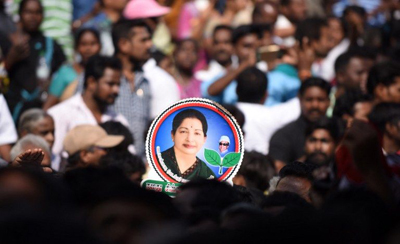
Govt. allocates Rs. 15 crore for Jayalalithaa memorial

[email protected] (The Hindu)
December 10, 2016

Chennai, Dec 10: The State government has allotted Rs. 15 crore for the construction of a memorial for former Chief Minister Jayalalithaa near the MGR memorial on the Marina.

jayalalithamemoryAccording to a minister, the tender for executing the work will be floated soon.

“The money has been allotted and officials have taken the measurements around where Amma was laid to rest. A tender will be floated, and after the minimum required period, work on her memorial will be undertaken at full speed,” the Minister told The Hindu on Friday.

Jayalalithaa was laid to rest within the confines of the MGR memorial, which is spread over eight acres.

Officials of the Public Works Department (PWD) said the department was yet to come up with a design for the memorial. “We are yet to receive a directive from the government in this regard,” an official said.

“We are only carrying out minor repair work on the site. Temporary arrangements like provision of tent and barricades around the site have been made. The construction of the memorial is still in the preliminary planning stage,” an official said.

Even as thousands of people thronged the Marina to pay homage to Jayalalithaa all through the day, the late Chief Minister's confidante V.K. Sasikala visited the burial site and spent some time there. Teary-eyed, she went around the place where Jayalalithaa was buried.

Chief Minister O. Panneerselvam and his senior Cabinet colleagues — P. Thangamani, Edapaddi Palaniswami, Dindigul Srinivasan and S.P. Velumani — were waiting at the barricades when Ms. Sasikala, her sister-in-law Ilavarasi, a few family members and domestic aides at Veda Nilayam, the former Chief Minister's Poes Garden residence, paid their respects.

Later, Mr. Panneerselvam and the ministers too paid their respects. A couple of Ministers tonsured their heads.

Comments

rameez
 - 
Sunday, 11 Dec 2016

waste of money. give this money to poor who suffers for food and shelter.

Mohammed musthafa
 - 
Saturday, 10 Dec 2016

Waste of money.....

Add new comment

  • Coastaldigest.com reserves the right to delete or block any comments.
  • Coastaldigset.com is not responsible for its readers’ comments.
  • Comments that are abusive, incendiary or irrelevant are strictly prohibited.
  • Please use a genuine email ID and provide your name to avoid reject.
coastaldigest.com news network
May 15,2020

Mangaluru, May 15: Mohammed Kana, son of late Ismail Kana and grandson of late Dr M S Bapanad Mulki passed away in Riyadh, Saudi Arabia due to heart attack on Thursday. He was 57.

Hailing from Mangaluru, Mohammed Kana was working in Saudi Arabia for past 30 years. He is survived by his wife, son and a daughter.

He was involved in various social and welfare activities in India and Saudi Arabia. His tragic demise has left huge vacuum in his family and community at large.

Comments

Ahmed Ali Kulai
 - 
Sunday, 17 May 2020

Inna Lillahi Wa Inna Ilaihi Rajihoon

Add new comment

  • Coastaldigest.com reserves the right to delete or block any comments.
  • Coastaldigset.com is not responsible for its readers’ comments.
  • Comments that are abusive, incendiary or irrelevant are strictly prohibited.
  • Please use a genuine email ID and provide your name to avoid reject.
News Network
June 8,2020

Bengaluru, Jun 8: Veteran Congress leader Mallikarjun Kharge on Monday filed his nomination as the party's candidate for the June 19 Rajya Sabha polls from Karnataka.

The former union minister filed his nomination in the presence of KPCC President D K Shivakumar, Leader of Opposition Siddaramaiah and other senior party leaders at the office of Legislative Assembly Secretary M K Vishalakshi, who is the returning officer for the polls.

Ahead of filing of nomination, the Congress Legislature Party meeting was held under the leadership of Siddaramaiah, after which Shivakumar issued "B-form" to Kharge.

The Congress high command on June 5 had announced Kharge as the party's candidate for the Rajya Sabha polls.

The election is scheduled on June 19 to fill four Rajya Sabha seats from Karnataka represented by Rajeev Gowda and BK Hariprasad of the Congress, Prabhakar Kore of the BJP and D Kupendra Reddy of the JD(S) that will fall vacant on June 25, with their retirement.

June 9 is the last date for filing nominations.

Congress with 68 MLAs in the assembly can win one of the four seats easily on its own, so Kharge's victory is said to be certain.

This will be the first stint in Rajya Sabha for Kharge, who has always got elected directly by the people in his political career spanning over four decades.

The leader, earlier popularly known as "solillada Saradara", (a leader without defeat), faced his first electoral loss in his political life against BJP's Umesh Jadhav in Gulbarga by a margin of 95,452 votes during the 2019 Lok Sabha polls.

A nine-time MLA and two-term Lok Sabha member, he had served as Congress floor leader in the previous Lok Sabha, and also as Union Railway and Labour Minister during the UPA government.

Kharge, who is 77-years-old, has also served as minister during several Congress governments in the state, and as KPCC President and Leader of Opposition in the Karnataka Assembly in the past.

His son, Priyank Kharge, is currently MLA representing Chittapur constituency and had served as minister during the previous Congress and coalition governments.

JD(S) patriarch and former Prime Minister HD Deve Gowda is the JD(S) candidate.

The regional party that has 34 seats in the assembly is not in a position to win a seat in Rajya Sabha on its own, and will need the support from the Congress with its surplus votes.

A minimum of 44 votes are required for candidates to win.

BJP with 117 members in the assembly (including Speaker), can ensure easy victory in two seats.

The BJP's central leadership on Monday sprang a surprise by fielding Eranna Kadadi and Ashok Gasti as its candidates for the Rajya Sabha election ignoring the recommendations of the state BJP unit.

Comments

Add new comment

  • Coastaldigest.com reserves the right to delete or block any comments.
  • Coastaldigset.com is not responsible for its readers’ comments.
  • Comments that are abusive, incendiary or irrelevant are strictly prohibited.
  • Please use a genuine email ID and provide your name to avoid reject.
Media Release
February 14,2020

Veteran journalist P. Sainath has said that the nation is in a crisis. And this crisis is not limited to just the rural area. It has become a national crisis at various areas such as agriculture, education, economy, job creation etc.

He was delivering the endowment lecture on the topic ‘Indian democracy at the post-liberalization and post-truth era’ at Media Manthan 2020 organized by the PG department of journalism and mass communication at St Aloysius College (Autonomous). 

Mr Sainath said that the many policies adopted in the 90s led to India becoming unusually unequal. Referring to the speech Ambedkar had made at the Constituent Assembly while handing over the draft of the Constitution, Mr Sainath said, “Ambedkar had warned about the weakness of Indian democracy that liberty without equality allows the supremacy of a few over the multitude. Liberty, equality and fraternity must be kept together as we cannot have one without the other.” 

Mr Sainath stated that the agrarian crisis was no longer about the loss of productivity, employment or about farmer suicide; it was a societal, civilizational crisis. Commenting on the lopsided policies such as cow-slaughter ban, he explained how cow slaughter ban had adversely affected many industries due to their interdependency. While Muslims who slaughtered cows were rendered helpless, the cattle traders who were mostly OBCs lost their earnings as the cattle prices crashed. An important industry like Kolhapur sandals industry in Maharashtra went bankrupt as a result of the cow slaughter ban in Maharashtra. He said the policymakers had no idea how the rural industries were interconnected. Demonetisation too devastated the rural economy as 98 percent of rural transactions happen through cash. 

Mr Sainath also spoke about the crisis of inequality which affects the Dalits and the Adivasis far more than anyone else as 90 percent of the rural households take home less than Rs 10,000/- per month. “Women are yet another group whose labour is never counted in the gross domestic product. Women and girls globally do unpaid work which amounts to about 12.5 billion working hours per year. Monetarily speaking, this is worth 10.8 trillion dollars,” Mr Sainath added. 

Speaking about the crisis of jobs Mr Sainath said that major companies were laying off employees just to create more profits for the investors and the adoption of artificial intelligence in the industry would further destroy millions of jobs.

Rector of St Aloysius College Institutions Fr Dionysius Vaz SJ, Principal Dr (Fr) Praveen Martis SJ, HOD of Journalism and Mass Communication department Dr (Fr) Melwyn Pinto SJ were present.

‘Veerappan and Vijay Mallya’s business models are interesting!’

Addressing the gathering during his endowment lecture on Friday, Mr Sainath made an interesting comment on the so called ‘revenue model’. “Whenever I visit IIMs and IITs for lectures on my PARI project, the students there ask me what my revenue model for my project is. I tell them that I do not have a revenue model. In fact, journalism does not begin with a revenue model. Gandhiji, Ambedkar, Bhagat Singh were all great journalists. But they did not have a revenue model,” Mr Sainath said.

On a lighter note, he said that the best revenue model that he liked was that of forest brigand Veerappan and liquor baron Vijay Mallya. “Veerappan ruled the forest for forty years and from the top ministers to the villagers he could dictate terms and liver royally. Similarly, Mallya’s revenue model was to steal the banks and run away abroad and live like a king,” Mr Sainath added.

Journalism is not and can never be a business. It is a calling, he opined. While newspaper can be a business, television can be a business, journalism per se cannot be reduced to a business. “Unfortunately today, journalists are recruited on a contract basis and they have no bargaining power; and there are no unions to fight for their cause. Hence, they are at the mercy of the corporate media houses for their survival and are made to write stories that cannot be called journalism,” Mr Sainath said.

Answering a question as to the pressures he faced as a journalist, he said that external pressures from the government or others could be very well handled. It is the internal pressures from once own media house that journalists find it difficult to manage.


 

Comments

Add new comment

  • Coastaldigest.com reserves the right to delete or block any comments.
  • Coastaldigset.com is not responsible for its readers’ comments.
  • Comments that are abusive, incendiary or irrelevant are strictly prohibited.
  • Please use a genuine email ID and provide your name to avoid reject.