


Govt in 'mission mode' to expand aviation sector: PM Modi

October 22, 2016

Vadodara, Oct 22: Accusing previous governments of having "no vision" for aviation, Prime Minister Narendra Modi today said his government has come out with the first integrated policy for the sector and is working in a "mission mode" for its expansion which will spur growth and employment.modi
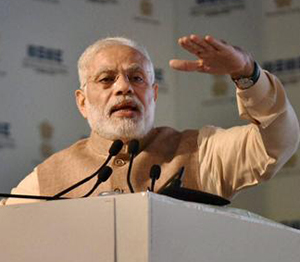
Dedicating the new integrated terminal building of the airport here, Modi noted that India in the near future would probably become the third country in the world in terms of airport activity benchmarks and "if you think only 80 to 100 airports are enough, then we are trying to create hurdles in the country's growth".

He said the country's development can take new dimensions if attention is given to tier-2 and tier-3 cities, which have the same potential, and referred to government's new regional connectivity scheme.

Attacking the previous governments, he said, "Earlier airports were set up, planes would fly but the country did not have an aviation policy.

"How to take the sector forward in next five or ten years and take care of its and passengers' needs, what should be done for common people, there was no vision in place earlier. It was just moving," he said.

"After the new NDA government came to power, for the first time since independence it formulated a new aviation policy for the country," he said inaugurating the terminal building which is now the country's second green airport after Kochi.

He said the new aviation policy will take care of the consumers' needs and the growth of the sector. Modi said that the aviation sector is growing at a very fast pace and more middle-class families aspire to travel by air.

"It is estimated that within five years, the situation in India would be such that the airports in the country would have as much footfall in a year as America's total population.

"You can well imagine how this sector is growing. India in the near future would probably become the third country in the world in terms of airport activity benchmarks. This will help increase employment opportunities and would spur economic activity," he said.

Spread in an area of 17,500 sq mt, the new integrated terminal has been built at a cost of Rs 160 crore. It has been designed to handle 700 passengers, including international fliers, per hour with 18 check-in counters, which would help in a seamless boarding process.

It took about seven years to complete the project as the then Civil Aviation Minister Praful Patel had laid the foundation stone in 2009.

The 8,100-meter-long runway of the Vadodra airport can handle small and narrow body aircraft such as Airbus 320 and Boeing 737s. Besides national carrier Air India, private airlines likes IndiGo and Jet aiways are operating from here.

Comments

Dr joby
 - 
Sunday, 23 Oct 2016

knowing the expansion plan in advance Meredian college Mangalore started Aviation Management course for mangaloreans

Add new comment

  • Coastaldigest.com reserves the right to delete or block any comments.
  • Coastaldigset.com is not responsible for its readers’ comments.
  • Comments that are abusive, incendiary or irrelevant are strictly prohibited.
  • Please use a genuine email ID and provide your name to avoid reject.
Ram Puniyani
January 14,2020

In the beginning of January 2020 two very disturbing events were reported from Pakistan. One was the attack on Nankana Sahib, the holy shrine where Sant Guru Nanak was born. While one report said that the place has been desecrated, the other stated that it was a fight between two Muslim groups. Prime Minister of Pakistan Imran Khan condemned the incident and the main accused Imran Chisti was arrested. The matter related to abduction and conversion of a Sikh girl Jagjit Kaur, daughter of Pathi (One who reads Holy Guru Granth Sahib in Gurudwara) of the Gurudwara. In another incident one Sikh youth Ravinder Singh, who was out on shopping for his marriage, was shot dead in Peshawar.

While these condemnable attacks took place on the Sikh minority in Pakistan, BJP was quick enough to jump to state that it is events like this which justify the Citizenship Amendment Act (CAA). Incidentally CAA is the Act which is discriminatory and relates to citizenship with Religion, which is not as per the norms of Indian constitution. There are constant debates and propaganda that population of Hindus has come down drastically in Pakistan and Bangla Desh. Amit Shah, the Home minister stated that in Pakistan the population of Hindus has come down from 23% at the time of partition to 3.7% at present. And in Bangla Desh it has come down from 22% to present 8%.

While not denying the fact that the religious minorities are getting a rough deal in both these countries, the figures which are presented are totally off the mark. These figures don’t take into consideration the painful migrations, which took place at the time of partition and formation of Bangla Desh later. Pakistan census figures tell a different tale. Their first census was held in 1951. As per this census the overall percentage of Non Muslim in Pakistan (East and West together) was 14.2%, of this in West Pakistan (Now Pakistan) it was 3.44 and in Eat Pakistan it was 23.2. In the census held in Pakistan 1998 it became 3.72%. As far as Bangla Desh is concerned the share of Non Muslims has gone down from 23.2 (1951) to 9.6% in 2011.

The largest minority of Pakistan is Ahmadis, (https://minorityrights.org/country/pakistan/) who are close to 4 Million and are not recognised as Muslims in Pakistan. In Bangla Desh the major migrations of Hindus from Bangla Desh took place in the backdrop of Pakistan army’s atrocities in the then East Pakistan.

As far as UN data on refugees in India it went up by 17% between 2016-2019 and largest numbers were from Tibet and Sri Lanka.  (https://www.un.org/en/development/desa/population/migration/publication…)

The state of minorities is in a way the index of strength of democracy. Most South Asian Countries have not been able to sustain democratic values properly. In Pakistan, the Republic began with Jinnah’s classic speech where secularism was to be central credo of Pakistan. This 11th August speech was in a way what the state policy should be, as per which people of all faiths are free to practice their religion. Soon enough the logic of ‘Two Nation theory” and formation of Pakistan, a separate state for Muslim took over. Army stepped in and dictatorship was to reign there intermittently. Democratic elements were suppressed and the worst came when Zia Ul Haq Islamized the state in collusion with Maulanas. The army was already a strong presence in Pakistan. The popular formulation for Pakistan was that it is ruled by three A’s, Army, America and Allah (Mullah).

Bangla Desh had a different trajectory. Its very formation was a nail in the coffin of ‘two nation theory’; that religion can be the basis of a state. Bangla Desh did begin as a secular republic but communal forces and secular forces kept struggling for their dominance and in 1988 it also became Islamic republic. At another level Myanmar, in the grip of military dictatorship, with democratic elements trying to retain their presence is also seeing a hard battle. Democracy or not, the army and Sanghas (Buddhist Sang has) are strong, in Myanmar as well. The most visible result is persecution of Rohingya Muslims.

Similar phenomenon is dominating in Sri Lanka also where Budhhist Sanghas and army have strong say in the political affairs, irrespective of which Government is ruling. Muslim and Christian minorities are a big victim there, while Tamils (Hindus, Christians etc.) suffered the biggest damage as ethnic and religious minorities. India had the best prospect of democracy, pluralism and secularism flourishing here. The secular constitution, the outcome of India’s freedom struggle, the leadership of Gandhi and Nehru did ensure the rooting of democracy and secularism in a strong way.

India so far had best democratic credentials amongst all the south Asian countries. Despite that though the population of minorities rose mainly due to poverty and illiteracy, their overall marginalisation was order of the day, it went on worsening with the rise of communal forces, with communal forces resorting to identity issues, and indulging in propaganda against minorities.

While other South Asian countries should had followed India to focus more on infrastructure and political culture of liberalism, today India is following the footsteps of Pakistan. The retrograde march of India is most visible in the issues which have dominated the political space during last few years. Issues like Ram Temple, Ghar Wapasi, Love Jihad, Beef-Cow are now finding their peak in CAA.

India’s reversal towards a polity with religion’s identity dominating the political scene was nicely presented by the late Pakistani poetess Fahmida Riaz in her poem, Tum bhi Hum Jaise Nikle (You also turned out to be like us). While trying to resist communal forces has been an arduous task, it is becoming more difficult by the day. This phenomenon has been variously called, Fundamentalism, Communalism or religious nationalism among others. Surely it has nothing to do with the religion as practiced by the great Saint and Sufi traditions of India; it resorts mainly to political mobilization by using religion as a tool.

Comments

Ashi
 - 
Tuesday, 14 Jan 2020

If Malaysia implement similar NRC/CAA, India and China are the loser.

Add new comment

  • Coastaldigest.com reserves the right to delete or block any comments.
  • Coastaldigset.com is not responsible for its readers’ comments.
  • Comments that are abusive, incendiary or irrelevant are strictly prohibited.
  • Please use a genuine email ID and provide your name to avoid reject.
News Network
March 31,2020

Kasaragod, Mar 31: Two more Kasaragod natives lost their lives on Monday due to blockade of the interstate border by Karnataka police in the wake of outbreak of novel coronavirus.

They could not get emergency health care as the Karnataka police stopped the ambulance carrying them to a hospital in Mangaluru at the border.

Another critically-ill person, who was sent back by Manguluru hospital authorities on March 23 for being a Kasaragod native, also died on Monday.

This is the fifth such case in many days.

The deceased are Madhavan, 50, Ayesha, 55 and Aziz Haji, 61 respectively.

All three of them lived near the Karnataka border.

Madhavan, who hailed from Thummanattu in Manjeswaram, died enroute to Kanhangad hospital after being denied entry to cross over to Karnataka. He had an acute bronchial attack.

Udyavar native Ayesha, an asthma patient, was referred to the Mangaluru Hospital by the hospital authorities at Uppali. When the authorities stopped her at the border, she was taken to the Kanhangad hospital. However, she died before reaching the hospital.

Aziz Haji, from Nayabazar Cherugoli MA Cottage at Uppala, was allegedly refused entry into a Manguluru Hospital on March 23 on account of being a Kasaragod native. Haji was a dialysis patient at the hospital. “We were unable to contact his doctor at the time,” his relatives said. Haji, who was on the ventilator, lost his life Monday morning.

One more from Kerala dies as Karnataka police stop ambulance at border
Kunjathoor native Abdul Hameed and Bandwal native Fathima also lost their lives due to the closing of the interstate border.

The district authorities has appealed to the Government to intervene in the matter and influence Karnataka as to lift a ban in crossing over for ambulances carrying critical patients.

The people of Kasaragod are largely dependent on the medical facilities in Mangaluru for critical illness care.

The Kasaragod MP, Rajmohan Unnithan has said he would move the Supreme court against this.

Kerala Chief Minister Pinarayi Vijayan has already taken up the issue with the Centre.

Kerala HC takes up issue with Karnataka AAG

The Kerala High Court on Monday sought the views of the Advocate General of Karnataka on the issue of the government of the neighbouring state blocking its borders with Kerala.

Considering a Public Interest Litigation (PIL) filed by Kerala High Court Advocates Association, seeking a direction for opening the roads, a bench comprising Justices A K Jayasankaran Nambiar and Shaji P Chali requested the Advocate General of Karnataka to join the hearing at 11 am on Tuesday through video conferencing.

The Court orally observed that the blockades erecting embankments on the inter-state roads would affect the people's right to life.

The Karnataka government blocked the state highway with to prevent movement of vehicles carrying essential goods and people seeking emergency treatment at hospitals in the city of Mangalore bordering Kasaragod.

With 97 infected patients, Kasaragod has the largest number of COVID-19 cases in Kerala. 7,437 people are under observation in the district.

Comments

Add new comment

  • Coastaldigest.com reserves the right to delete or block any comments.
  • Coastaldigset.com is not responsible for its readers’ comments.
  • Comments that are abusive, incendiary or irrelevant are strictly prohibited.
  • Please use a genuine email ID and provide your name to avoid reject.
News Network
April 15,2020

Bengaluru, Apr 15: Karnataka and five other states have their coronavirus antibody test kits stuck in China because of the country's new policy of getting clearance from their government before a company exports its products.

Singapore-based Sensing Self Ltd and China’s Wondfo are the only companies that have cleared Pune's National Institute of Virology (NIV)’s validation for rapid antibody test kit.

Dr CN Manjunath, Director, Jayadeva Institute of Cardiovascular Sciences and Research, and nodal officer for COVID-19 lab testing, Karnataka, said, "Inventory is ready in Hong Kong Airport. Karnataka's consignment is stuck with five other states' consignments: Kerala, Andhra Pradesh, Rajasthan, Gujarat, and Meghalaya. On April 1 or 3, China's policy changed saying any exports going out of China has to be certified by the Chinese government."

Comments

Add new comment

  • Coastaldigest.com reserves the right to delete or block any comments.
  • Coastaldigset.com is not responsible for its readers’ comments.
  • Comments that are abusive, incendiary or irrelevant are strictly prohibited.
  • Please use a genuine email ID and provide your name to avoid reject.