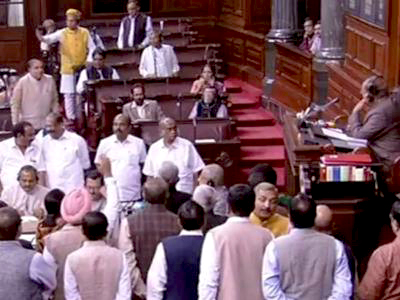
Govt rejects demand for PM's reply on demonetisation debate

November 17, 2016

New Delhi, Nov 17: Government today rejected the demand for Prime Minister Narendra Modi's response on the debate on demonetisation and accused the opposition of using it as an excuse to scuttle discussion on the issue in Parliament.

GovtInformation and Broadcasting Minister M Venkaiah Naidu told reporters after Parliament was adjourned for the day, amid protests by opposition demanding Modi's presence, that the reply to the debate would be given by the minister concerned or any other person on behalf of the government as per the rules of the House and precedents.

The opposition disrupted the Rajya Sabha, stalling midway the discussion on demonetisation that started yesterday.

A united opposition's relentless demand for a debate on demonetisation under a rule which entails voting forced the adjournment of the Lok Sabha also for the day as the government refused to accept it.

"Half way through, they realised that by raising such a debate it is going negative on them and boomeranging. Now I am afraid, are they trying to find a way out to come out of this and then stall the debate on one pretext or the other," Naidu said.

Dubbing the uproar by Congress and other opposition parties as an "excuse" to stall a debate, Naidu alleged that there is no rationale, whatsoever, behind it.

The Minister said things will happen as per the rules and procedures of the House and urged that the debate should go on.

"I feel that those who started the debate are now understanding that it is going negative, that is why they are finding excuse for not allowing the discussion.

"They are speaking in double tone and in different voices. They are not coming out openly either for or against. They are in dilemma and that dilemma will continue," he said.

Naidu said the entire country is watching as to who are with the hoarders and with the people with black money and who are with the government and the Prime Minister, who has "taken such a revolutionary step. They have to make a choice".

"Let the discussion take place. Then who will reply in the government. It could be the concerned Minister. The solution will come through the government as per traditions and rules," he said.

Naidu said government is addressing the problems faced by people on demonetisation and any suggestion, if worth considering, will be take up positively.

"Government is open to ideas to improve the system. But if somebody is trying to question this and attribute motives, then people are there to finally come to an assessment and decide. Let every party decide are they in favour of this move or against it, for which they have no answer directly," the minister said.

Comments

c.m bin
 - 
Thursday, 17 Nov 2016

cancel this PM. see korea and build the nation.

Add new comment

  • Coastaldigest.com reserves the right to delete or block any comments.
  • Coastaldigset.com is not responsible for its readers’ comments.
  • Comments that are abusive, incendiary or irrelevant are strictly prohibited.
  • Please use a genuine email ID and provide your name to avoid reject.
News Network
February 24,2020

Ahmedabad, Feb 24: US President Donald Trump and his wife Melania on Monday tried their hands at spinning the 'charkha' (spinning wheel) at the Sabarmati Ashram here.

Accompanied by PM Narendra Modi, the US president and his wife went around the Ashram, before resuming the roadshow from the airport to the Motera stadium. "To my great friend Prime Minister Naredra Modi, thank you for this wonderful visit," Trump wrote in the Ashram visitors' book.

The US President was briefed about Gandhiji and the importance of charkha as a symbol of self reliance. Trump reached Ahmedabad at 11.37 am for the first leg of his India visit.

US President Donald Trump arrived in Ahmedabad on Monday for the first leg of his India trip. The Air Force One plane carrying Trump and his wife Melania landed at the Sardar Vallabhbhai Patel international airport here at 11.37 am, officials said. It was scheduled to land at 11.40 am.

Trump, who is also accompanied by daughter Ivanka, son-in-law Jared Kushner and top brass of his administration, will get a taste of India's cultural melange during his high- optics Gujarat itinerary, after the bonhomie between the two leaders at the 'Howdy, Modi!' event in Houston last year.

Comments

Add new comment

  • Coastaldigest.com reserves the right to delete or block any comments.
  • Coastaldigset.com is not responsible for its readers’ comments.
  • Comments that are abusive, incendiary or irrelevant are strictly prohibited.
  • Please use a genuine email ID and provide your name to avoid reject.
News Network
July 18,2020

Washington, Jul 18: The Foreign Direct Investment (FDI) from the US to India has crossed the $40 billion mark so far this year, reflecting the growing confidence of American companies in the country, the head of an India-centric business advocacy group has said.

The American companies, during the Covid-19 pandemic, which has battered the world economy, have shown great confidence in India and its leadership, said Mukesh Aghi, president of the US-India Strategic and Partnership Forum (USISPF), which keeps a track of the major US FDIs in India.

“Year to date investment from the US, including the recent ones, is over $40 billion,” Aghi said.

In recent weeks alone, the announcement of the FDI into India has been over $20 billion, he said, referring to the announcements made by some of the top companies like Google, Facebook and Walmart.

“Investors’ confidence in India is high. India still remains a very promising market for global investors. If you look at the $20 billion… not just the US, but (investment) has also come from other geographies such as the Middle East and the Far East.

“So, India still remains a very, very bullish market for the investor community,” Aghi said in response to a question.

The USISPF has been working with New Delhi to bring in FDI into India… playing a key role in encouraging American companies planning to move their bases out of China, he said, adding that the move was going on in the last three years of the Trump administration, but gained momentum during the coronavirus pandemic.

“We feel that Prime Minister (Narendra Modi’s) intention is very high. The challenges lie on the execution side. Efforts are being made to encourage manufacturing… I've never seen it so better. The policy framework is moving in the right direction,” he said.

Early this week, Larry Kudlow, the White House Economic Advisor, told reporters that the US tech giants like Google and Facebook announcing big investments in India shows that people are losing trust in China and India is emerging as a big competitor.

At the same time, he rued that India continues to be a protectionist country.

“The question is how do you define protectionism... the administration here is saying America first and India is saying vocal for local…,” Aghi added.

Comments

Add new comment

  • Coastaldigest.com reserves the right to delete or block any comments.
  • Coastaldigset.com is not responsible for its readers’ comments.
  • Comments that are abusive, incendiary or irrelevant are strictly prohibited.
  • Please use a genuine email ID and provide your name to avoid reject.
Agencies
June 29,2020

From March through May, around 1 crore migrant workers fled India’s megacities, afraid to be unemployed, hungry and far from family during the world’s biggest anti-Covid-19 lockdown.

Now, as Asia’s third-largest economy slowly reopens, the effects of that massive relocation are rippling across the country. Urban industries don’t have enough workers to get back to capacity, and rural states worry that without the flow of remittances from the city, already poor families will be even worse off -- and a bigger strain on state coffers.

Meanwhile, migrant workers aren’t expected to return to the cities as long as the virus is spreading and work is uncertain. States are rolling out stimulus programs, but India’s economy is hurtling for its first contraction in more than 40 years, and without enough jobs, a volatile political climate gets more so.

“This will be a huge economic shock, especially for households of short-term, cyclical migrants, who tend to come from vulnerable, poor and low-caste and tribal backgrounds,” said Varun Aggarwal, a founder of India Migration Now, a research and advocacy group based in Mumbai.

In the first 15 days of India’s lockdown, domestic remittances dropped by 90%, according to Rishi Gupta, chief executive officer of Mumbai-based Fino Paytech Ltd., which operates the country’s biggest payments bank.

By the end of May, remittances were back to around 1750 rupees ($23), about half the pre-Covid average. Gupta’s not sure how soon it’ll fully recover. “Migrants are in no hurry to come back,” Gupta said. “They’re saying that they’re not thinking of going back at all.”

If workers stay in their home states long term, policymakers will have more than remittances to worry about. If consumption falls and the new surplus of labor drives wages down, Agarwal said, “there will also be a second-order shock to the local economy. Overall, not looking good.”

India announced a $277 billion stimulus package in May and followed it up with a $7 billion program aimed at creating jobs for 125 days for migrants in villages across 116 districts. Separately, local authorities are also looking for solutions.

Officials in Bihar have identified 2,500 acres of land that could be made available to investors, said Sushil Modi, deputy chief minister of Bihar, a state in east India. “We can use this crisis as an opportunity to speed up reforms,” he said.

The investors haven’t materialised yet, and in the meanwhile, state governments are relying on the national cash-for-work program that guarantees 100 days worth of wages per household.

Skilled workers don’t want to do manual labor offered through the program, and even if they did, says Amitabh Kundu of RIS, many think of it as beneath their station. “There will be an increase in social tensions,” he predicts. “Caste may again start playing a role. It’s absolute chaos.”

For skilled workers, initiatives vary:

* Uttar Pradesh, which received 3.2 million people, is compiling lists of skilled workers who need employment and trying to place them with local manufacturing and real estate industry associations. So far, the government says, it’s placed 300,000 people with construction and real estate firms.

* Bihar has placed returners in state-run infrastructure projects and hired others to stitch uniforms and make furniture for government-run schools, even as they waited in quarantine centres, said Pratyay Amrit, head of the state’s disaster management department.

* The eastern state of Odisha announced an urban wage employment program aimed at putting as many as 450,000 day labourers to work through September. Some 25,000 people have been employed, so far, under the scheme, G. Mathivathanan, principal secretary for housing and urban development said.

Attracting Investments

It’s not clear any of this will be enough to make a dent, says Ravi Srivastava, professor at New Delhi-based Institute of Human Development, adding that the states don’t have much of a track record on economic development.

“It was the failure of these states to improve governance and put development plans in place that led to the out-migration in the first place,” he said.

But officials and workers’ rights advocates see opportunity. Uttar Pradesh has established liaisons to encourage companies from the US, Japan and South Korea to establish manufacturing in the state. There and in Madhya Pradesh and Rajasthan, the government has made labour laws more friendly to employers, making it easier to hire and fire workers.

Modi, the minister from Bihar, said the migration may also give workers--historically a disenfranchised group--new power, particularly as urban centres struggle. “The way industries treated workers during the lockdown -- didn’t pay them, the living conditions were poor -- now these industries will realize the value of this force,” Modi said.

“In the days to come, labour will emerge as a force that can’t be ignored anymore,” he added. “That’s the new normal. We will work out how to ensure dignity, rights to our people who are going to work in other states.”

Bihar is due for elections by November, a vote that could be an early test of the mass migration’s political consequences. The state is currently governed by a coalition that includes Prime Minister Narendra Modi’s Bharatiya Janata Party. Amitabh Kundu, a fellow at the Research and Information System for Developing Countries, a New Delhi-based government think-tank, said migrant workers are likely to be angry voters.

“Chief ministers are telling these migrants that they will not have to go back for work,” he said. “But their capacity to do something miraculous in the next four to five months is doubtful. If they can retain even one-fourth of the migrants, I would call it a success.”


Comments

Add new comment

  • Coastaldigest.com reserves the right to delete or block any comments.
  • Coastaldigset.com is not responsible for its readers’ comments.
  • Comments that are abusive, incendiary or irrelevant are strictly prohibited.
  • Please use a genuine email ID and provide your name to avoid reject.