



Govt ups duty on gold to 10 pc, plans import curb

August 14, 2013

Govt_ups_dutyNew Delhi, Aug 14: Acting for the third time since January, the government on Tuesday raised import duty on gold to 10 per cent to stem import of the yellow metal, a key contributor to India's exorbitantly high current account deficit (CAD) and the consequent currency depreciation.

But concerns remained that a 10 per cent duty difference in gold prices in India and outside may lead to increase in smuggling.

Duty on the precious metal was hiked in June, when its import rose to $2.9 billion.

The government expects to garner an additional Rs 4,830 crore through hikes in duties on two other precious metals, platinum and silver.

The move comes after Finance Minister P Chidambaram said on Monday that the government would soon take measures to compress luxury and non-essential imports.

Gold is the biggest luxury import in India which does not contribute to economic growth in a significant way but is shipped into the country to meet the domestic consumption demand.

Soon after the announcement, the rupee recovered to 61.12 to the dollar from 61.66, but analysts said more structural reforms were needed to stem the fall in the India currency, which has lost more than 10 per cent against the dollar this year.

Revenue Secretary Sumit Bose said the government was working on the proposed hike in import duties on non-essential goods, but sources in the ministry say that import duty could be hiked on items such as high-end cars and LCD and LED TV sets.

The government raised the customs duty on gold from 4 per cent to 6 per cent in January, too, and thereafter to 8 per cent in June. Despite that, there was an 87 per cent increase in gold import in the four-month period from April to July. Gold import went up to 383 tonnes in the April-July period this year, as against 205 tonnes in the same period last year.

Bullion traders said that after the latest measure, gold prices could go up by Rs 600 per 10 grams.

Meanwhile, Minister of State for Finance J D Seelam said there have been apprehensions that a duty hike could lead to an increase in smuggling of gold or gold jewellery. In a written reply to a question in the Rajya Sabha, he said customs and other departments have been alerted to keep a vigil against smuggling.

During April-July, a total of 294 kg of gold, valued at Rs 75 crore, have been seized by the Customs Department.

Comments

Bettye
 - 
Saturday, 13 Feb 2016

Hello there, I discovered your site via Google even as searching for a similar matter, your website
came up, it seems good. I've bookmazrked
iit in my google bookmarks.
Hi there, simply tturned info alert to your weblog thru Google, and
founhd that it's really informative. I'm gonna wtch out for brussels.
I will be grateful in case youu continue this in future.
Maany other folks might be benefited from your writing.
Cheers!

Also visit my page ... self storage rapid city sd: http://farm4.static.beauvir.www.ww.w.isaev.info/?a%5B%5D=self%20storage…

Add new comment

  • Coastaldigest.com reserves the right to delete or block any comments.
  • Coastaldigset.com is not responsible for its readers’ comments.
  • Comments that are abusive, incendiary or irrelevant are strictly prohibited.
  • Please use a genuine email ID and provide your name to avoid reject.
News Network
May 18,2020

Bengaluru, May 18: Karnataka education minister S Suresh Kumar on Monday announced the SSLC examination dates. Earlier, Karnataka SSLC examinations were to be held between March 27 and April 9, 2020, but had to be postponed due to the outbreak of Covid-19 pandemic and the subsequent lockdown.

The minister announced that Karnataka Secondary Education Examination Board (KSEEB) will conduct SSLC examination between June 25 to July 4 and the PUC exam for English paper will be held on June, 18, 2020.

"Examinations for Secondary School Leaving Certificate (SSLC) will be conducted between June 25 and July 4 in Karnataka. Exams for English paper of Pre-University Course (PUC) will he held on June 18: Karnataka Education Minister S Suresh Kumar," ANI tweeted.

The minister for primary and secondary education had held a meeting with the department officials to discuss the feasibility of conducting the exam.

Modalities of conducting the examination in the current situation of the COVID 19 pandemic while taking care of interests of students is of paramount importance, S Suresh Kumar said adding these issues have been kept in mind while finalising the schedule.

With inter-state and inter-district mobility a major issue with public transport not available and also due to 14-day institutional quarantine norms, the minister had told TOI that an idea has been introduced to allow students appear for the examination in the district where they presently are than at their designated examination centre.

Comments

Add new comment

  • Coastaldigest.com reserves the right to delete or block any comments.
  • Coastaldigset.com is not responsible for its readers’ comments.
  • Comments that are abusive, incendiary or irrelevant are strictly prohibited.
  • Please use a genuine email ID and provide your name to avoid reject.
News Network
May 17,2020

Bengaluru, May 17: Karnataka Deputy Chief Minister and Transport Minister Laxman Savadi on Sunday wrote to Union Minister Nitin Gadkari requesting to issue new lockdown guidelines including permission to operate public transport and said the lockdown has caused a financial loss of Rs 16,00 crore to all four Karnataka Transport Undertakings.

In view of these problems, the state Transport Minister requested Gadkari to permit the deployment of Non-AC buses on scheduled routes to ensure the adequacy of services.

The four State Transport Undertakings (STUs) in Karnataka which are providing bus-based public transport services within the state and to the neighbouring states are Karnataka State Road Transport Corporation (KSRTC), North West Karnataka Road Transport Corporation (NWKRTC), North Eastern Karnataka Road Transport Corporation (NEKRTC) and Bangalore Metropolitan Transport Corporation (BMTC).

"KSRTC, NWKRTC and NEKRTC operate buses for mofussil services i.e. Interdistrict, intradistrict and interstate, whereas BMTC operates only in urban and suburban areas in the city of Bengaluru. The four STUs put together hold a fleet of about 24,900 buses including 1,520 air-conditioned buses and operate about 71.00 lakh km. per day and carries about 98.00 lakh passengers every single day," Savadi outlined in the letter.

The Minister said due to the COVID-19 outbreak and the lockdown that ensued have brought regular bus operations and functioning to a grinding halt.

"This has caused a devastating impact on the operations of all the four STUs due to the combination of lack of revenue and continuing fixed costs such as salaries and pensions to staff, payables against existing loans etc. It has been estimated that the lockdown has caused a financial loss of INR 1,600/- crore to these four STUs," he added.

Savadi said even after post-COVID lockdown, operations and revenues won't reach its previous demand& supply patterns in the next six to eight months due to reduced economic activity and users' perceived risk of contacting COVID in public transport.

In addition to that, "occupancy should be allowed up to seating capacity (without standees). This is essential to meet minimal demand," he said in the letter.

"The crew should wear facemask and hand gloves. The crew with health issues should not be deployed. The face masks should be made mandatory for all the passengers. Only asymptomatic persons should be allowed to travel in public transport. The Government of India may consider staggering working hours for various sectors to reduce peak hour traffic demand," the minister listed out these recommendations in the letter.

Savadi said that with social distancing norm of reduced seating capacity in public transport, it will not be possible to provide transport facility to all the daily passengers. This will create demand for more buses, which cannot be met.

"Restrictions on public transport will lead to passenger commute by overcrowding in smaller vehicles like cars, maxi cabs, goods tempos etc. which will adversely affect preventive measures," he added.

Therefore, Savadi requested Union Minister to look into the above matter and issue fresh guidelines to all the states / UT's.

Comments

Add new comment

  • Coastaldigest.com reserves the right to delete or block any comments.
  • Coastaldigset.com is not responsible for its readers’ comments.
  • Comments that are abusive, incendiary or irrelevant are strictly prohibited.
  • Please use a genuine email ID and provide your name to avoid reject.
News Network
August 2,2020

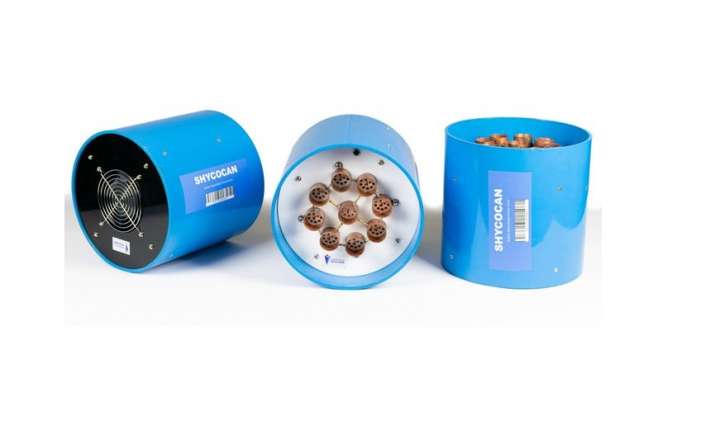
Bengaluru, Aug 2: Bengaluru based Centre for Advanced Research and Development (CARD), the research wing of organisation De scalene has come up with a device called "SHYCOCAN" (Scalene Hypercharge Corona Canon) which neutralizes the coronavirus.

Speaking to news agency Dr Rajah Vijay Kumar, Chairman, Organisation De Scalene said that the device will not kill any bacteria or fungus, however, neutralizes the coronavirus particles.

"The device was tested for its safety and efficacy and is soon going to be manufactured and marketed in the US under the Enforcement Discretion policy of USFDA and in Europe as the device is CE compliant and is CE marked," said Kumar.

He also added the device will cover a volume of 10,000 cubic feet.

The device Scalene Hypercharge Corona Canon (SHYCOCAN) is intended to be used in the residential, industrial and commercial environment and is designed for active containment by attenuation of Corona family of viruses. (Laboratories de Especialidades Immunological S.A. de C.V, Virucidal Activity concludes 99.9 per cent virus elimination), Kumar asserted.

"SHYCOCAN operates on regular 110/240V - 50/60 Hz wall socket and is a plug and play device, that delivers the necessary signals to a photon mediated electrons emitters (PMEE), that produces hypercharge high-velocity electrons by photon mediation that interacts with the negative seeking S-protein of Corona family of viruses thus reducing infectivity and prevent air and surface borne transmission of corona family of viruses," said Kumar.

The device does not use any chemicals, or any other consumables and does not produce harmful ozone gas or any other substances and is completely safe for use in any environment, he added.

"The attack mechanism of the Virus starts with the initial attachment of the virion to the host cell, it is initiated by interactions between the S-protein and its receptor on the "negative" cell membrane. The sites of receptor binding domains (RBD) within the S1 region of a coronavirus S-protein vary depending on the virus. 

The S-protein/receptor interaction is the primary determinant for a coronavirus to infect a host species and governs the tissue tropism of the virus. However, the end result is the fusion and release of the viral genome into the cytoplasm," said Kumar.

He continued saying that the counter mechanism by the device SHYCOCAN is that if negative seeking is the guidance mechanism of the S- Protein, attracted by the transmembrane potential of the host cells, then breaking this mechanism would block the Coronavirus infectivity and spread.

"The device has been in use for more than a year at the S-CARD campus, the headquarters of Scalene," said Kumar.

Comments

Add new comment

  • Coastaldigest.com reserves the right to delete or block any comments.
  • Coastaldigset.com is not responsible for its readers’ comments.
  • Comments that are abusive, incendiary or irrelevant are strictly prohibited.
  • Please use a genuine email ID and provide your name to avoid reject.